What is a consent management platform (CMP)? Why a cookie banner is only the first step
If you’re exploring the concept of a Consent Management Platform (CMP) – a system that helps businesses obtain, store, and demonstrate customer consent before using their personal data – for the first time, there is one important point to understand from the outset: a CMP is not a cookie banner, and a cookie banner is not a CMP.
The two are often confused because they are closely related. However, their relationship is much like that between a door and an access control system. The door is what people see. The access control system determines who is allowed in, when they are allowed in, and what permissions they have – and, more importantly, keeps a complete record so everything can be audited later.
This article explains what a CMP is, how it works, and why businesses that collect customer data through their websites are increasingly relying on this type of infrastructure.
What is a CMP?
A Consent Management Platform (CMP) is a software platform that enables businesses to collect, store, manage, and demonstrate users’ consent for the collection and processing of their personal data across every channel and customer touchpoint.
Put simply, a CMP ensures that when you ask a customer, “Do you consent to us using your personal data?” their answer is recorded correctly, stored as verifiable evidence, consistently enforced across every system that uses their data, and can be withdrawn at any time upon request.
A simple comparison:
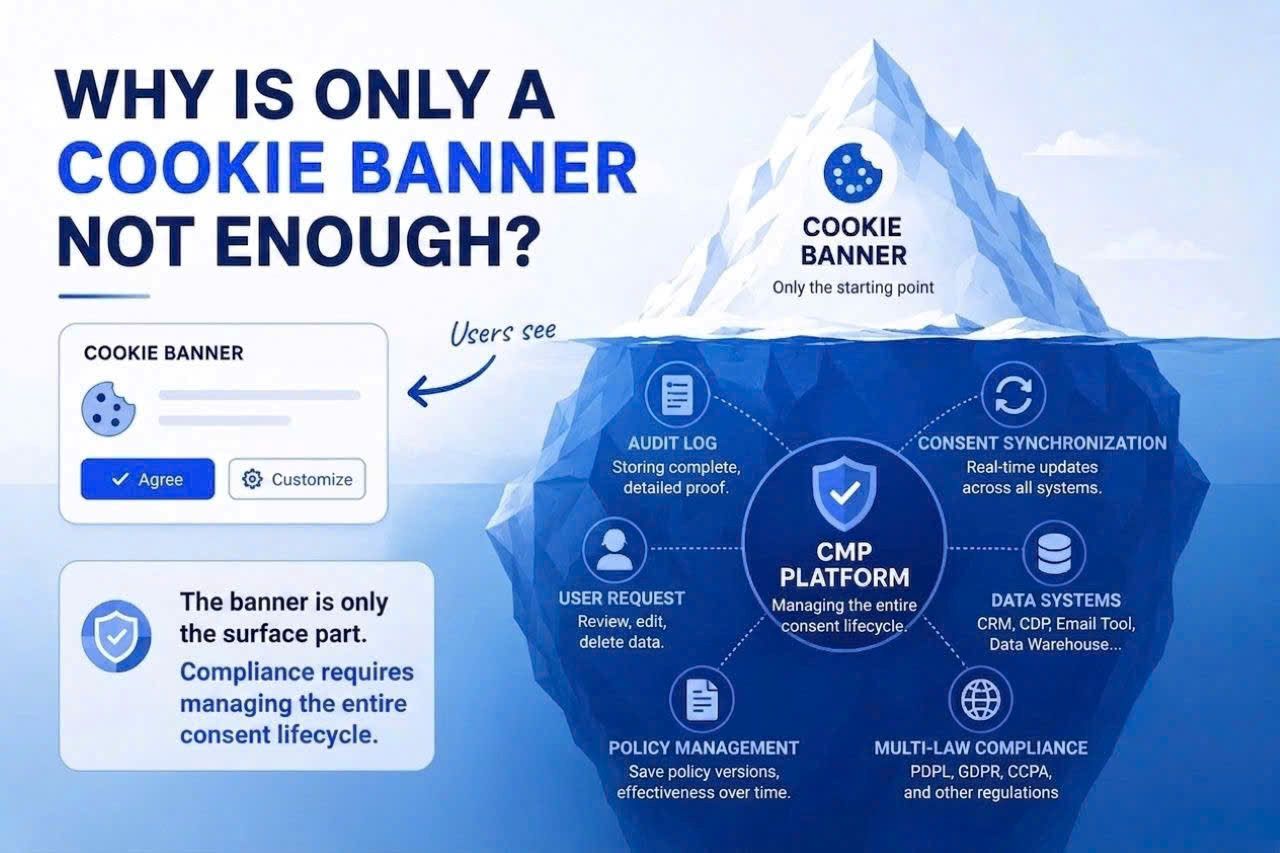
- Cookie banner – the interface users see when they visit a website, allowing them to express their preferences.
- CMP – the entire system behind the scenes that stores those preferences, synchronizes them with other systems, processes consent withdrawal requests, and generates audit and compliance reports.
A cookie banner is one component of a CMP – it is not the CMP itself.
How does a CMP work?
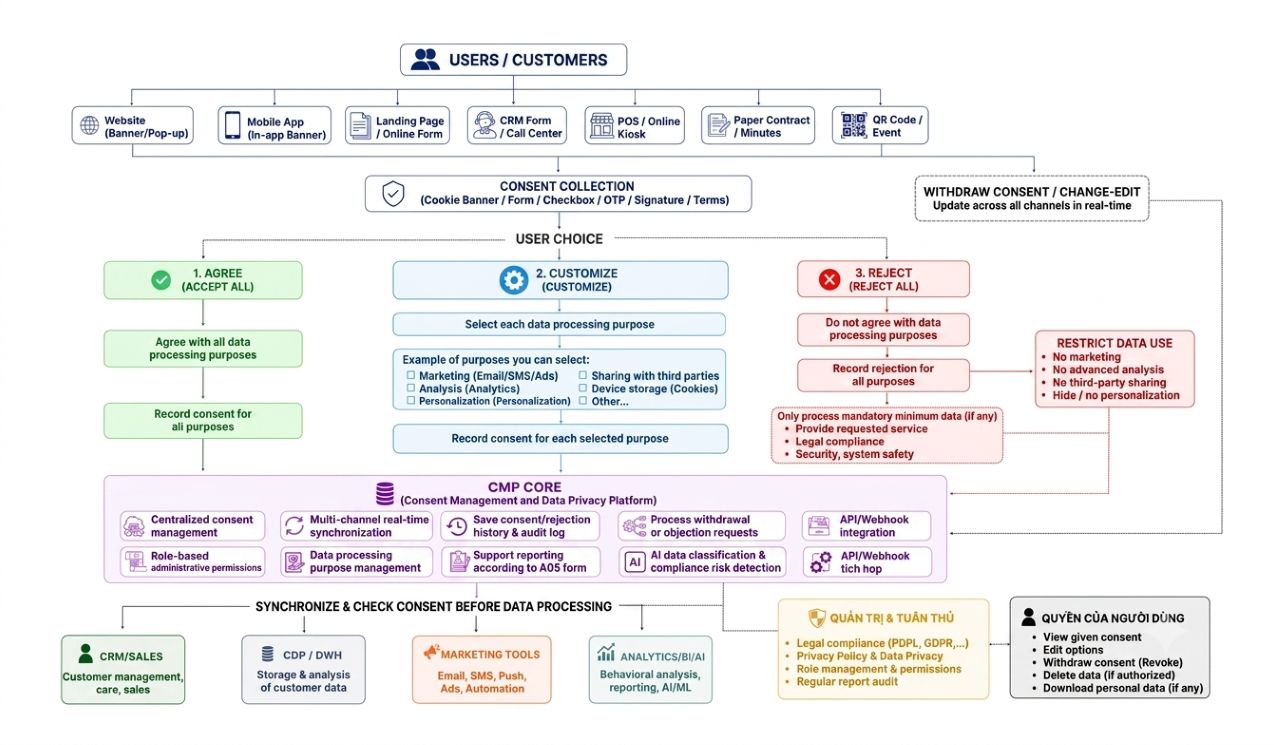
A fully featured CMP operates across four layers.
Layer 1 – Consent capture
This is the part users actually see: cookie banners, preference pop-ups, consent forms for collecting sensitive personal data, and checkboxes within registration flows.
A CMP ensures that these consent touchpoints are designed in accordance with legal requirements – they distinguish between different processing purposes, avoid pre-selected consent, provide a clearly visible “Reject” option, and work consistently across every channel, including websites, mobile apps, kiosks, and even offline forms.
Layer 2 – Consent repository
Every time a user makes a choice – whether accepting, rejecting, or customizing specific processing purposes – the CMP creates a record containing: who made the choice (user ID or session); when the choice was made (timestamp); what they consented to (the specific processing purpose); which version of the privacy policy or consent notice applied at that time; and through which channel the consent was collected.
These records are stored independently and can be retrieved whenever required for an audit or a regulatory request.
Layer 3 – consent enforcement
When a user withdraws consent for email marketing, that decision should not simply be recorded in one system and forgotten.
Instead, the change needs to be propagated to the email platform, CRM, CDP, advertising platforms, and any other downstream systems that rely on that consent.
A CMP connects with these systems through APIs and webhooks, ensuring that consent status is synchronized in real time.
This is the layer that many businesses are currently missing – and arguably the most important one for preventing situations where customers unsubscribe from marketing emails but continue receiving them anyway.
Layer 4 – Audit and compliance
A CMP provides dashboards that allow businesses to monitor consent and rejection rates by processing purpose, review each user’s consent history, and generate standardized reports for regulatory authorities or internal audits.
Some modern CMPs also incorporate AI-powered anomaly detection – for example, identifying unusually large volumes of consent being recorded within a short period of time, which may indicate bot activity or technical issues
Why isn’t a cookie banner enough?
The easiest way to understand the difference is to look at what a cookie banner cannot do.
A banner does not know where customer data goes after it is collected. If a customer gives consent on your website but your email platform, CRM, or CDP either does not know about it – or fails to update when that customer later withdraws consent – that consent cannot be enforced in practice.
A banner does not retain sufficiently detailed evidence. A cookie stored in a user’s browser is not an audit log. If regulators ask, “Which version of the privacy policy did customer X agree to, and on what date?” you need server-side records – not information stored only on the user’s device.
A banner cannot manage user requests after consent has been given. When customers want to review what they previously consented to, update their preferences, or request deletion of their personal data, a cookie banner alone cannot perform those functions. That requires a system capable of managing the entire consent lifecycle.
A banner cannot support compliance with multiple privacy laws at the same time. If your business serves customers in Vietnam, Europe, and the United States, you may need to comply simultaneously with the PDPL, GDPR, and CCPA, each of which has different requirements for consent, retention periods, and data subject rights. A CMP can automatically apply the appropriate rules based on a user’s geographic location.
Which businesses need a CMP?
The short answer is: any business that collects customer data through digital channels and wants to use that data for marketing, analytics, or data sharing with third parties.
The need becomes even more pressing if your business has one or more of the following characteristics.
Multiple data collection touchpoints. Websites, mobile apps, landing pages, offline forms, and call centers all collect consent independently. Once consent is scattered across multiple channels, managing it manually is no longer practical.
A complex marketing tools stack. The more systems that process customer data—such as email platforms, CRMs, CDPs, Google Ads, Facebook Ads, and marketing automation tools – the greater the need for a single source of truth for consent status.
Customers across multiple jurisdictions. Different countries impose different compliance requirements. A CMP can automatically apply the appropriate legal rules based on the user’s location.
Industries handling sensitive personal data. Businesses in finance, healthcare, education, or retail services that use location-based features often process sensitive personal data, making robust consent management and stricter controls particularly important.
A CMP is becoming standard infrastructure – not an optional feature
In markets where the GDPR (Europe) and the CCPA (California) have been in force for years, a CMP is no longer viewed as a competitive advantage. It has become a basic requirement for operating lawfully. Platforms such as OneTrust, Didomi, and Secure Privacy have evolved into standard infrastructure for businesses operating in those markets.
With the introduction of Law No. 91/2025/QH15 in Vietnam, effective January 1, 2026, the same trend is beginning to emerge domestically. One key difference from the GDPR rollout is that Vietnamese businesses have not had an extended transition period comparable to that experienced in Europe. The law is already in effect, and regulators have begun enforcing it against non-compliant organizations.
That does not mean every business must immediately deploy a comprehensive CMP. It does mean that understanding where your organization currently stands on its compliance journey – and how far that is from the legal requirements – is something that should be addressed sooner rather than later.
Frequently asked questions
What’s the difference between a CMP and a DMP (Data Management Platform)? A Data Management Platform (DMP) collects and analyzes user behavioral data to support advertising targeting. A Consent Management Platform (CMP) manages users’ permissions for that data – who has consented to its collection and processing, and who has not. The two systems are often integrated: the CMP determines which data may legally be used, while the DMP analyzes only the data that has been collected with valid consent.
What’s the difference between a CMP and a CDP (Customer Data Platform)? A Customer Data Platform (CDP) consolidates customer information from multiple sources into unified customer profiles to support personalization. A CMP determines which data may be transferred into the CDP – and which data must be excluded or removed when a customer withdraws consent. CMPs are commonly integrated with CDPs to ensure that customer profiles always reflect the current consent status.
Do small businesses need a CMP, or is a cookie banner enough? It depends on the scale and complexity of your data operations. A simple website that only collects contact form submissions and does not rely on third-party advertising tools may be able to manage consent with a lighter-weight solution. However, if you use Facebook Pixel, Google Ads, email marketing, and a CRM, customer data is already flowing across multiple systems. Even for SMEs, inconsistent consent management becomes a real compliance risk.
Will a CMP slow down my website? Potentially – but only if it is poorly implemented. Modern CMPs are typically built using API-first architectures and asynchronous loading techniques to minimize any impact on page performance. This is one of the technical criteria you should discuss when evaluating CMP vendors.
Can we build our own CMP in-house? Technically, yes. However, the real cost extends far beyond initial development. You also need to consider the ongoing costs of adapting to legal changes, integrating with new systems as your technology stack evolves, and coordinating multiple departments to operate and maintain the platform. These trade-offs are explored in more detail in Article B4.
| Exclusive article by experts from FPT IS
Duong Hong Nhung, Product Marketing, Data Privacy & Compliance Solution , FPT IS, FPT Corporation |
| Additional information about FPT’s CMP solution
FPT’s Consent Management Platform (CMP) enables businesses to manage the entire consent lifecycle – from obtaining user consent to governing how customer data is used – in a transparent and structured manner. Every consent record is captured and securely stored, helping organizations demonstrate compliance, reduce legal risks, and improve operational efficiency. |
To explore a CMP solution tailored to your business needs, simply leave your contact information at the bottom of this page. An FPT expert will get in touch to discuss your requirements and recommend the most suitable approach.
Read more