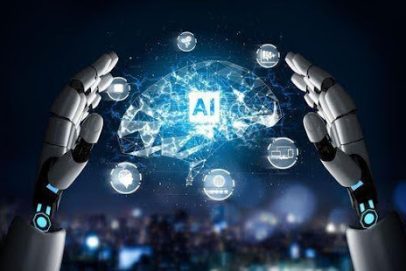
From Physical labs to Virtual spaces: VR becomes a catalyst for workforce development in healthcare and semiconductors within national digital transformation
1. When training cannot fail: The workforce challenge in the era of high-precision technologies
The global knowledge economy’s transformation in 2026 has placed high-precision industries such as healthcare and semiconductor manufacturing in an unprecedented dilemma: how to train a workforce capable of mastering the most complex technologies while maintaining an environment where errors are simply unacceptable.
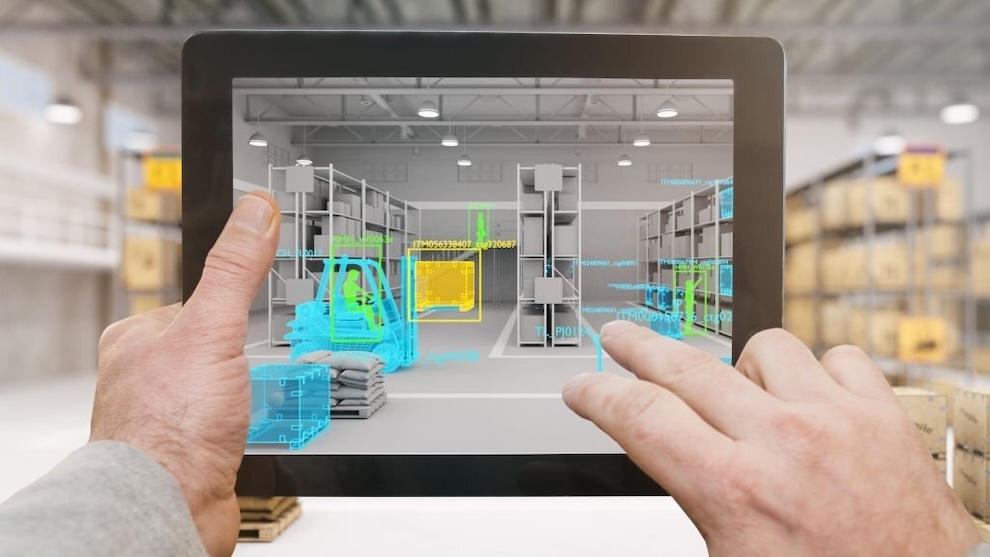
Workforce training now faces a fundamental question: how can learners truly perform the work instead of merely “watching – listening – memorizing”?
In this context, Extended Reality (XR) is no longer a supplementary tool but has become a strategic training infrastructure. According to the latest research from IEEE Xplore (2025) on XR applications in digital education, the ability to create presence and immersion significantly shortens the gap between pure theory and hands-on clinical skills. This is particularly critical as healthcare systems face mounting pressure from global pandemics and aging populations, requiring training processes that are both accelerated and absolutely safe for patients.
In healthcare specifically, the application of Virtual Reality (VR) training scenarios has demonstrated clear advantages over traditional training methods using 2D images or even physical plastic models. A randomized controlled trial published in MDPI Healthcare (2025) found that medical professionals and nursing students trained in XR environments retained emergency procedures significantly better and reported dramatically higher confidence when performing real clinical tasks. The integration of Augmented Reality (AR) with real-time diagnostic imaging data also allows surgeons to rehearse complex operations using digital replicas of actual patients, helping them identify potentially dangerous anatomical variations in advance. This creates a learning ecosystem where mistakes carry no life-threatening consequences but instead become valuable data points for improving professional skills.
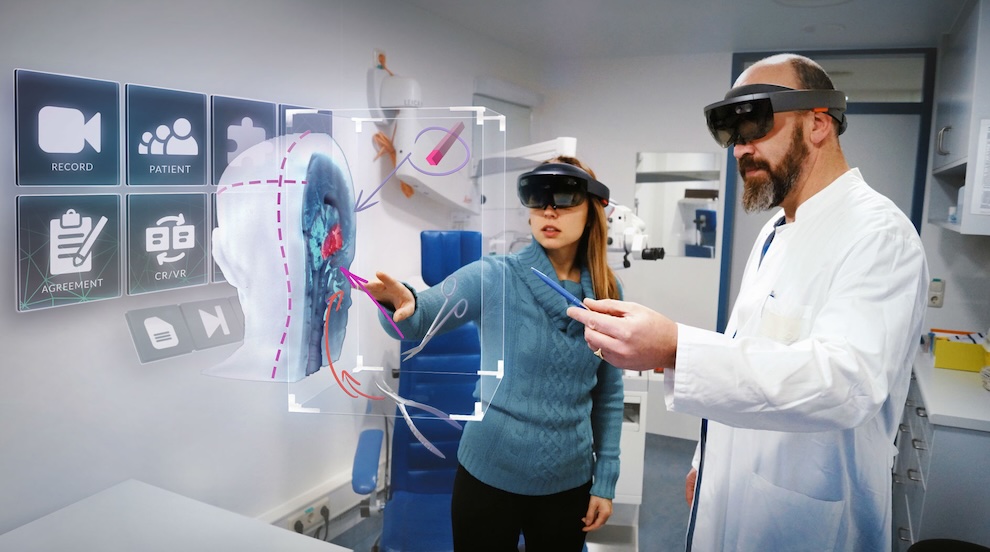
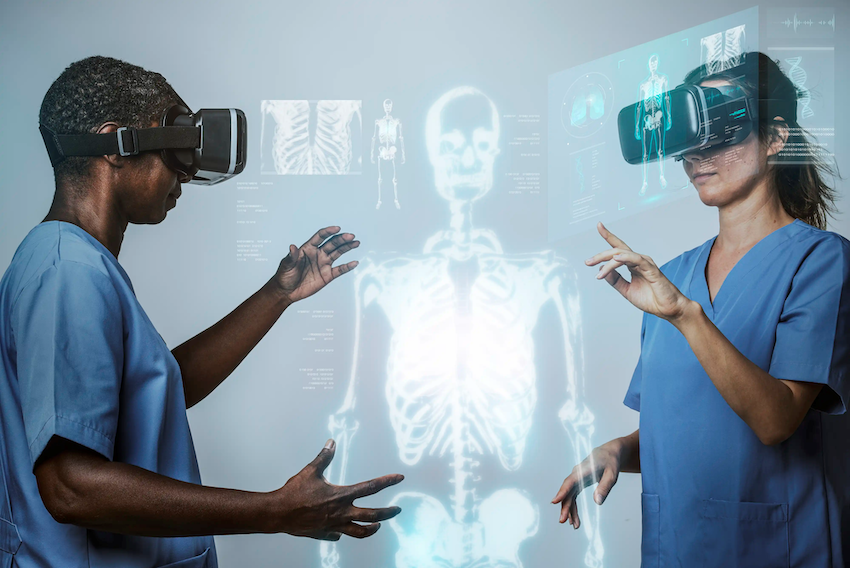
Technology enables the creation of safe medical training environments where students can repeatedly practice clinical skills without putting real patients at risk.
2. Bridging the gap between theory and practice: Simulation and digital twins in healthcare and semiconductors
Turning to the semiconductor industry – a field where precision is measured in nanometers and cleanliness is a prerequisite for every production activity. Training technicians to operate EUV lithography systems or High-NA optical equipment worth hundreds of millions of dollars requires extremely sophisticated simulation environments. According to a report by Dassault Systèmes (2025), the use of “Virtual Twins” allows workers to familiarize themselves with the entire process – from cleanroom gowning procedures to robotic arm operations, without risking contamination or damaging expensive equipment. Research from the NSF (2025) also highlights that AI-integrated VR simulations enable engineers to visualize invisible processes such as photon interactions or chemical gas flows – phenomena that no physical laboratory can present as clearly or safely.
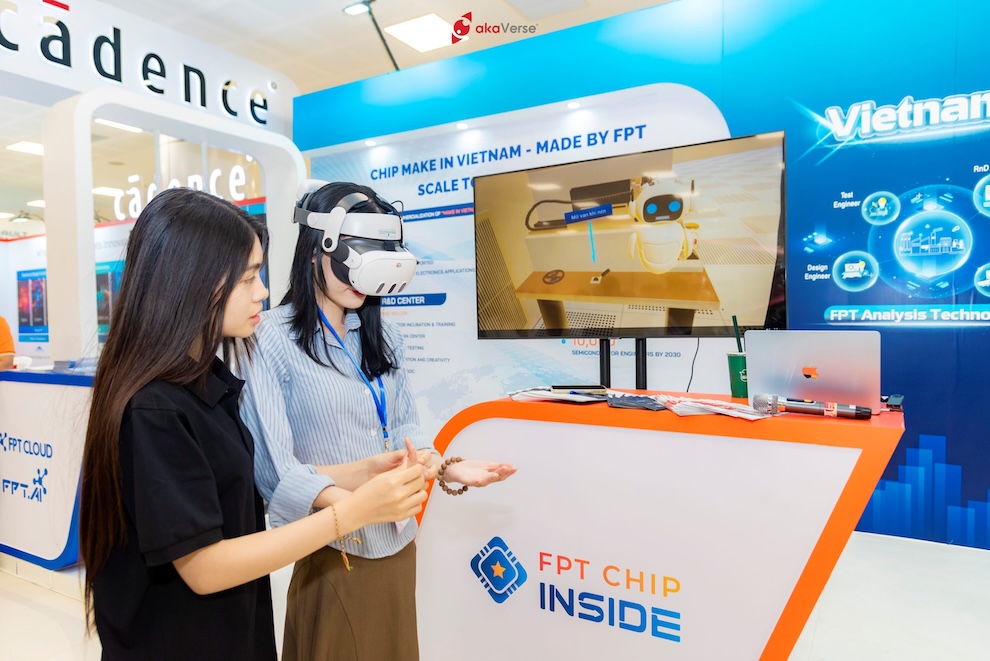 Vietnam aims to become a regional chip manufacturing hub, focusing on training high-quality human resources, especially in cleanroom operation processes.
3. From lab CapEx to XR infrastructure: The cost and scalability equation
One of the most critical considerations for organizations is the cost structure between investing in a physical laboratory and implementing a dedicated XR training system. Building a surgical training facility equipped with robotic surgery systems, anesthesia machines, and life-support equipment can require initial capital expenditures (CapEx) ranging from USD 10 to 20 million, not including the enormous consumable costs incurred after each training session. In the semiconductor industry, constructing a Class 10 cleanroom for training purposes with representative equipment models demands similar investment levels and extremely high operational expenditures (OpEx) for air filtration and intensive maintenance systems.
By contrast, establishing a modern XR training environment based on platforms such as akaVerse dramatically reduces CapEx requirements, replacing million-dollar machinery with highly accurate digital 3D models. Expanding training capacity from 10 learners to 1,000 learners in an XR environment requires only additional endpoint devices, whereas scaling a physical laboratory to that level would be practically impossible in terms of space and financial resources.
4. Spatial data and immersive training: Foundations for long-term workforce strategy
From another perspective, instead of simply recording right or wrong answers, platforms like akaVerse can deeply analyze the entire interaction journey of learners in virtual environments, from gaze tracking and hand reaction speed to the sequence of decisions made when solving problems. Analyzing these datasets enables training designers to understand each learner’s cognitive patterns and skill barriers, allowing them to deliver highly personalized feedback and learning pathways.
While collecting biometric and behavioral data requires strict data protection standards, the benefits for workforce quality improvement are substantial. Each hour of virtual training becomes a valuable dataset that can be used to optimize real-world performance later.
Looking more broadly across industries, we can observe pioneering efforts from companies such as Varjo and Innosimulation. Varjo has demonstrated through its collaboration with Laerdal that combining ultra-high-resolution XR headsets with virtual patient models can help save thousands of lives by training emergency teams to react effectively in critical scenarios. Meanwhile, Innosimulation – a leading company from South Korea, has successfully applied simulation training across industries ranging from smart mobility and railway systems to military equipment and heavy machinery. The success of these organizations demonstrates that immersive training is no longer confined to a narrow sector but has evolved into a multi-industry ecosystem. Solutions like akaVerse build upon and extend these developments by simplifying content creation processes, enabling Vietnamese and regional enterprises to access advanced technology more easily and efficiently.
The future of workforce training in healthcare and semiconductor industries will be closely tied to the ability to digitize expert knowledge into virtual environments. The combination of reduced infrastructure costs, flexible scenario development through the akaVerse platform, and powerful analytics derived from spatial data is establishing a new standard for professional education.
Transitioning from a model of “learning to know” toward “experiencing to understand” not only helps organizations optimize their resources but also ensures that individuals entering real-world environments are already equipped with confidence and competence built through thousands of hours of virtual practice. This will ultimately be the key for organizations seeking to maintain leadership in a world where technology evolves every day.
References
- El-Amine, S., & Abusamra, K. (2024). Artificial Intelligence-Driven Virtual Reality Framework for Workforce Training in the Semiconductor Industry. IEEE Xplore. https://ieeexplore.ieee.org/document/10877657/
- Al-Azawi, R., Al-Sadi, A., Al-Azawei, A., & Cuccurullo, S. (2025). The Impact of Immersive Technologies on Medical Education and Training: A Systematic Review. Healthcare, 13(9), 1034. https://www.mdpi.com/2227-9032/13/9/1034
- Smith, J., et al. (2024). The Role of Extended Reality in Transforming Healthcare Delivery and Training. PubMed Central. https://pmc.ncbi.nlm.nih.gov/articles/PMC12123137/
- Dassault Systèmes. (2024). Virtual twins: Addressing the semiconductor workforce issue. Truy cập từ https://www.3ds.com/industries/high-tech/virtual-twins-addressing-the-semiconductor-workforce-issue (2023). Case Laerdal: Mixed reality for healthcare and medical simulation. Truy cập từ https://varjo.com/case-studies/case-laerdal-mixed-reality-for-healthcare-and-medical-simulation
- (2024). Innosim: Immersive Simulation Solutions for Industry 4.0. Truy cập từ https://www.innosim.com/
- Pappas, C. (2024). Bringing Immersive Technologies Into Workforce Training: Benefits And Strategies. eLearning Industry. Truy cập từ https://elearningindustry.com/bringing-immersive-technologies-into-workforce-training
- Farra, S. L., Miller, E. T., & Hodgson, E. (2019). Comparative Cost of Virtual Reality Training and Live Exercises for Training Hospital Workers for Evacuation. ResearchGate. https://www.researchgate.net/publication/333586817_Comparative_Cost_of_Virtual_Reality_Training_and_Live_Exercises_for_Training_Hospital_Workers_for_Evacuation
- Thompson, R., & Garcia, L. (2025). Integrating Mixed Reality in Semiconductor Manufacturing Training. Journal of Advanced Manufacturing Technology. https://doi.org/10.1080/27525783.2025.2508268
- National Science Foundation (NSF). (2024). Sparking curiosity in the future semiconductor workforce. Truy cập từ https://www.nsf.gov/news/sparking-curiosity-future-semiconductor-workforce
| Exclusive article by an expert from FPT IS, FPT Corporation Vu Duy Thanh – Director of the akaVerse Center |