Insurance core transformation: A safe path from legacy core to real-time
Insurance core transformation has become a strategic imperative for insurers in Vietnam. According to a survey by Vietnam Report, 98.7% of insurance companies increased their digital investment in 2025 – among which core system modernization is identified as the most costly and highest-risk initiative.
This article examines a pragmatic roadmap for insurance core transformation: why a phased, risk-controlled approach is more effective than a “rip-and-replace” strategy, and which modules organizations should prioritize first.
Why does insurance core transformation no longer be delayed?
The pressure to modernize core systems is driven by three structural forces, not a passing trend:
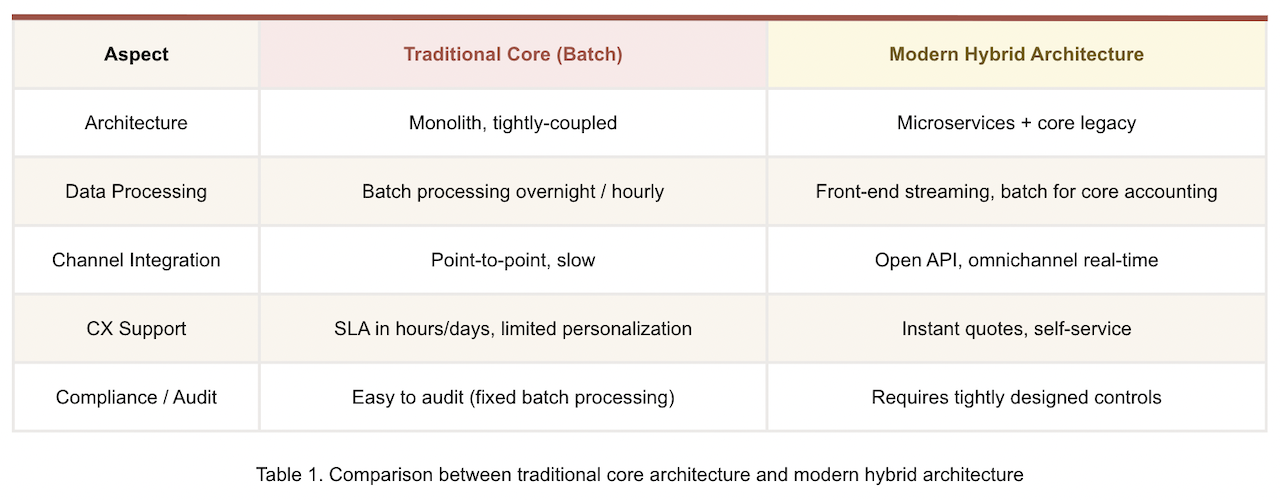
Customer expectations have fundamentally shifted. Users are accustomed to instant payments via e-wallets and booking rides in under 30 seconds. When an insurance quote still takes 2-3 days, the experience gap becomes untenable.
Competition from insurtech and digital bancassurance is intensifying. In 2025, the Vietnamese market saw the entry of new players such as TechcomLife and AlphaRe – bringing technology-first approaches and advanced risk management capabilities. Traditional insurers can no longer rely solely on brand strength as experience gaps widen.
Regulatory requirements are accelerating digitization. Decree 46/2023 and Circular 67/2023 raise the bar for auditability, process control, and reporting. When implemented correctly, modern technology becomes an enabler of compliance, not a risk.
Why are operations staff concerned about “core transformation”?
Understanding the concerns of experienced insurance professionals is essential to designing the right transformation path. Legacy batch systems running on mainframes may be slow, but they have delivered operational stability for decades. A technical failure is not just a software issue, it can result in thousands of policies being disrupted, delayed claims processing, and reputational damage.
Four common concerns in core modernization projects include:
- Operational instability when modifying systems that are currently stable
- Migration risks impacting policy issuance and cash flow
- Dependency on new vendors and reduced internal control in more complex architectures
- Challenges in auditability and regulatory reporting when moving to real-time processing
“Real-time is not inherently risky – the real risk lies in a ‘big bang’ approach that replaces everything at once.”
Core principle: Hybrid batch + Real-time architecture
Based on multiple core transformation programs, a foundational principle emerges: introduce real-time processing in the channel, interaction, and data layers first, while retaining the legacy core as the system of record.
Functional separation is critical:
- Processes requiring instant response – such as quoting, fraud alerts, and customer notifications → should be event-driven
- Processes requiring absolute accuracy – such as premium reconciliation, actuarial accounting, and regulatory reporting → should remain batch-based
- End-of-day batch reconciliation ensures ledger integrity, even when front-end processes operate in real time
Three core transformation models for Vietnamese insurers
Drawing on practical implementation experience and research from BCG, McKinsey, and Kearney, three modernization models are particularly suited to Vietnam’s context:
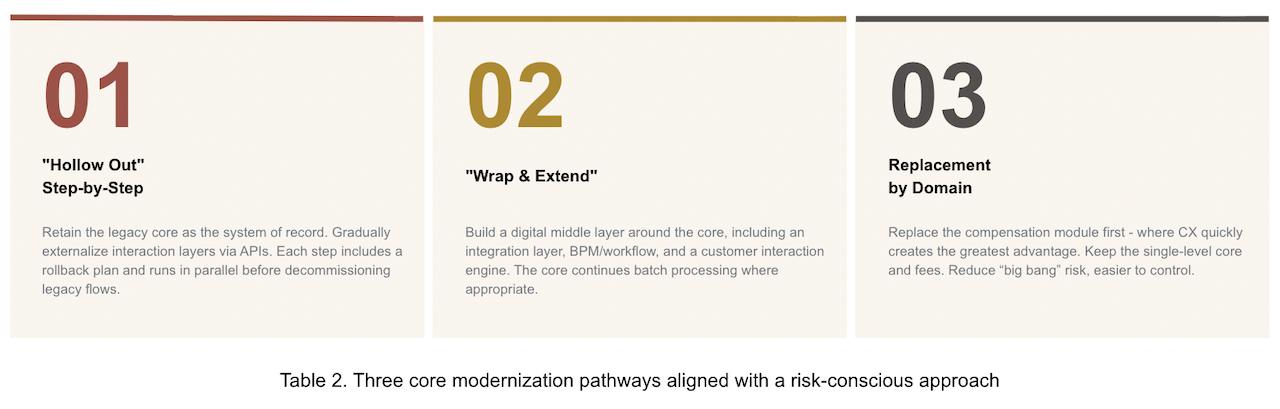
Model 1: “Hollow Out” – Retain the core, externalize digital capabilities
Keep the existing core system as the system of record. Gradually externalize customer-facing functions via APIs, such as: quoting, agent portals, and self-service applications. Each phase includes a rollback plan and runs in parallel before decommissioning legacy flows. This model is ideal for organizations seeking tight control over migration risk.
Model 2: “Wrap & Extend” – Build a digital middle layer
Introduce a digital middle layer around the core, including: an integration layer, BPM/workflow, and customer interaction engine. This layer handles real-time orchestration, while the core continues batch processing where appropriate. This is the fastest path to enabling real-time customer experience with minimal disruption to the core.
Model 3: Domain-by-Domain replacement
Replace modules incrementally. For example, starting with claims, where customer experience improvements deliver the fastest impact, while retaining core policy administration and billing. Alternatively, sequencing can vary based on strategy. This approach reduces risk compared to a big bang and enables controlled learning.
The common principle across all three models: no credible strategy recommends replacing the entire insurance core system in a single step.
Impact on core insurance functions
Underwriting and pricing:
Real-time risk scoring engines leverage behavioral data, claims history, and IoT signals. This is not “AI magic” – it is a rule-based system designed by underwriting teams, executed automatically in milliseconds instead of hours.
Claims:
Digital FNOL (First Notice of Loss), automated triage, and real-time fraud detection significantly improve efficiency. In Vietnam, real-world implementations have reduced simple claims processing time to ~20 minutes, with over 80% of cases resolved at first contact.
Billing and Renewals:
Context-aware notifications are delivered at the right time, through the right channel, based on actual customer behavior. Renewal rates improve when engagement happens during active app usage, rather than via batch-generated communications at the start of the month.
Critical Success Factors in Core Modernization
Most core transformation failures are not caused by technology, but by the gap between business and IT. Key success factors include:
- Underwriting, claims, and product teams must co-design rules and event flows with IT, not simply define requirements and hand them over
- Shift from a “system implementation project” mindset to a “product and platform” approach, with continuous optimization post go-live
- Invest in internal capabilities for data and integration, including teams specializing in APIs, streaming, and data platforms
- Define a clear risk appetite for downtime and data inconsistencies before deciding which processes can operate in real time
Conclusion: Transforming the insurance core the right way – Safe and future-ready
Established insurers possess strengths that many insurtech startups lack: deep domain expertise, experience managing systems across multiple cycles, and strong financial discipline. The goal is not to abandon these advantages, but to embed them into the design of modern digital architectures.
Insurance core transformation is not a race for speed, it is a race to manage risk while moving forward.
The real question is not “whether to transform,” but “which model enables progress without compromising stability.”
References
[1] Vietnam Report – Top 10 Công ty Bảo hiểm uy tín 2025, phân tích xu hướng công nghệ ngành
[2] Hiep hội Bảo hiểm Việt Nam (Bùi Gia Anh) – Năm tái thiết niềm tin và chuyển đổi mạnh mẽ, 12/2025
[3] VNEconomy – Hội nghị Cấp cao Bảo hiểm Việt Nam 2025: Chiến lược phát triển kỷ nguyên AI
[4] PJICO – Bộ ba công nghệ quyết định tăng trưởng doanh nghiệp bảo hiểm, 12/2025
[5] Hicron Software – Strategies for Core IT Modernization in Insurance
[6] McKinsey – How P&C Insurers Can Successfully Modernize Core Systems
[7] BCG – Three Paths to Modernizing Core IT for Insurers (2024)
[8] FPT Software – From Traditional to Tech-Abled: Insurance in Vietnam
[9] IAIS – Insurance and Financial Stability (2022)
[10] PS Global Consulting – Event-Driven vs Batch Processing: Why Not Both
[11] Kearney – Futureproof Core Strategy for Insurers
[12] AWS – InsurTech Event-Driven Insurance Policy Processing
[13] EasySend – Core Systems & Customer Interaction Engines
[14] Moldstud – Implementing Real-Time Data Processing in Insurance Operations
[15] Centric Consulting – Data in Insurance: How Real is Real-Time?
| Mr. Hung Nguyen – Head of Product Development, Healthcare Division, FPT IS, FPT Corp A technology expert with over 10 years of experience in software development and digital transformation, specializing in system architecture design, digital product development, and leading large-scale technology implementations. His approach aligns technology strategy with business objectives, helping organizations optimize operations and build sustainable competitive advantage. |