Notes from WAIC 2026: Embodied AI, Open Models, and the Race for Compute
Over four days in mid-July, Shanghai welcomed more than 400,000 visitors, 1,117 exhibitors, and over 4,400 products on display. The World Artificial Intelligence Conference (WAIC) 2026 made one thing clear: AI is moving closer to everyday life, showing up in consumer products, robots, and edge devices.
Dr. Pham Quang Nhat Minh, Director of the AI Research & Development Center at FPT IS, FPT Corporation, attended WAIC 2026 in Shanghai in person. Drawing on firsthand observations at the event, cross-checked against official WAIC sources, Xinhua, and international outlets including Reuters and AP, here are the products and trends that mattered most, and why they’re worth watching for anyone building technology, running a business, or shaping IT strategy.

The Race for Domestic Compute
One of the standout exhibits at WAIC 2026 was Huawei’s Atlas 950 SuperPoD, shown live as physical hardware for the first time rather than on a slide. The rack-scale system links 16 cabinets and 1,024 Ascend chips into a single unit, delivering 1 EFLOPS at FP8, 2 EFLOPS at FP4, and a unified memory address space of up to 256TB. The Ascend 950 went on to win the Superior award at SAIL (Superior AI Leader), with total prize money this year topping $280,000 across four core categories and six “SAIL Star” categories.

Huawei’s Atlas 950 SuperPoD on display at WAIC 2026
Sugon showed up with the Sugon 8000 “Dengfeng”, a fully domestic AI supercluster built on 100,000 AI accelerators and named by organizers to WAIC’s list of 10 “showcase treasures”, the event’s flagship product picks announced ahead of the opening. Also on that list: Alibaba’s Zhenwu M890 superpod paired with its Panjiu AL128 chip, and ZTE’s OEX superpod, a sign that the race to build large-scale compute clusters isn’t limited to a handful of household names. Further down the stack, domestic chipmakers Biren and MetaX are both expected to ship new supernode lines soon.
At the model layer, Moonshot AI brought Kimi K3, a 2.8-trillion-parameter model the company bills as the largest open-source AI system in the world at launch. Its booth drew crowds large enough to force a pause on new demo sign-ups simply because compute capacity couldn’t keep up, a small detail that speaks to the real pull of large-scale open models.
Robots Move From the Stage to the Production Line
One of the clearest shifts at WAIC 2026 was embodied AI, no longer confined to jaw-dropping demos and now running in real-world scenarios. The category drew more than 200 exhibitors and over 300 robots shown in factory, retail, and service contexts. Xinhua went so far as to call 2026 “the first year of physical AI,” the year AI truly stepped off the screen and into physical space.
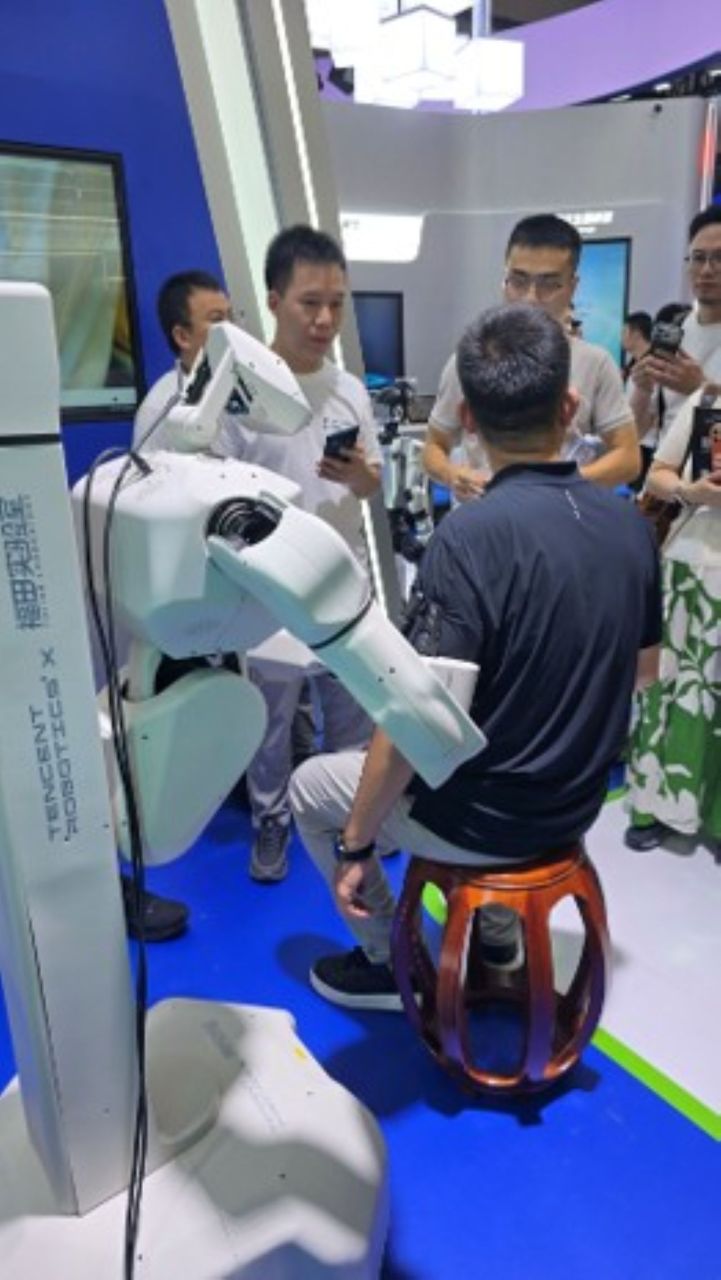
A health-screening robot
The standout example was a smart pharmacy system: a single embodied AI model coordinating three robots from three different manufacturers to split tasks, pick medication, and hand it over, now live at Guo Da Drugstore locations in Shanghai, completing a full order in about 90 seconds. Another demo made for a striking visual: six robots working nonstop for 15 hours to assemble a Great Wall model from 81,920 Lego pieces, built by Dexmal in partnership with StepFun on the DM0.5 model. The real story wasn’t the Lego, it was the environmental awareness, flexible role-splitting, and sustained multi-robot coordination behind it.

Robots autonomously assembling a Great Wall model
On the commercial humanoid side, Agibot’s Yuanzheng A3 Ultra was the only embodied AI product to make WAIC’s list of 10 “showcase treasures,” a clear signal from organizers on which product they see as the category’s standard-bearer. Wei Liang, deputy director of CAICT, attributed the leap forward in humanoid robotics to three reinforcing factors: stronger domestic models, falling core component costs, and steadily growing real-world interaction data.
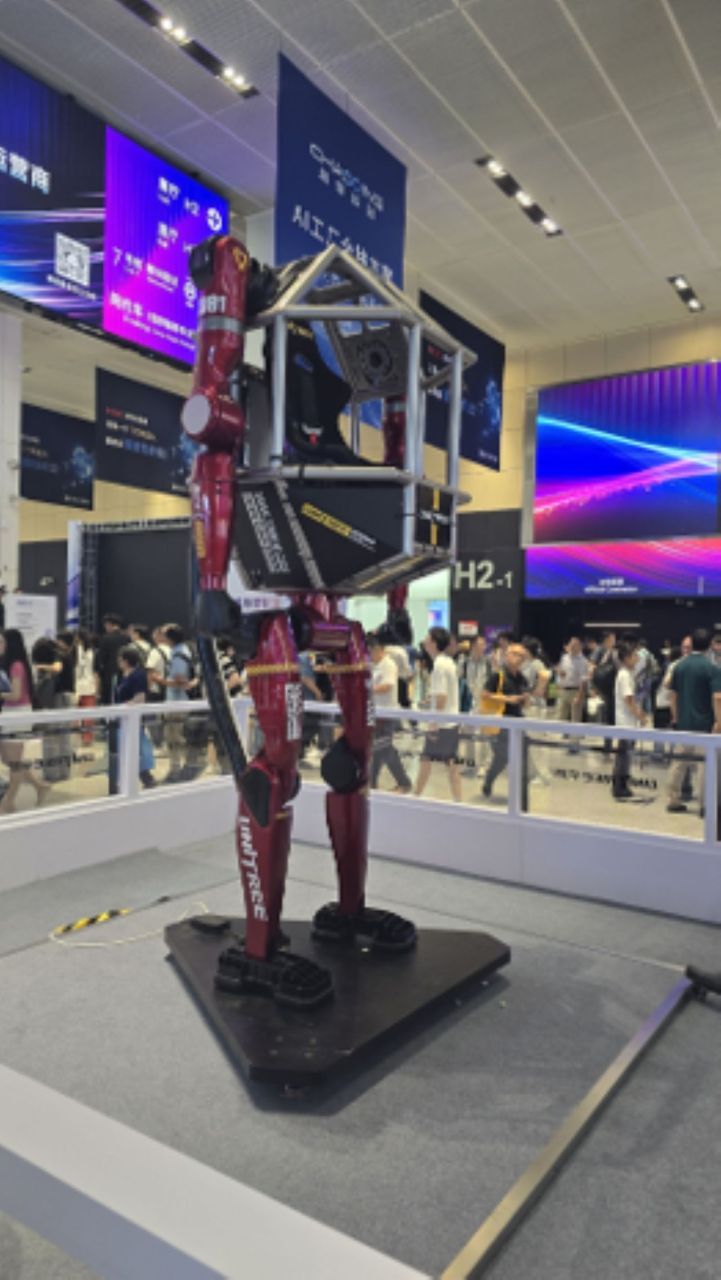 Unitree’s shape-shifting GD01 robot on display at the exhibition
Agentic AI: From Answering Questions to Running the Show
Another standout trend at the conference was agentic AI, backed by a wave of new product launches: assistants like Baidu DuMate, WorkBuddy, and WPS Lingxi, a new crop of agent operating systems, and AI-agent phones, including StepFun’s STEPX Neo, which runs the company’s native Step AOS and also made WAIC’s list of 10 flagship products. The message: AI is shifting from answering questions to planning, calling tools, and orchestrating multiple services to complete complex tasks, a meaningful step for any companies weighing how to fold AI into their operations rather than treating it as just a lookup tool.
Edge AI: Off the Cloud, Into Your Pocket
Edge AI devices were everywhere at WAIC 2026, AI glasses, AI-agent phones, and non-invasive brain-computer interfaces. iFlytek’s AI glasses, weighing about 40 grams, combine lip-reading and multimodal noise cancellation to isolate the right speaker in noisy environments, and made the event’s list of 10 “showcase treasures.” iFlytek wasn’t alone: Moonix and Viture also showed AI glasses, underscoring a wearables market that’s heating up well beyond one or two big names.
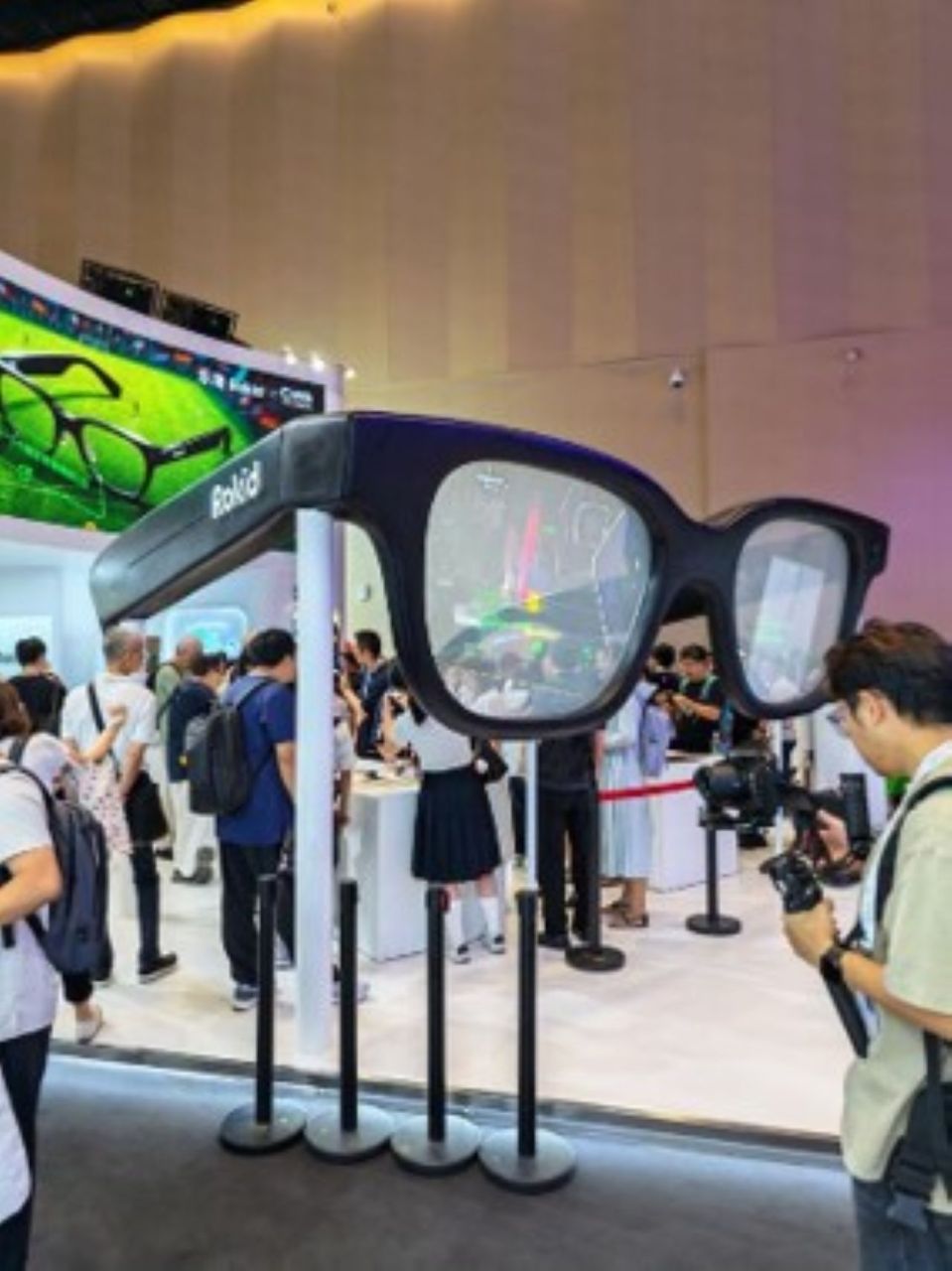
An AI-glasses exhibit booth at WAIC 2026
One of the more intriguing demos was a brain-controlled gaming interface: a lightweight EEG headset that let users control a character in Black Myth: Wukong using brainwaves alone, no keyboard, mouse, or controller. It’s nowhere near a mainstream product yet. But as a statement, it shows WAIC 2026 pushing the boundaries of “AI + interface” toward a post-keyboard, post-screen future.
The Academic Debate: Is AI Smart Enough Yet?
Beyond the show floor, 2026 also marked the first time WAIC ran an independent academic track, WAIC Academic, chaired by Yao Qizhi, the Chinese-American computer scientist and theoretical physicist who won the Turing Award in 2000. The track received 282 valid submissions and accepted 57, from authors across 12 countries and regions. Its arrival signals that WAIC is no longer just a product showcase, it now carries a genuine research layer as well.
Among the most talked-about exchanges: Richard Sutton, widely regarded as the father of reinforcement learning and a co-recipient of the 2024 Turing Award, cautioned against equating the power of large language models with genuine, self-directed intelligence, arguing that AI needs to move from “the era of data” to “the era of experience”: learning through direct interaction with the real world, not just from human-generated data. Yao Qizhi made a similar point: today’s AI is powerful, but it isn’t the endpoint of intelligence. Both remarks help explain why embodied AI, which learns through physical interaction, drew such heavy investment at this year’s WAIC.
Four Technology Shifts to Watch
Taken together, WAIC 2026 points to four technology shifts worth tracking: domestic compute infrastructure scaling up through massive superpod clusters; open models and open sharing becoming a strategic priority rather than just a technical choice; agentic AI displacing single-purpose models as the center of gravity; and embodied AI steadily moving out of the lab and into everyday life and production.
This article draws on firsthand reporting by Dr. Pham Quang Nhat Minh, Director of the AI Research & Development Center at FPT IS, FPT Corporation, who attended WAIC 2026 in Shanghai in person, cross-checked against WAIC, Xinhua, Reuters, AP, and other industry analysis.
| Reporting by Dr. Pham Quang Nhat Minh, Director of AI R&D, FPT IS, FPT Corporation, who attended WAIC 2026 in Shanghai in person |