The journey from service portal to digital companion: AI Citizen Agent and the next step of dCitizen
From paperwork to the on-screen experience, the digital citizen app is helping people access services more conveniently. But to get a task done, people still have to find information themselves, choose services themselves, and complete the necessary steps one by one. The question for the next step is whether there can be a simpler experience: where citizens just need to say what they need, and the app will understand the request, suggest the next steps, and provide support until the task is completed?
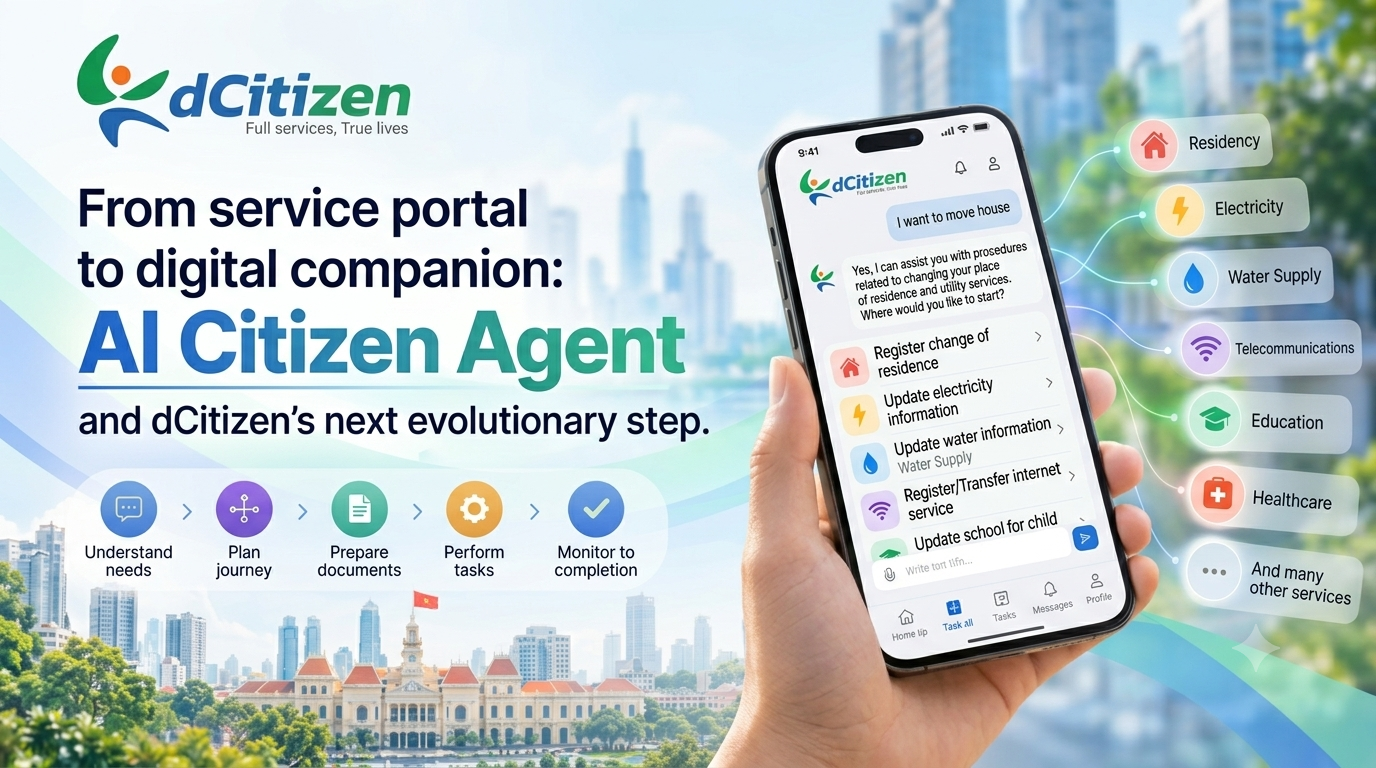
“I am about to move to another place, what do I need to do?”
A service portal can return a list of related procedures. But to know which ones apply to them, in what order to do them, and where to track the results, citizens still have to piece together the information themselves. The issue is not just about adding more services to the application. Services need to be connected around the real-life needs of the people.
The policy context is creating favorable conditions for this direction. From September 28, 2026, Decree 320/2026/ND-CP takes effect: documents integrated on VNeID have the same validity as physical documents, and citizens can create profiles, submit requests, and receive results directly on the application. Once documents are fully digitized, the remaining task is no longer “what to digitize next,” but rather who helps citizens navigate these services with the least effort.
That is the transition we envision for dCitizen: from a Digital Service Hub, where citizens search for and select services, to an AI-powered Citizen Platform, where the system can help them identify the next steps they need to take. AI Citizen Agent is the interactive layer of this orientation.
One question, multiple steps to process
Returning to the house moving scenario, a helpful assistant should not rush to provide a generic list. First, it needs to ask the truly necessary information: whether the citizen is moving within the same area or to a different one, whether family members are moving together, and what they want to resolve first.
Based on the answers, the system can create a journey for the citizen to check. At each step, the assistant points to official guidance sources, clarifies which information is already available, which is missing, and which agency or system receives the request. If there is technical connection and granted permission, the agent can help prepare forms or retrieve processing status. Before submitting a request that affects the record, the citizen must review and confirm the content.
This is the difference between answering a question and supporting the completion of a task. The value does not lie in AI writing longer answers. It lies in the ability to maintain context across multiple steps, use the correct information sources, and know when to stop within its authority limits.
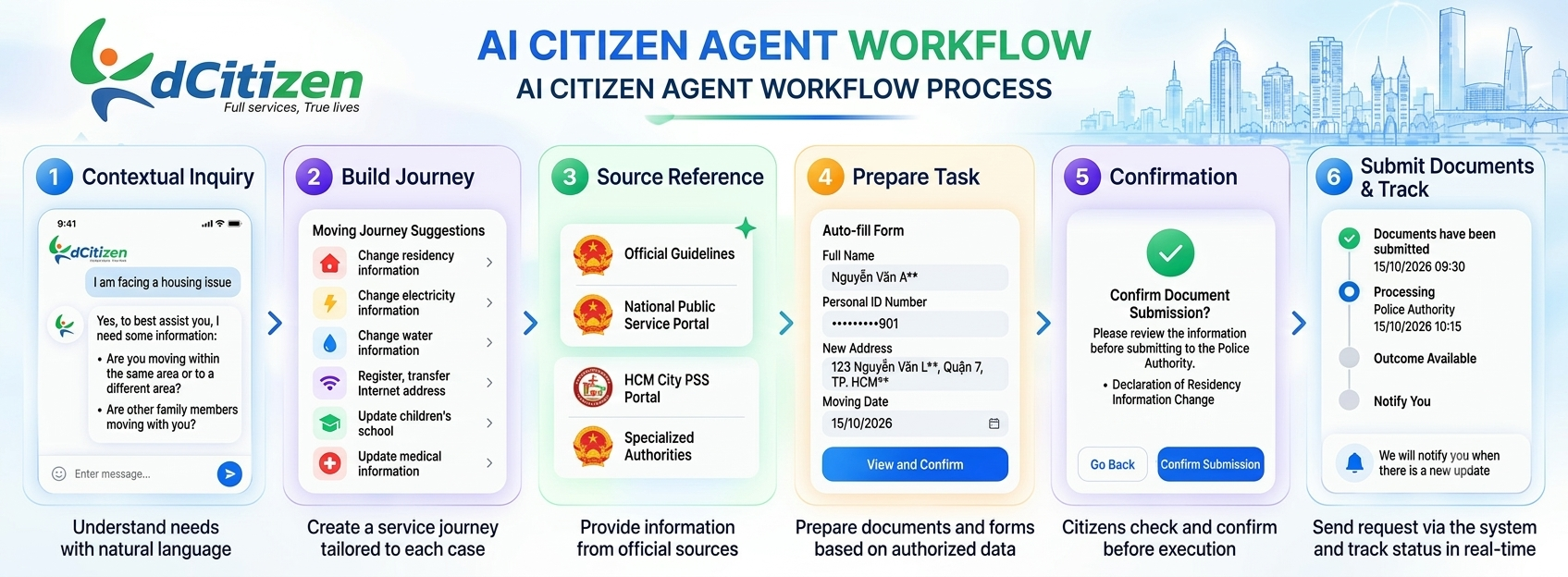
AI Citizen Agent Workflow for Moving House
OECD analyzed 200 cases of AI applications in 11 government functions. According to this report, 57% of cases support automation, streamlining, or adjusting services according to needs. This figure shows a remarkable application direction in the public sector; it does not mean every procedure should be fully automated by AI.
From understanding needs to supporting actions
To develop that experience, dCitizen needs to connect three capabilities.
Citizen information permitted for use helps the system recognize the necessary data for a specific request. The data scope must be defined by purpose, source, and access rights. The system does not need to create a comprehensive profile of each person’s life.
Citizen Journey places requests into a sequence of tasks. For example, a question about enrolling a child in grade 1 may relate to timelines, conditions, documents, and local implementation channels. Citizens need an easy-to-follow roadmap rather than many disconnected answers.
AI Citizen Agent helps citizens interact with that journey using natural language. At a basic level, the agent explains and directs to the correct service. When reliable data sources, API connections, proper authorization mechanisms, and supervision are in place, it can assist in preparing tasks, proposing confirmations, submitting requests through authorized systems, and tracking status.
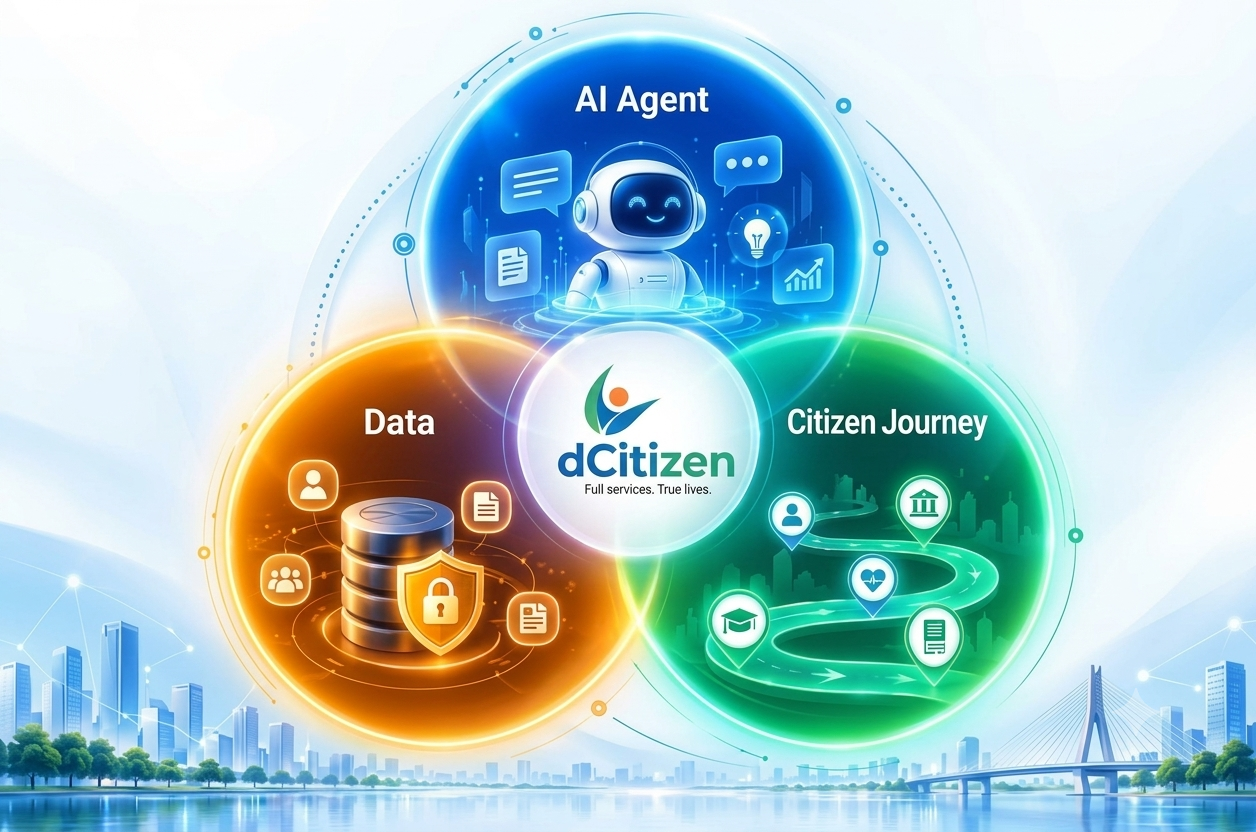 The Three Capabilities of dCitizen: Permitted Citizen Data, Citizen Journey, and AI Agent
These capability levels need to be implemented in stages. An agent may suggest the next step without having permission to perform it. Calling a backend system, changing data, or submitting records must comply with the rights of each task and the responsible agency’s procedures.
Gartner forecasts that by 2028, at least 80% of governments will deploy AI agents to automate routine decisions. This is a trend forecast, not a current achievement rate or a success metric for a specific product. Gartner’s cited survey also shows fragmented strategies and legacy systems are major obstacles in digital government solution deployment.
Where do VNeID and dCitizen stand in the user experience journey?
A seamless service journey must start with a reliable identity. VNeID is the national identity application. According to the orientation in this article, dCitizen connects based on permitted mechanisms to build an experience layer and coordinate services suitable for local contexts.
This relationship can be expressed through five questions:
Know Me — Who am I? Identity and authentication based on authoritative platforms.
Understand Me — What do I need? The system understands current requests from permitted information and citizen-provided context.
Help Me — What are my options? The agent explains suitable services and guides the steps.
Act for Me — How far is the system supported? Permitted tasks can be prepared or executed via integration, with clear confirmation points.
Protect Me — How are my rights and data protected? Every step is subject to access control, supervision, and traceability.
This framework describes dCitizen’s proposed role in the ecosystem. It does not imply all connections and processing rights mentioned have been implemented.
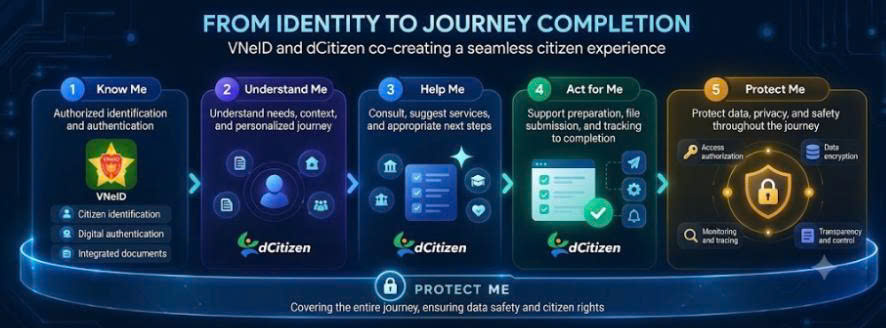
Diagram of the Five Stages Know Me → Protect Me VNeID handles Know Me; dCitizen handles Understand Me, Help Me, Act for Me; Protect Me covers the entire journey.
A natural question arises: when Decision 940/QD-TTg has oriented VNeID to become a super app, and Decree 320/2026/ND-CP allows citizens to create profiles and receive results directly on VNeID, why is a platform like dCitizen still needed? In the proposed experience model here, VNeID provides the authoritative identity and authentication platform; dCitizen plays the role of the experience layer, coordinating journeys and connecting services suitable for local contexts, based on permitted integration mechanisms. Therefore, the two platforms do not compete but coexist symbiotically: one maintains the national identity infrastructure, the other organizes specific experiences around the needs of each citizen and locality.
To serve proactively, one must be trustworthy
An AI agent can give wrong suggestions, misunderstand context, or use outdated information. In public services, such errors can cause citizens to waste time, submit incorrect documents, or misunderstand their rights. Therefore, control must accompany experience design from the start.
Every procedural answer must trace back to official sources and update times. Each task must have a specific scope of authority. Citizens need to know whether the agent is suggesting, preparing, or executing an action; they must review content before confirming; and have a way to escalate to a human officer when issues exceed the system’s scope. Processing logs must be sufficient for operators to check what happened.
These requirements align with NIST’s AI risk management approach. Gartner also forecasts increasing demand for explainable AI and human-in-the-loop control mechanisms for automated decisions affecting citizen services. For dCitizen, these principles must become concrete processes, access rights, and operational metrics.
In Vietnam, these principles are not just international recommendations. The Personal Data Protection Law No. 91/2025/QH15, effective January 1, 2026, sets specific obligations on processing purposes, consent, and data subject rights. The Artificial Intelligence Law No. 134/2025/QH15, effective March 1, 2026, requires risk-based AI management, ensures human oversight is not disabled, and transparency of AI-generated content. For dCitizen, this is a directly binding legal framework, not just a best practice.
Measuring Results by Citizen Journeys
An AI Citizen Agent should not be evaluated mainly by the number of conversations or answers. More important questions are: do citizens find the right services? How many times do they have to re-enter information? How many requests are completed, and how many require escalation to officers? When the agent makes a suggestion, can citizens and operators verify its basis?
Therefore, a feasible deployment approach is to start with a few high-demand journeys with relatively clear procedures. For each journey, identify authoritative information sources, receiving systems, agent permissions, citizen confirmation steps, and evaluation metrics. Pilot results will show which capabilities truly reduce citizen effort and which need adjustment before scaling.
If achieved, the step from “providing services” to “proactively serving” will have very concrete meaning. Citizens state what they need; the platform helps them understand options, perform permitted steps, and track progress until completion. AI Citizen Agent then reorganizes the service experience around the citizen’s journey.
References:
Gartner, Forecast on AI agents in government and survey on digital solution deployment obstacles (March 17, 2026).
NIST, Artificial Intelligence Risk Management Framework: Generative Artificial Intelligence Profile, NIST AI 600-1 (2024).
Prime Minister’s Decision No. 940/QD-TTg: Approval of the National Identity Application Development Project VNeID for 2026-2030, vision to 2045.
Government Decree No. 320/2026/ND-CP: Amendments to Decree No. 69/2024/ND-CP on electronic identification and authentication.
Personal Data Protection Law No. 91/2025/QH15 (effective January 1, 2026).
Artificial Intelligence Law No. 134/2025/QH15 (effective March 1, 2026).
Explore more articles on related topics
| Exclusive article by Mr. Pham Ngoc Khoa – Product Director at FPT IS, FPT Corporation. Mr. Khoa possesses nearly 20 years of experience in the technology sector with key projects in Electronic Invoicing, PKI digital signature applications, government-related projects such as LGSP, BI data warehouses, Digital Citizens, etc. He is currently researching and developing products applying new technologies: AI, Big Data, PKI, etc. |