KEY HIGHLIGHTS
2,700 students simultaneously participated in the quality assessment test with citizen ID authentication
26 high schools across Hung Yen conducted the examination concurrently
Candidate identity verification completed within 12 seconds with 100% accuracy
Over 30 teachers collaboratively built a shared provincial question bank of 500 questions online
Approximately VND 500 million saved in printing, transportation, accommodation, and travel expenses for examination staff
Data from regular and periodic assessments serves as a basis for improving teaching and learning methods
OVERVIEW
As part of the implementation of Model 21 under Project 06, on November 3, 2023, 26 high schools in Hung Yen piloted an online quality assessment examination for nearly 2,700 students on the Khaothi.Online platform developed by FPT IS. At the time of deployment, this was the largest pilot implementation nationwide of Model 21 – a centralized online examination model integrated with chip-based citizen ID authentication technology.
Instead of paper-based examinations, the entire process was operated on a unified technology platform, covering curriculum management, question bank development, exam generation, planning, examination organization, candidate authentication, supervision, grading, storage, and result analysis.
Beyond serving as a provincial-level quality assessment examination, Khaothi.Online demonstrated its role as a comprehensive digital assessment platform capable of supporting large-scale centralized examinations, regular and periodic assessments, curriculum management, shared question banks aligned with the 2018 General Education Curriculum, and data analytics to support teaching and learning improvements.
CLIENT
The Hung Yen Department of Education and Training is the provincial authority responsible for educational management, teaching supervision, assessment activities, and educational quality improvement across schools in the province.
Following directives from the Provincial People’s Committee, together with existing school infrastructure and collaboration with FPT IS, the Department selected large-scale implementation of Model 21 to evaluate the effectiveness of centralized online examinations with chip-based citizen ID authentication while establishing a foundation for data-driven educational quality management.
CHALLENGES
In general education, assessment is not limited to examinations or surveys but plays a continuous role throughout the teaching and learning process. Under the 2018 General Education Curriculum, schools require reliable data to evaluate student competencies, monitor learning progress, and adjust teaching methods.
However, when assessments rely on paper-based processes and disconnected tools, data often becomes fragmented across teachers, schools, and examination periods. Developing shared question banks, securing examination content, organizing synchronized assessments, grading, consolidating results, and analyzing student performance therefore require substantial time, manpower, and operational costs.
Within the framework of Project 06, Hung Yen needed a model capable of simultaneously supporting large-scale examinations with chip-based citizen ID authentication and establishing a province-wide digital assessment system where examination data could be used not only for recording scores but also for quality management, analytics, and educational improvement.
SOLUTION
FPT IS deployed Khaothi.Online to support the quality assessment examination under Model 21, creating a centralized online examination process on a unified technology platform..
During the preparation phase, assessment frameworks and question banks were collaboratively developed online using tools that enabled teachers across the province to work together efficiently and securely without requiring in-person meetings. Examination questions were generated using tightly controlled algorithms to prevent information leakage while laying the foundation for province-wide shared question banks organized by subject, grade level, topic, and competency requirements under the 2018 General Education Curriculum.
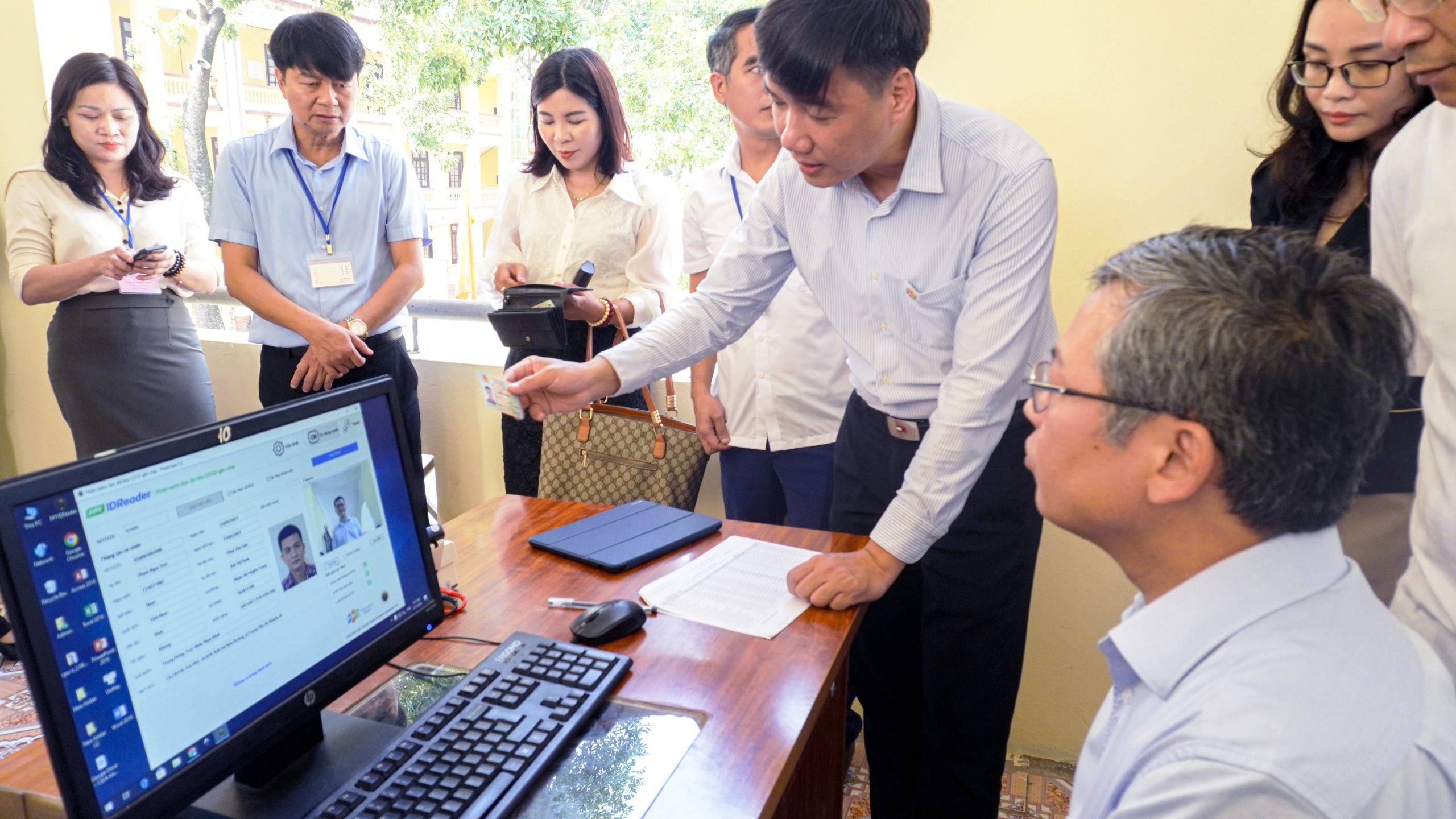
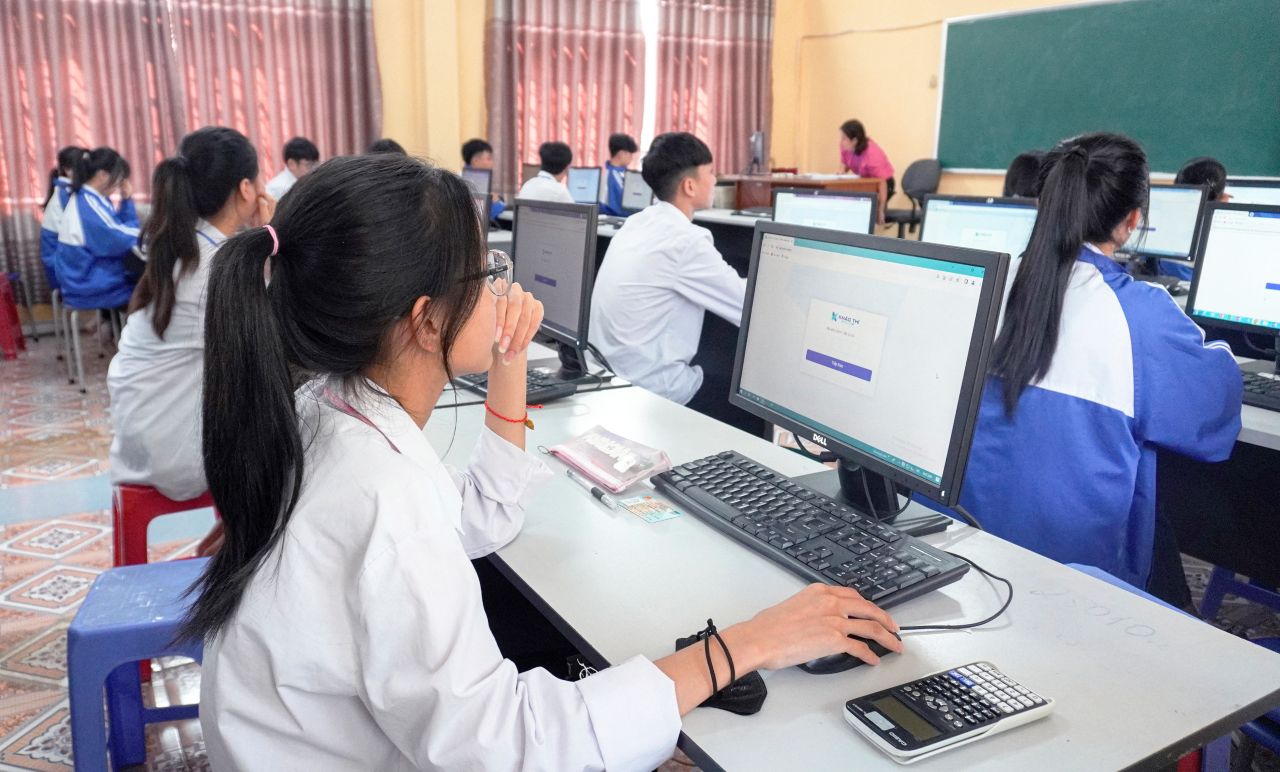
During examination operations, students completed tests directly on computers at examination sites, simplifying administrative procedures and reducing costs, time, and manpower. Candidate identity verification was conducted using FPT.IDCheck and FPT.IDReader, integrated with the Ministry of Public Security’s National Population Database to ensure accurate authentication and eliminate impersonation.
The entire examination process across all 26 schools was monitored online in real time. Through remote reporting dashboards, leaders of the Department of Education and participating schools could track authentication status, absentee rates, examination progress, and examination site conditions without waiting for reports from individual schools.
After examinations were completed, the system automatically graded results, reducing the need for large grading committees and shortening processing time. Results were packaged and securely stored on servers, minimizing paperwork while simplifying auditing and post-examination verification.
In particular, Khaothi.Online provided advanced reporting and analytics tools for evaluating student competencies, examination quality, question effectiveness, and overall assessment data, supporting the development of question banks, educational quality evaluation, and data-driven decision-making.
RESULTS
The pilot examination was successfully conducted simultaneously across 26 high schools in Hung Yen with nearly 2,700 participating students, becoming the largest implementation of Model 21 under Project 06 nationwide at the time.
Chip-based citizen ID authentication was completed quickly, averaging approximately 12 seconds per student with 100% accuracy, significantly improving transparency and preventing examination fraud. More than 30 teachers collaboratively developed a shared online question bank of 500 questions for the entire province. The centralized online examination model also helped save approximately VND 500 million in printing, transportation, accommodation, and travel expenses for examination staff.
The resulting data extended beyond examination scores. Statistical reports and advanced analytics enabled evaluation of examination quality, question effectiveness, student competencies, and teaching performance while supporting the continued development of shared question banks and future educational improvements.
VALUE
The successful pilot implementation of Model 21 by the Hung Yen Department of Education and Training demonstrated that centralized online examinations with chip-based citizen ID authentication represent not merely a change in examination format but a new operational model for educational assessment.
With Khaothi.Online, the examination process is managed consistently from curriculum frameworks, question banks, authentication, supervision, grading, reporting, and advanced analytics on a single platform. This enables local authorities to build comprehensive digital assessment ecosystems, including shared question banks aligned with the 2018 General Education Curriculum, regular and periodic assessments, quality surveys, and large-scale examinations.
“The successful pilot implementation of Model 21 by Hung Yen Department of Education and Training demonstrates the province’s proactive and pioneering role in deploying Project 06. The system enables local authorities to better control examination processes through data, reduce inspection and supervision costs, and minimize fraud risks. This creates a solid foundation for organizing future large-scale examinations through a consistent and scientific process.”
Senior Lieutenant Colonel Tran Duy Hien
Deputy Director, National Population Data Center
Director, Population Data and Citizen ID Application Research Center
The success achieved in Hung Yen has created a foundation for expanding Model 21 to high school entrance examinations, gifted student examinations, quality assessments, and other large-scale examinations. FPT IS has also deployed Khaothi.Online under Model 21 in other provinces and cities including Hai Phong, Hue, and Khanh Hoa, with the long-term vision of establishing centralized provincial databases for question banks, student competencies, and learning progress.
More broadly, the project demonstrates FPT IS’s capabilities in digital assessment platforms, identity authentication, and educational data analytics, enabling Departments of Education and Training to standardize curriculum management, monitor learning progress, identify competency gaps, improve teaching methods, and gradually transition from managing isolated examinations to managing educational quality through data.
Explore more




Sign up to receive the latest news from FPT IS