From electronic medical records to health data management platform (HDMP): the data infrastructure Vietnam’s digital health needs
For years, digital transformation in healthcare has been treated like an IT project: deploy a hospital information system, digitize patient records, invest in management software, automate a few workflows. But the global picture today tells a different story. Healthcare is no longer facing a need to “improve” — it’s being forced to rethink its entire operating model to survive and grow. According to the KPMG 2025 Healthcare CEO Outlook, pressure on health systems worldwide is accelerating fast: aging populations, surging demand for care, chronic workforce shortages, financial strain, and growing cybersecurity threats. And layered on top of all of this, AI is expected to fundamentally reshape how healthcare is delivered.
The same KPMG report found that 85% of healthcare leaders globally still believe in the industry’s long-term growth. But most also admit the traditional healthcare model is becoming obsolete — no longer capable of meeting future demand. Their top priorities for the next three to five years: accelerate digitalization, improve data connectivity, deploy AI, and build a digital-ready workforce.
AI may be the most visible layer of healthcare’s digital transformation. But the foundation that actually determines whether it succeeds is data — specifically, the ability to standardize data, connect systems, govern data properly, and build a digital infrastructure large enough to operate at scale across an entire health system. Because if data remains fragmented, unstandardized, non-real-time, and non-interoperable, AI simply cannot create real value in healthcare.
Vietnam is now entering exactly this phase of transition.
Some analysis and proposals for Vietnam’s health system
Picture this: an elderly patient is rushed to the emergency room during a work trip far from home. The attending physician needs to know their medical history, current medications, and latest lab results — right now. But all of that information is scattered across a provincial hospital, a private clinic, and a paper health booklet the family hasn’t had time to bring.
This isn’t a hypothetical. It’s the reality that millions of patients and tens of thousands of doctors in Vietnam face every day.
The question is no longer “should we digitize health data” — that’s essentially settled. The real question is: once digitized, how do we stop health data from staying fragmented, siloed, and wasted?
The policy framework is ready — execution is the hard part
Over the past two years, Vietnam has built a fairly comprehensive policy framework for digital health transformation. Resolution 72-NQ/TW sets out clear requirements: complete the health databases needed for standardized connectivity, sharing, and interoperability; operationalize electronic health records, electronic medical records, and electronic prescriptions; and manage citizens’ health data across their entire lifetimes.
Resolution 282/NQ-CP translates this into a government action plan. Decision 3516/QĐ-BYT issued the Ministry of Health’s digital transformation strategy for 2025–2030. Most recently, Decision 586/QĐ-BYT dated March 9, 2026, approved a national plan to roll out electronic medical records across all healthcare facilities in 2026 — with a hard deadline of January 1, 2027.
At the same time, Data Law 60/2024/QH15 and Decree 165/2025/NĐ-CP clearly classify health data as critical and core data that must be protected and used responsibly.
In short, the legal framework for digital health is taking shape. What’s missing isn’t direction or political will — it’s a deep enough understanding of the technology architecture needed to turn those directives into systems that actually work in practice.
What other countries have figured out
Looking at countries that have successfully deployed national-scale health data systems, a common pattern emerges: they didn’t start with software. They started with data architecture.
Singapore built the National Electronic Health Record (NEHR) on cloud infrastructure, connecting hospitals, clinics, and community health centers across the country. Any authorized healthcare provider can access a patient’s complete information — medical history, lab results, medication lists — through a multi-layered security and access control system. The results are measurable: significantly fewer redundant tests, fewer medical errors caused by missing information, and a marked improvement in continuity of care. The entire system is built on international standards — HL7 FHIR, SNOMED CT, LOINC, ICD-10 — creating a shared data language that every system can understand.
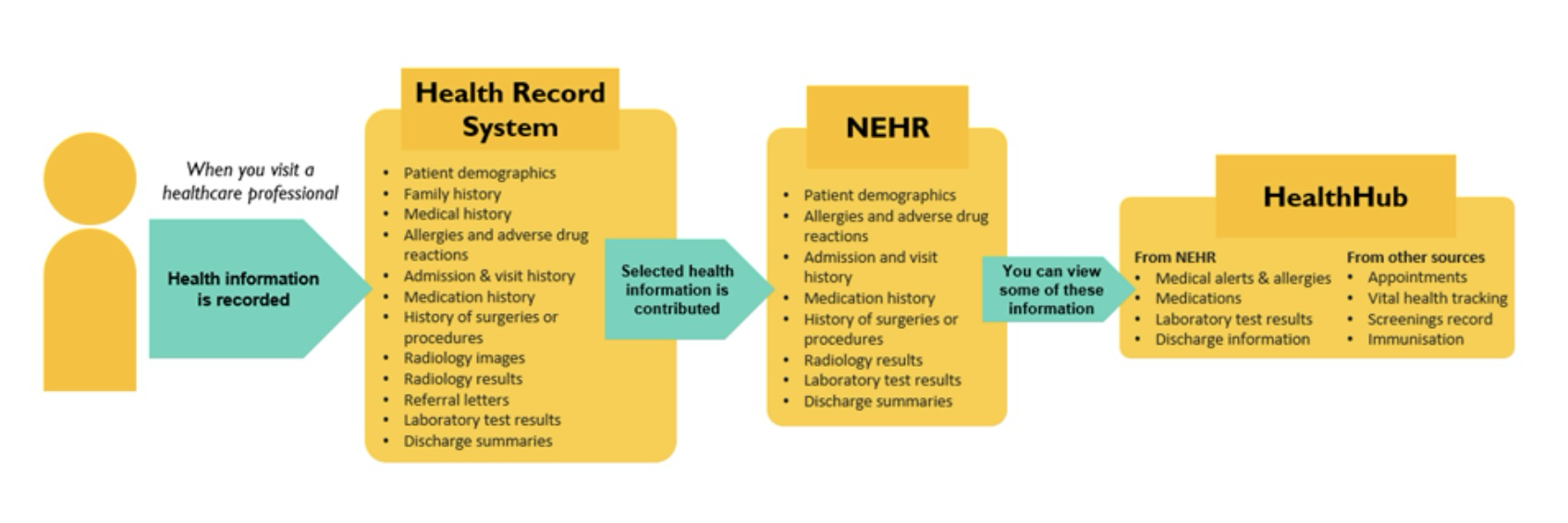
Singapore’s Electronic Health Record (EHR) system spans an individual’s entire lifetime, ensuring that “data follows the patient.” (Image source: Health Information Bill, https://theinterview.asia)
Australia’s My Health Record takes a citizen-empowerment approach. Every resident has a continuously updated digital health record that can be shared with authorized providers anywhere in the country. Citizens control who gets access to their data — a design choice that turned out to be critical for building trust in the system.
Estonia and Denmark have gone further still, integrating health data into their broader digital citizen ecosystems, enabling real-time epidemiological analysis, medical research, and evidence-based health policy.
The common thread across all of these models: they didn’t just digitize data — they governed it. That means data is standardized, connected, secured, and intentionally exploited at a system-wide scale.
The core problem: lots of data, not much value
Many hospitals in Vietnam have already deployed hospital information systems, management software, and started storing data electronically. But the widespread reality is that each system speaks a different data language and can barely understand the others.
In quite a few facilities, lab data in the LIS has no connection to medical records in the HIS; imaging results in PACS exist as a completely isolated data island; medication data in the pharmacy system doesn’t talk to the treatment record. And critically, almost none of this data can be shared outside the hospital in any structured, consistent way.
The root cause isn’t a lack of technology — it’s a lack of standardization. When each facility uses its own terminology codes, lab codes, and data structures, even a technically connected system can’t actually interpret and use the data consistently.
This is why international standards — SNOMED CT for clinical terminology, LOINC for lab tests, ICD-10 for diagnoses, HL7 FHIR for data exchange — shouldn’t be treated as optional technical add-ons. They need to become non-negotiable prerequisites for any healthcare IT system going forward.
The architecture: health data management platform (HDMP)
To solve the fragmentation problem and unlock data’s value, the right architecture to aim for is a Health Data Management Platform (HDMP) — a central hub that serves as the “data backbone” for the entire health ecosystem.
An HDMP isn’t a single piece of software. It’s a multi-layer data architecture with distinct, specialized functions.
The first layer handles data collection and integration: pulling data from source systems like HIS, LIS, RIS, PACS, and clinic software through data exchange standards like HL7 FHIR. Data from multiple sources is then cleaned, standardized in terminology, and harmonized in structure before being stored.
The second layer handles data governance: ensuring data is stored to the right security standards, with clear access controls, lifecycle management, and compliance with legal requirements.
The third layer handles data exploitation and sharing: Data Lakes and Data Warehouses that enable large-scale analytics, management reporting, epidemiological research, and the foundation for AI applications or Clinical Decision Support Systems (CDSS).
The entire platform needs to run on cloud infrastructure based in Vietnam — to satisfy data sovereignty requirements while maintaining the flexibility to scale as data volumes grow.
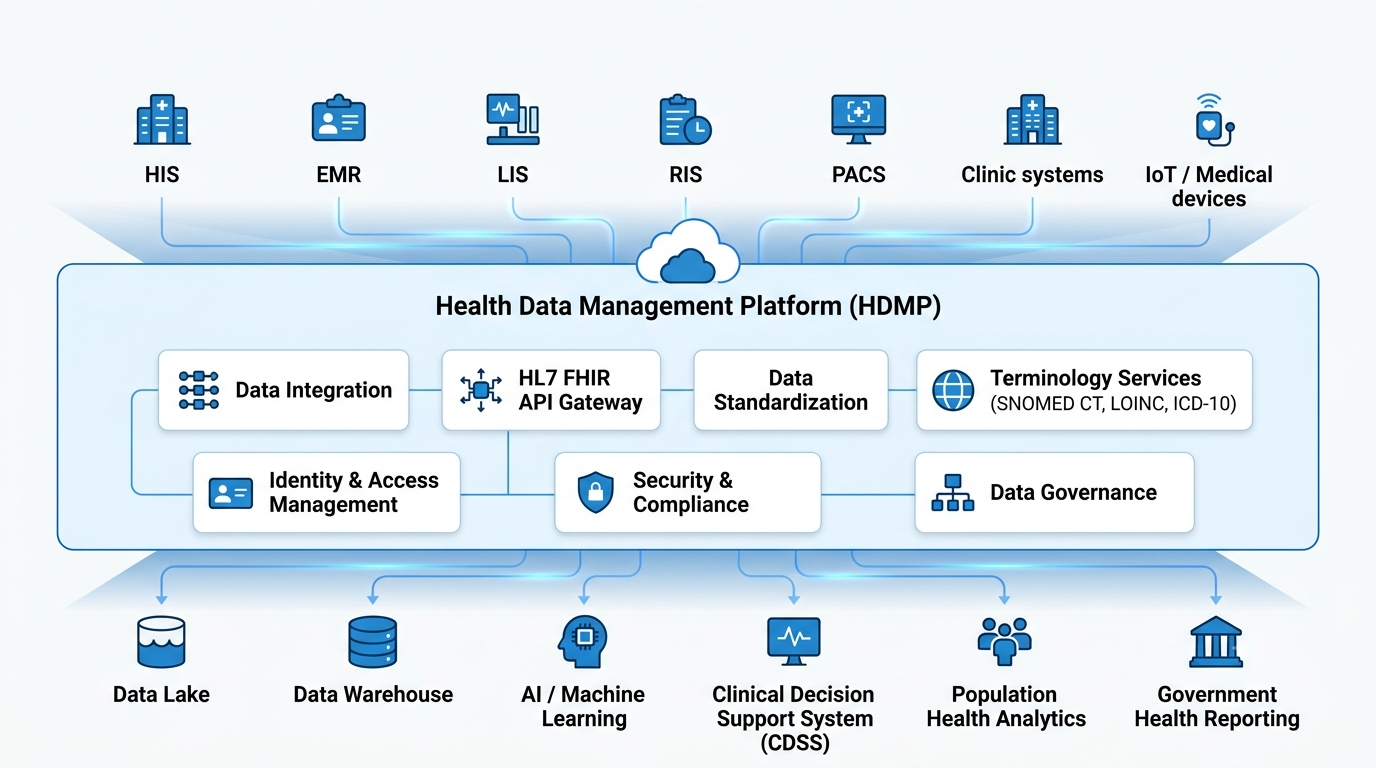
The architecture: health data management platform (HDMP)
EMR Cloud: the most realistic starting point
In the HDMP roadmap, electronic medical records (EMR) remain the most important and most urgent data source — especially with the Ministry of Health requiring all healthcare facilities to replace paper records with EMR before January 1, 2027.
For many provincial and district hospitals, the biggest challenge isn’t the will to implement — it’s the cost of the on-premise IT infrastructure needed to run EMR locally. Servers, long-term storage, backup systems, dedicated IT staff, and security requirements under Circular 13/2025 (Level 2 and above) all demand substantial resources.
In this context, EMR Cloud — deployed on cloud infrastructure based in Vietnam — is a more practical path for most healthcare facilities. It reduces upfront capital investment, increases scalability, and meets information security requirements more readily. And more importantly: if designed correctly, data in an EMR Cloud system is ready to integrate into an HDMP and interoperate with other systems according to national standards.
But the value of EMR Cloud doesn’t come simply from “moving the system to the cloud.” What matters more is that data is standardized at the point of entry, the system integrates properly with HIS, LIS, RIS, and PACS, and it’s ready to share data according to national interoperability standards.
If the data problem isn’t solved from the start, the biggest risk is simply trading paper records for isolated digital records.
From stored data to data that creates value
When EMR is deployed to the right standard and an HDMP is in place, health data starts generating value well beyond the walls of any individual hospital.
At the hospital level, data can support treatment outcome monitoring, service quality control, and operational optimization based on real data rather than manual reports.
At the provincial health department level, connected data enables real-time disease surveillance, early detection of epidemiological trends, and evidence-based preventive health planning.
At the national level, data warehouses built on the OMOP CDM model can support large-scale clinical research, population-level treatment effectiveness evaluation, and the development of AI applications for diagnostic support and disease forecasting.
This is the fundamental difference between “digitization” and “digital transformation”: one changes how data is stored; the other changes how the health system operates and makes decisions.
A local example
In Vietnam, some technology companies have started building health data platforms that follow international standards. FPT has developed FPT Health Data Platform that applies HL7 FHIR and international clinical terminology standards, with an EMR Cloud component currently being deployed at a number of healthcare facilities across the country.
The platform is also in the early stages of integrating an OMOP CDM data warehouse at several provincial health departments, with the goal of supporting large-scale analytics and AI research in healthcare.
This shows that building “Made in Vietnam” health data platforms to international standards is entirely achievable. More importantly, healthcare facilities choosing technology solutions need to start from the right questions: does the system actually standardize data? Can it interoperate? Is it ready to plug into a larger data ecosystem down the road?
Questions health leaders need to ask right now
With the January 1, 2027 deadline approaching, the question for hospital leaders is no longer “should we implement EMR?” It’s whether the current system can handle long-term storage, meet security requirements, and be ready for data interoperability.
A few concrete questions worth putting on the table now:
One: Does our current IT infrastructure have the capacity for long-term EMR storage and meet the security standards required under Circular 13/2025?
Two: Is the data we’re collecting actually standardized for large-scale use — or is it data that looks right but can’t be used beyond this hospital?
Three: What’s the roadmap from standalone EMR to data interoperability across facilities in the province, and across the sector — and who owns that roadmap?
And the bigger question underneath all of these: is the organization investing in technology to store data, or to build the data capability that will make the health system actually work better in the future?
Conclusion
Digital transformation in healthcare can’t stop at each hospital having its own software. The real value — for patients, clinicians, and health system administrators — only emerges when data is standardized, connected, and intentionally used across the entire system.
A health data management platform (HDMP), built on cloud architecture, applying international standards, and integrated with properly designed EMR systems, is no longer an option reserved for large hospitals. It’s the baseline requirement for Vietnam’s health system to achieve what Resolution 72-NQ/TW set out: lifetime health data management for every citizen, national-scale data interoperability, and a health system built on evidence.
The legal framework is forming. The technology is ready. The biggest challenge now isn’t deciding whether to pursue digital transformation — it’s whether Vietnam can build the data capability it needs before the combined pressure of operational demand and AI reshapes healthcare entirely.
References: Resolution 72-NQ/TW; Resolution 282/NQ-CP; Decision 3516/QĐ-BYT; Decision 586/QĐ-BYT; Data Law 60/2024/QH15; Decree 165/2025/NĐ-CP; KPMG 2025 Healthcare CEO Outlook; Gartner Health Data Management Platform Research; Ministry of Health Singapore (NEHR) and Australian Digital Health Agency (MyHR) published documentation; healthcare specialists in Vietnam.
| Exclusive article from FPT technology expert
Nguyen Duy Hien, Deputy Director of Healthcare Sector, FPT IS, FPT Corporation |