One more night: How data can help heritage destinations keep visitors longer
Many heritage destinations have already digitized their archives and are doing well at attracting visitors. The next challenge is harder: getting those visitors to stay one more night. According to FPT expert, the answer is not another tourism app. It is how a destination organizes its own data into journeys that can actually be sold.
The tour ends at 11 a.m.
Picture a group of international travelers. At 8 a.m., their coach leaves a hotel in a neighboring city. By 9:30, they reach the heritage site, listen to their guide, and take a few photos. At 11, the coach pulls away to the next stop. Lunch, dinner, the overnight stay, and the souvenirs all happen somewhere else.
It is a familiar pattern at many heritage destinations in Vietnam. Attracting visitors is no longer the hard part. The opportunity lies in the fact that most of the economic value of the trip flows to wherever they spend the night.
Quang Tri province has clearly identified this challenge. In the first nine months of 2026, the province welcomed an estimated more than 8.4 million visits, up 17.7%, while tourism revenue rose 35%. Rather than stopping at visitor numbers, Quang Tri has set its next goal: extend length of stay and raise the value of every visitor. It has also tasked its agencies with building a Smart Tourism Platform for 2026–2027.
The province is not starting from zero. Around 520 of its 652 heritage sites have been digitized as 2D data, and 156 artifacts have been captured in 3D (source: Quang Tri Department of Culture, Sports and Tourism). But digitization preserves heritage. On its own, it does not keep visitors in town.
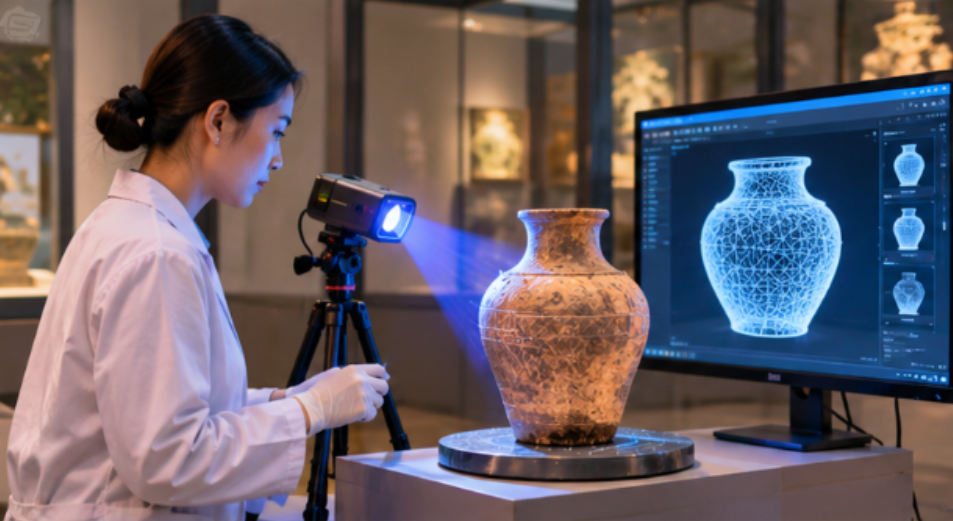
Digitization preserves heritage. Well-organized data turns it into an experience visitors want to stay for. (AI-generated illustration)
What is one more night worth?
For policymakers, the right question is not “how many visitors came?” but “how much does each visitor leave behind?”
In 2025, Quang Tri recorded nearly 9.6 million visits and more than VND 11.04 trillion in tourism revenue, an average of about VND 1.15 million per visit. In the first nine months of 2026, revenue grew 35% while visits grew 17.7%. Spending per visit is rising, and that is a trend worth protecting.
An extra night is more than a room rate. It brings dinner, evening activities, breakfast the next morning, and often one more attraction before departure. That spending goes straight to hotels, restaurants, small businesses, and local workers.

Growing visitor numbers is a marketing question. Growing overnight stays is a question of product and data. (AI-generated illustration)
Within the scope of what digital technology can address, four bottlenecks come up again and again. Tourism information is scattered across too many channels. Heritage sites are often just a brief stop on tours that start elsewhere. Valuable experiences, such as evening visits to historic sites, already exist but are hard for travelers to find and book. And emerging markets, such as Thai and Lao visitors arriving by road, still lack information in their own languages.
No shortage of portals, just no single source of truth
The default response to “smart tourism” is to build a portal or a dedicated destination app. Many provinces already have one. The real question is whether travelers actually use them.
International experience offers a thought-provoking answer. Japan’s official travel app, run by the Japan National Tourism Organization, reached about 2 million downloads by April 2021 but was suspended at the end of September 2023. In South Korea, a survey of 1,232 international visitors found that the apps they relied on most were Naver Map (56.2%), Papago (48.3%) and Google Maps (33.9%), all built by private companies. The Korea Tourism Organization went a step further: it publishes TourAPI, an open data repository of 2.8 million records that Naver, Daum and other apps reuse. In Switzerland, the shared tourism data infrastructure discover.swiss grew from more than 7 million to more than 13 million API requests per month in a single year.
The lesson is clear. Travelers do not want to install a new app for every place they visit. They use the maps, search engines, messaging apps and virtual assistants already on their phones. Tourism authorities should therefore shift their focus from building channels to becoming the source: providing standardized, authoritative data that every channel can use, including the destination’s own portal and browser-based apps.
| Old approach: build channels | New approach: become the source | |
| Investment focus | Portals and standalone apps, each with its own dataset | A standardized, verified data repository shared by every channel |
| How travelers get access | They must find it or install it | Through channels they already use: search, maps, messaging, virtual assistants, browser-based apps |
| Updating information | Re-entered on every channel | Entered once, reused everywhere |
| Role of businesses | Content posters | Partners that use the data to package products |
| When a channel becomes obsolete | Rebuild from scratch | Retire the channel; the data remains |
There is also a regulatory reason. Prime Minister’s Decision No. 1132/QĐ-TTg, dated June 24, 2026, prohibits agencies from investing in platforms that duplicate a national shared digital platform once that platform is operational; until then, existing systems may continue. The national list includes a Tourism Management and Business Platform. That does not leave provinces on the sidelines: Government Decree No. 277/2026/NĐ-CP still allows them to invest in their own platforms, as long as they do not duplicate national ones. A provincial platform should therefore be designed to interoperate, not to replace.
A digital platform for smart tourism: optimizing operations, distribution and visitor experience
FPT proposes a “one data core, many specialized modules” model. Think of it as a central library: every book is catalogued once, then served through different desks for different groups of readers.
The foundation: shared data, governed responsibly
At the center sits the destination’s data repository: attractions, events, services, itineraries, heritage archives and local stories, all standardized and linked together. Data is curated once and reused across every channel and every visitor segment. An outer layer connects bidirectionally with national platforms, so nothing has to be entered twice.
In this model, software is not what matters most. Software can be built, upgraded and even replaced as technology cycles turn. Accurate, complete, clean and current data, by contrast, has to be built up patiently, record by record, through review, cleansing and standardization. When the data is good, every channel, from the official portal and virtual assistant to tour operators, tells the same correct story. When the data is poor, the more modern the system, the faster it spreads errors. Technology comes and goes; data is the asset that stays with the destination.
Heritage data has one more distinctive feature: much of it comes from artisans, historical witnesses and the families of fallen soldiers. Every record therefore needs clear provenance and the consent of the people it concerns. If they withdraw consent, the material must come down. Data here is not just technical infrastructure. It is a commitment to authenticity and to respect for heritage.
Operations: one trusted source for managers and travelers alike
Travelers only plan to stay when they trust the information they receive. Each attraction therefore needs a real-time status layer: open or temporarily closed, busy or quiet. Businesses update prices and offers once through a partner portal, and the Department of Culture, Sports and Tourism reviews content before it goes live. For caves and ecologically sensitive sites, travelers see available time slots and remaining capacity at a glance, then book through licensed operators. When authorities declare a natural disaster, the platform switches to emergency mode: it publishes only official bulletins, pauses promotion, and announces reopenings only after the managing authority confirms them. Existing tourism channels, including the Quang Tri Smart Tourism Portal, are consolidated into a single point of contact.
Experience: AI-personalized discovery journeys
The same heritage site means different things to different visitors. Pilgrims need ceremony schedules and crowd alerts. Students need stories that are easy to follow. International visitors need content in their own languages. The province’s virtual assistant can answer questions, tell heritage stories and suggest itineraries based on available time, interests and starting point. A traveler interested in the Truong Son Road, for example, could receive a route connecting related sites, complete with archival material and visit times.
Imaging technology opens new ways to tell these stories. At the 17th Parallel, international visitors could compare wartime archival photos with the landscape as it looks today. One condition is non-negotiable: the province’s AI answers only from its verified data repository, never invents historical details, and always tells users they are talking to an AI. In the longer term, once the National Virtual Assistant is operational, the province’s tourism assistant can be customized on top of it rather than built separately.
Distribution: turning stopovers into sellable journeys
An attractive destination is not automatically an attractive tourism product. Drawing on the data core, the platform bundles scattered experiences into multi-day itineraries by theme, duration and starting point. Open data makes it easier for search engines and virtual assistants to cite the destination’s information accurately.
More importantly, itinerary data is shared with tour operators so they can package it into tours that include overnight stays. Booking, ticketing and payments are funded and run by businesses, which connect to the platform. Around the Hien Luong – Vinh Moc – Quang Tri Citadel heritage cluster, the province could combine daytime visits with evening activities and accommodation in the area.
New markets offer real headroom. According to nationwide data from NAPAS, the number of cross-border QR payment transactions by Thai, Lao and Cambodian visitors in Vietnam grew eightfold in the first eight months of 2026 compared with the same period in 2025. Thai-language guidance on crossing at the Lao Bao International Border Gate, combined with self-drive route maps, could help the province get ahead of this segment.
Experience: the digital destination passport
Information alone is not enough. Travelers need a reason to keep going. With a digital destination passport, visitors scan a code at each site to collect a digital stamp, earn points toward themed collections, and redeem offers at participating hotels and restaurants. One collection might link the Hien Luong – Ben Hai riverbanks, the Vinh Moc Tunnels and the Quang Tri Citadel. Evening visits to Hien Luong or the Truong Son National Martyrs’ Cemetery could also become stages in a collection, tied to an overnight stay nearby. Points are higher in the low season. And every check-in also becomes data: in aggregate, it shows the destination which sites travelers visit and when, so it can refine products and manage visitor flows.
The approach has precedents. The Camino de Santiago pilgrimage route in Spain has offered a digital pilgrim credential since 2021, and Japan’s MY JAPAN RAILWAY program features more than 900 digital stamps at railway stations. At solemn sites such as martyrs’ cemeteries, a code of conduct appears the moment a visitor checks in.

Travelers don’t need another app. They need one more reason to stay. (AI-generated illustration)
Risks to plan for
A public data platform is not just a technical project. Decision-makers need to see the risks, and how to control them, from the design stage.
| Risk | Mitigation |
| Data becomes outdated or wrong, with no one maintaining it | A single lead agency curates and reviews content; operating rules are formally issued; update frequency is tracked as a KPI |
| Duplicating a national platform | Build the interoperability layer from day one; reuse data already on national platforms instead of re-entering it |
| Dependence on a single channel or module | Channels and modules are decoupled from the core; retiring one module does not affect the rest |
| Losing control of the data | The platform and the data generated through its operation are owned by the province |
| The virtual assistant gives wrong answers | AI answers only from the verified repository; users are told they are interacting with AI |
| Breaches of personal data or community archives | Personal data is processed in line with the law; a digital consent ledger lets artisans and martyrs’ families withdraw consent and have material removed |
| Spreading the budget too thin | Booking, ticketing and payments are funded by businesses; new modules launch only when there is a clear user group and need |
Start small, measure rigorously, then scale
A digital tourism platform should be judged by its economic impact, not just by the number of digitized records, downloads or page views. Those figures show that the system is running; they do not show what value it creates. The expected impact chain is simple: consistent information helps businesses sell multi-day itineraries; travelers visit more sites and stay more nights; spending rises accordingly. But this chain needs to be proven, not assumed.
The sensible path is step by step:
1. Appoint a lead agency. Assign one body to curate, review and operate the platform, backed by formal operating rules.
2. Build the data core and consolidate channels. Standardize data on attractions, services and events; bring existing portals under a single point of contact.
3. Pilot in one heritage cluster. Choose a cluster with real potential to hold visitors overnight, and bring tour operators and accommodation providers on board.
4. Measure with a sound methodology. Set a baseline year; track the share of overnight visitors, nights stayed, average spending and sites visited per trip; in parallel, track data update frequency and the accuracy of operational information; distinguish overnight visitors from same-day visitors using international tourism statistics standards; compare before and after, and against sites that have not adopted the model, with error estimates.
5. Scale with conditions. Add a new module only once the user group, the feature they need, the channel they use, and most of the required data in the core are all in place.
This approach gives the province evidence before it commits to larger investments.
Five questions to ask before investing
Technology is necessary, but not sufficient. A strong data core only delivers when the data is cared for, someone is accountable for it, and businesses turn it into products people will buy.
Before investing in a smart tourism platform, local leaders can ask themselves five questions:
1. Are we investing in channels, or in data?
2. Who is accountable for keeping the data accurate and up to date?
3. Does the platform interoperate with national platforms, or duplicate them?
4. Does the province own the data and the platform?
5. Will we measure success by downloads, or by overnight stays and spending?
If the answer to all five is clear, data becomes more than a promotional tool. It becomes a lasting asset for the destination, turning heritage value into economic value, one night at a time.
Technology does not replace the intrinsic value of heritage. It helps that value connect, be retold and reach further in new ways.
That is how digital transformation in tourism moves from digitizing resources to creating experiences, from promoting destinations to developing products, and from growing visitor numbers to growing the value of every journey.
| FPT Expert Insights
By Le Ngoc Anh – Sales Director, akaVerse Center, Government Division, FPT IS, FPT Corporation |
This article is adapted from the author’s presentation at the conference “Digital Technology Driving Quang Tri’s Economic Development” on October 23, 2026. Data as of October 2026.
References
1. Báo Văn hóa (25/9/2026), Quảng Trị sẽ làm gì để khách ở lại lâu hơn và chi tiêu nhiều hơn.
2. Sở Văn hóa, Thể thao và Du lịch tỉnh Quảng Trị (07/10/2026), Quảng Trị: Chuyển đổi số hướng đến những giá trị thực chất. [Ghi chú: số liệu số hóa trong bài đã điều chỉnh theo báo cáo của Sở nêu tại hồ sơ Đề án; đề nghị kiểm tra tài liệu này còn được sử dụng trong bài hay không.]
3. JNTO, Web và mạng xã hội – thông báo tạm dừng Japan Official Travel App.
4. Dailian (05/3/2024), Khảo sát du khách quốc tế của Bộ VH-TT-DL và Tổ chức Du lịch Hàn Quốc.
5. Ajunews (29/7/2024), TourAPI của Tổ chức Du lịch Hàn Quốc.
6. discover.swiss, Báo cáo thường niên 2024.
7. Quyết định số 1132/QĐ-TTg ngày 24/6/2026 của Thủ tướng Chính phủ.
8. Nghị định số 277/2026/NĐ-CP ngày 09/7/2026 của Chính phủ về hạ tầng văn hóa số.
9. VietnamPlus (25/9/2026), Thanh toán QR xuyên biên giới mở rộng dư địa cho du lịch, bán lẻ.
10. Camino de Santiago Consumer (02/6/2021), Credencial digital del peregrino.
11. Dentsu-ho (23/10/2023), MY JAPAN RAILWAY.