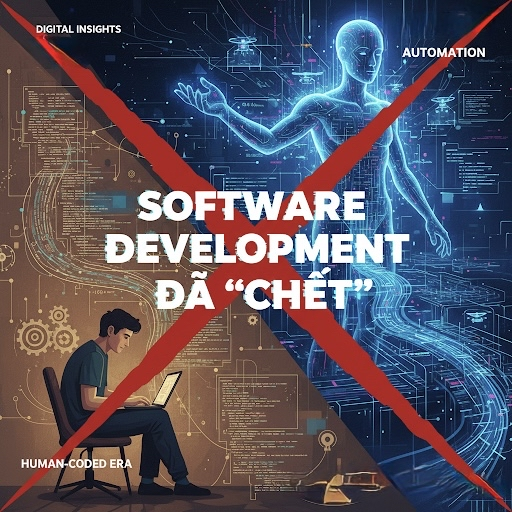
Software Development is “dead”
For more than four decades, the technology industry has operated on one assumption: source code is a scarce asset and programming is a highly refined craft. But the emergence of AI Agents is overturning everything. What we are witnessing is not simply a new tool, but the end of an era and the beginning of a revolution in the software industry.
-
The beginning of the end
For more than four decades, the software industry was built on an assumption that was almost never challenged: code is scarce.
This model was deeply manual in nature. The value of software depended directly on the individual capabilities of engineers: abstract thinking, years of accumulated experience, and deep domain knowledge. Writing correct, efficient, and scalable code was not only a technical skill, but also the fortress protecting professional status and the economic value of technology talent.
However, a new reality is gradually being established in the daily operations of the industry:
Software Development, understood as humans directly building software, is entering an irreversible period of decline.
This is not a future prediction. It is an operational reality already taking place.
Recently, the engineering community began paying attention to a technique informally called “Ralph” – AI Agents placed in deterministic loops to build large systems from lists of small tasks. Ralph’s rapid spread reflects an important fact: AI is no longer merely a coding assistant, but has begun participating directly in the process of creating software.
However, Ralph is only the beginning. Those who have worked deeply with AI for extended periods understand that far more sophisticated techniques are already being used, not only to build small applications, but to recreate software development capabilities at organizational scale within timeframes measured in hours.
-
The blind spot: obsession with tools, neglect of process
Most current discussions still revolve around choosing AI models: which model is stronger, faster, or smarter. These questions are not wrong, but they are no longer decisive.
Reality shows that outcomes are determined by process, not by the model itself.
This principle has long been familiar in traditional software development: a “good enough” team with a clear process often creates more sustainable products than a brilliant individual working without structure. With AI, this rule has not changed, it has simply become clearer and more unforgiving. A “good enough” model operating within a well-designed process will always outperform a cutting-edge model running in a fragmented workflow.
One truth rarely discussed openly is that many of today’s most effective agentic techniques have not been widely shared. The reason is not selfishness, but the disruptive nature of these methods. Their ability to restructure how organizations build software is too significant, too rapid, and too destabilizing.
Tools such as Ralph are reasonable starting points, but they remain limited. Believing that AI can determine task completion solely through token loops means only seeing the surface layer of the picture.
Over the next one to two years, the industry will witness a transition from “Coding Agents” to “Agentic Infrastructure for Coding.”
-
The collapse of barriers and the redefinition of professions
In finance, problems such as insider trading detection, tracking the behavior of major investors, or forecasting market volatility once required highly specialized and extremely expensive tools, with the Bloomberg Terminal being a typical example. Bloomberg is powerful, but also outdated in user experience, cumbersome to use, and very costly. Now, a focused analytics system tailored to specific needs. For example, prediction market platforms such as Polymarket, can be built within hours using AI, without humans writing or reviewing code in the traditional sense.
The issue is no longer whether something can be done, but whether it is worth spending additional resources to do it.
Such statements naturally invite skepticism. That is why many open-source projects are being built to demonstrate that this is not hype. Complex accounting systems, supporting multiple companies, countries, currencies, and accounting standards such as US GAAP, once required large teams and months of development. Now they can be built in very short periods using the right process and “good enough” AI. This can be achieved without state-of-the-art tooling, without proprietary secrets, but simply by applying fundamental principles correctly.
If one individual can recreate software products worth tens of thousands of dollars per month within hours, then the real question becomes: what does Software Development still represent?
Programming was once a craft requiring years of training. Now, the barrier to entry is fading rapidly. People without deep technical backgrounds can still build software systems good enough for practical use through effective interaction with AI.
-
The migration and the next evolution
What is truly ending is not Software Engineering, but Software Development in its old meaning. The role of engineers has shifted from building software to designing systems: focusing on creating processes, building mental models for AI, guiding behavior and functionality, and absorbing new technologies at extremely high speed. Forty years of best practices are not disappearing, but they can no longer be applied unchanged. A single individual with the right skills today can handle workloads that once required entire teams.
The software industry is entering its own Industrial Revolution. Software is shifting from scarcity to abundance, from handcrafted products to commodities. Like previous industrial revolutions, this transition carries deep economic consequences that are still not fully understood.
In traditional SI and outsourcing models, enterprise value is tightly linked to workforce scale, contractual delivery capability, and control over schedules, costs, and compliance. This model assumes execution capability is a scarce resource. AI Agents are breaking that assumption.
When most implementation activities can be automated or massively accelerated, customers are no longer simply purchasing “implementation manpower.” Instead, they are buying:
• The ability to transform business requirements into stable operating systems
• The capability to manage risk, compliance, and long-term accountability
• The ability to operate and evolve systems after go-live
For large SI enterprises, core value must shift from “delivery capacity” to “operational accountability.” Companies that continue positioning themselves mainly as “execution providers” will face increasing pressure on profit margins. Companies that reposition themselves as operational and accountability partners will maintain long-term relevance.
AI Agents are not well suited for fragmented operating models with multiple handoffs, which remain common in large SI organizations. In this new context, enterprises need to shift toward a Project-to-Product mindset:
From: organizing around projects, contracts, and manpower; multiple layers of management; measuring effectiveness based on progress and workload.
To: organizing around systems and operational lifecycles; small teams with end-to-end ownership; measuring effectiveness based on stability, adaptability, and risk control.
-
Conclusion
The software industry is not disappearing, it is transforming itself.
The death of Software Development in its old meaning is not a loss, but a prerequisite for a new era to begin. Software engineers are not being replaced, but they are being forced to evolve: from code writers into system designers, from craftsmen into architects of automated processes.
The question is no longer “Will AI replace programmers?”, the real question is: “Which side of the transition are you on?”
|
Exclusive article by an expert from FPT IS, FPT Corporation Vo Ta Nhat Anh – Solution Architect. Expert in system design and strategic digital transformation consulting based on AI and Agentic Infrastructure platforms. |