AI integrated with BIM for automated review of construction dossiers – A new direction for Digital Urban Governance
For many years, applying for a construction permit has remained a complex procedure for both citizens and businesses. A typical construction dossier includes multiple technical drawings, explanatory documents, and planning indicators. Regulatory authorities must review each component against numerous codes and standards. This process is time-consuming and heavily dependent on manual assessment by domain experts.
BIM – A digital foundation for building information
In the context of rapid urbanization and a growing number of construction projects, many countries are exploring technology-driven solutions to automate construction permit reviews. One of the most promising approaches is the integration of Building Information Modeling (BIM) with Artificial Intelligence (AI).
BIM, or Building Information Modeling, represents a digital model of a construction asset. Instead of relying on fragmented drawings, BIM creates a comprehensive 3D model that encapsulates geometry, materials, structural components, and technical parameters. This effectively provides a “digital twin” of the building, enabling more efficient validation and analysis.
Globally, BIM has been widely adopted across design, construction, and facility management. Countries such as Singapore, the United Kingdom, South Korea, and Finland have taken this further by using BIM models as structured input for automated compliance-checking systems. When project owners submit BIM-based dossiers, software systems can automatically analyze and validate them against regulatory requirements, identifying non-compliant elements.
In Vietnam, BIM adoption is also gaining strong momentum. The government has issued a roadmap for BIM implementation in construction activities, initially targeting large-scale and publicly funded projects. In the coming years, BIM is expected to become a critical data platform underpinning the digital transformation of the construction sector.
Applying AI to BIM-based construction permit review
Once construction data is digitized through BIM, AI can be leveraged to automate dossier validation. AI systems are capable of parsing model structures, recognizing building elements such as walls, doors, stairs, corridors, or technical systems. Based on this understanding, the system can compare project parameters against current regulatory frameworks.
For instance, it can automatically verify planning indicators such as building density, height restrictions, and setback distances. In terms of safety compliance, AI can evaluate the number and positioning of emergency exits, corridor widths, and evacuation distances. For fire safety systems, the software can assess the placement of equipment and escape routes in accordance with technical standards.
Benefits and potential for digital urban governance
One of AI’s key strengths lies in its ability to evaluate multiple criteria simultaneously. While manual reviews may take days or even weeks, automated systems can process an entire BIM model within minutes. Results are presented in a structured and transparent manner, clearly indicating which criteria are compliant and which require adjustment.
The application of AI in construction permit review also enhances transparency. Citizens and businesses can receive detailed reports outlining technical issues within their submissions. This clarity streamlines the revision process and reduces the need for repeated resubmissions.
For regulatory authorities, such systems function as intelligent technical assistants. AI can handle repetitive, rule-based checks, allowing experts to focus on more complex assessments. As a result, administrative processing times can be significantly reduced.
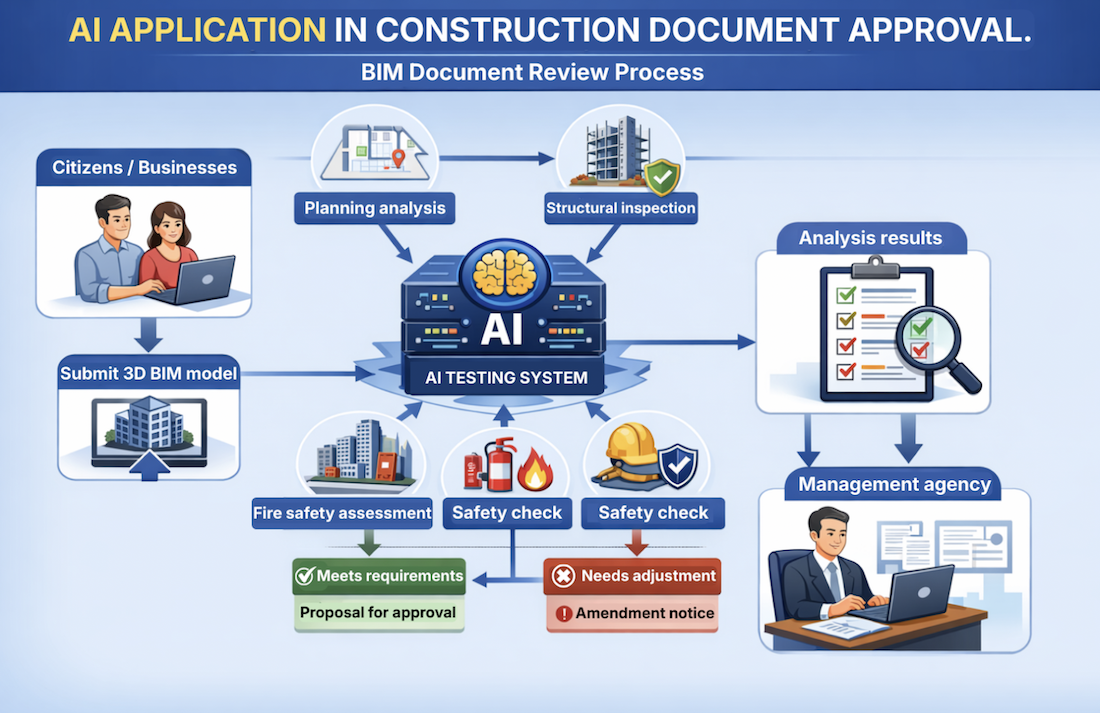
The process of reviewing construction documents is based on AI support.
Another advantage of automated validation systems is their flexibility in adapting to regulatory changes. Instead of retraining personnel on updated procedures, authorities can simply update the rule engine, enabling immediate application to subsequent submissions.
If deployed at a wide scale, this model could fundamentally transform the interaction between applicants and regulatory bodies in the permitting process. Citizens could submit BIM models online, AI systems would perform preliminary validation and provide instant feedback, and authorities would then review and approve based on system-generated insights.
The convergence of BIM and AI is increasingly seen as a key enabler of modern urban governance. When building data, planning data, and digital public services are interconnected, the construction permitting process can become faster, more transparent, and more accurate.
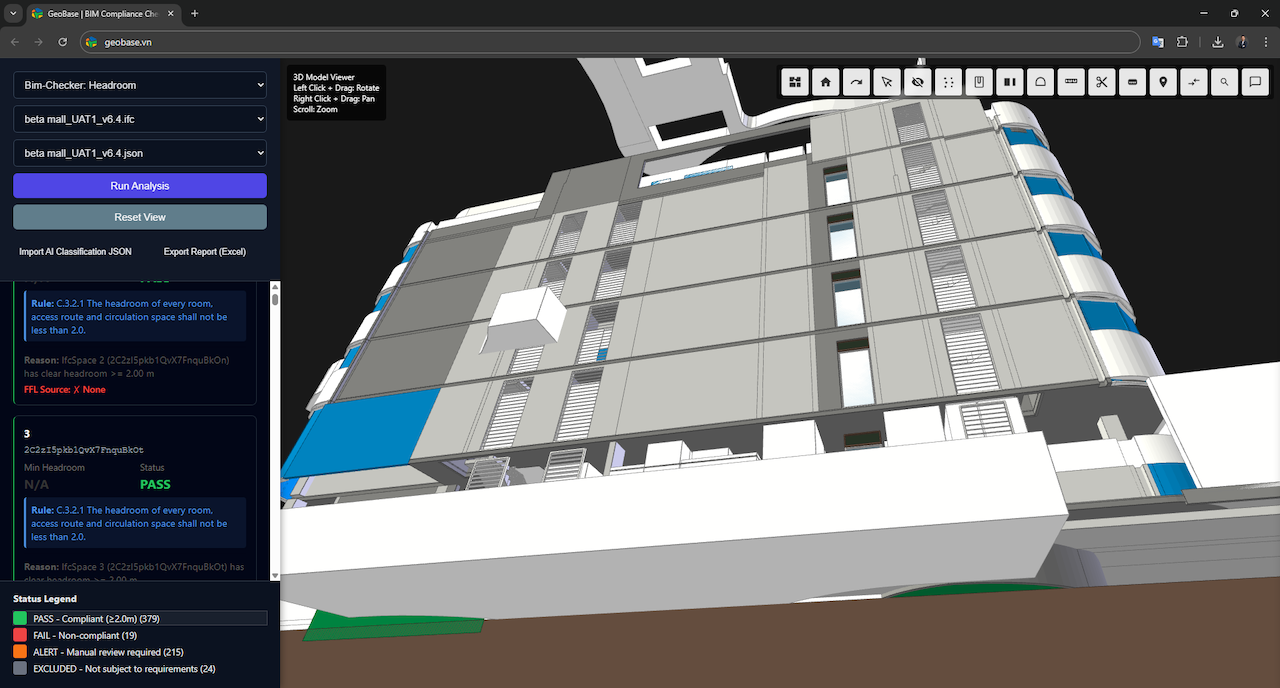
The AI-powered automated BIM model verification system that FPT is deploying for its customers.
In the context of Vietnam’s broader digital transformation agenda, applying AI to automate BIM-based construction dossier review is expected to significantly enhance governance efficiency while simplifying procedures for both citizens and businesses involved in construction activities.
See more information about the solution at
| Exclusive article by an expert from FPT IS, FPT Corporation
Author: Pham Xuan Truong Product Director, GeoBase Cloud, FPT IS Co., Ltd. Master’s degree in Remote Sensing and Geographic Information Systems (GIS). Over 10 years of experience in the GIS field, leading the development of multiple critical GIS systems for the Natural Resources and Environment sector. |