Vietnam Banks Association Officially Launches Pilot of Trade Finance Registry Platform
On March 23, 2026, in Hanoi, the Vietnam Banks Association (VNBA) convened a meeting of the Working Group for the implementation of the Trade Finance Registry (TFR) platform project, officially launching its pilot phase. At the event, Ms. Nguyen Hong Oanh, Product Director of TradeFlat at FPT Corporation, shared insights and perspectives on the development of TFR infrastructure in Vietnam.
The meeting was chaired by Dr. Nguyen Quoc Hung, Vice Chairman and Secretary General of VNBA. Participants included Mr. James Attwood, Growth Gateway Programme Advisor for Asia (UK Government); representatives from eight member banks—Agribank, MB, Vietcombank, VietinBank, BIDV, Techcombank, VPBank, and Standard Chartered; consulting firm Boston Consulting Group (BCG); and international and domestic technology partners such as Traydstream, MonetaGo, FPT, SumSub, and Lloyd’s List Intelligence.

The USD 100 Billion Challenge and the Role of TFR
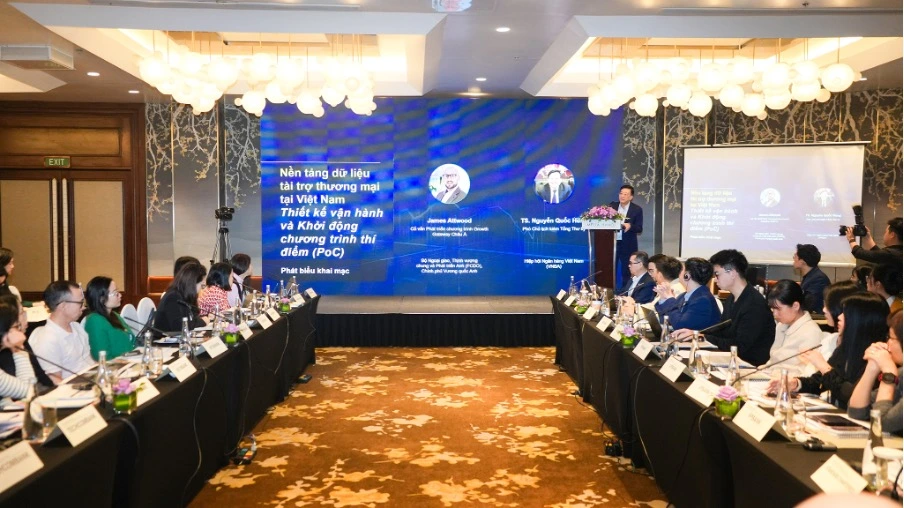
In his opening remarks, Mr. James Attwood noted that while Vietnam is a fast-growing, export-oriented economy, it still faces a trade finance gap estimated at around USD 100 billion. Addressing this challenge requires not only additional capital but also enhanced transparency, strengthened market trust, and an efficient, interconnected data infrastructure among stakeholders.

Mr. James Attwood – Growth Gateway Programme Advisor for Asia (UK Government)
In this context, the TFR is considered a critical infrastructure solution, enabling the establishment of a centralized database for trade finance transactions. This system is expected to help prevent duplicate financing across banks, reduce risks related to fraudulent documents and invoices, and improve access to financing for businesses—particularly small and medium-sized enterprises (SMEs), which account for 97% of all enterprises in Vietnam yet continue to face significant barriers in accessing trade finance.
The project also aligns with Vietnam’s strategic direction to develop international financial centers in Ho Chi Minh City and Da Nang, contributing to attracting global capital flows and enhancing the country’s position in global value chains.
At the event, Mr. Andika Enha from BCG emphasized that TFR is not merely a technology platform but a key component of national digital trade infrastructure. International experience shows that TFR implementation can significantly boost trade credit growth, strengthen risk management, and improve coordination among participants in the trade finance ecosystem.
Legal Framework – A Critical Bottleneck to Address
Dr. Nguyen Quoc Hung stated that VNBA has established a Working Group comprising four specialized teams: overall coordination, trade finance operations, legal and compliance, and information technology. This structure aims to ensure synchronized implementation, balancing practical business requirements with existing legal frameworks and technological capabilities of credit institutions.
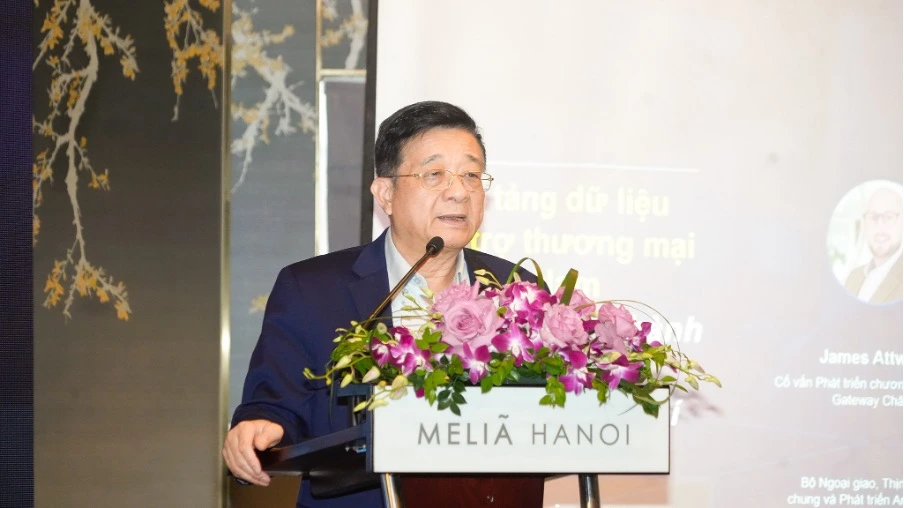
Dr. Nguyen Quoc Hung, Vice Chairman and Secretary General of the Vietnam Banks Association (VNBA), speaking at the meeting.
One of the core objectives is to develop a data-sharing platform among credit institutions to enhance credit appraisal quality and risk control, especially as businesses increasingly engage with multiple banks simultaneously. TFR is also expected to promote factoring activities—a segment with significant growth potential, currently involving only about 16 credit institutions.
Moreover, the transparent data ecosystem enabled by TFR is anticipated to attract international financial institutions to participate in supply chain financing through Vietnam’s banking system.
A key topic of discussion was the legal framework for platform operations. Several aspects require further clarification and alignment, including data connectivity with customs and tax authorities, regulations on data sharing and utilization among credit institutions, and requirements for information security and data protection.
Dr. Hung noted that VNBA has submitted recommendations to the State Bank of Vietnam and relevant authorities to support policy refinement. During the pilot phase, legal and technological issues will be addressed in parallel to ensure readiness for official deployment. He also encouraged member banks to proactively provide feedback based on operational realities, focusing on system integration capabilities, data connectivity and sharing mechanisms, and legal challenges that need resolution.
He expressed confidence that, with close collaboration among member banks, BCG, and technology partners, the TFR project will lay a strong foundation for digital transformation in trade finance, enhancing the competitiveness of Vietnam’s banking system amid deepening global integration.
Training and Live Testing with Technology Partners
Following internal discussions on implementation models, the meeting dedicated significant time to demonstrations and live pilot testing sessions conducted by technology partners.
In the afternoon session, MonetaGo—an experienced provider of duplicate financing prevention systems in international markets—collaborated with FPT to present and test their solution with participating banks.

Ms. Nguyen Hong Oanh, Product Director of TradeFlat, FPT Corporation, speaking at the meeting.
For the TFR platform, FPT is responsible for developing the frontend system for banks, providing cloud infrastructure, and integrating with national platforms as well as third-party systems. This is considered a key differentiator, ensuring the solution meets international standards while being tailored to Vietnam’s market context.
During the session, participating banks conducted proof-of-concept (PoC) testing on the TFR platform jointly developed by FPT and MonetaGo, noting stable performance and fast processing speeds. Positive feedback indicates that the solution not only meets technical requirements but also delivers tangible operational value—particularly in fraud prevention and credit risk mitigation.
FPT’s participation as a domestic technology partner reflects a strategic approach that combines local and international capabilities in building TFR infrastructure in Vietnam, aligned with a long-term vision of supporting the country in developing and mastering strategic technologies.
The session concluded with BCG facilitating a summary of testing results and defining next steps. In the coming phase, stakeholders will focus on discussing the TFR operating model in Vietnam, coordination mechanisms between banks and regulators, and a detailed implementation roadmap.
Source: Vietnam Banks Association
https://vnba.org.vn/vi/hiep-hoi-ngan-hang-viet-nam-chinh-thuc-khoi-dong-thi-diem-nen-tang-co-so-du-lieu-tai-tro-thuong-mai-21234.htm