FPT joins semiconductor alliance, advancing university–industry collaboration
At the launch ceremony of the Semiconductor Alliance held at Vietnam National University, Hanoi (VNU), the FPT representative emphasized that the establishment of the alliance marks an important opportunity for Vietnam to address two major “gaps” in its semiconductor ecosystem, while creating a foundation for universities, research institutes, and enterprises to jointly capture opportunities from one of the century’s most strategic industries.
The Semiconductor Alliance—initiated by Vietnam National University, Hanoi—is designed to advance education, research, and the development of high-quality human resources for the semiconductor industry. The initiative aligns with Resolution 57-NQ/TW of the Politburo on breakthroughs in science, technology, and innovation, as well as Decision No. 1017/QĐ-TTg on the national program for “Developing the semiconductor workforce by 2030, with orientation toward 2050.”
Phase 1 of the alliance brings together more than 20 domestic and international institutions, including major Vietnamese universities such as VNU Hanoi, VNU Ho Chi Minh City, FPT University, and the Vietnam Academy of Cryptography Techniques; leading global institutions such as Sungkyunkwan University (Korea), Kumamoto University (Japan), and HSE University (Russia); along with key semiconductor enterprises including Viettel, FPT, Nisso, and MRIV International. This diverse participation reflects the scale and expectations placed on the future of Vietnam’s semiconductor industry in the coming decade.
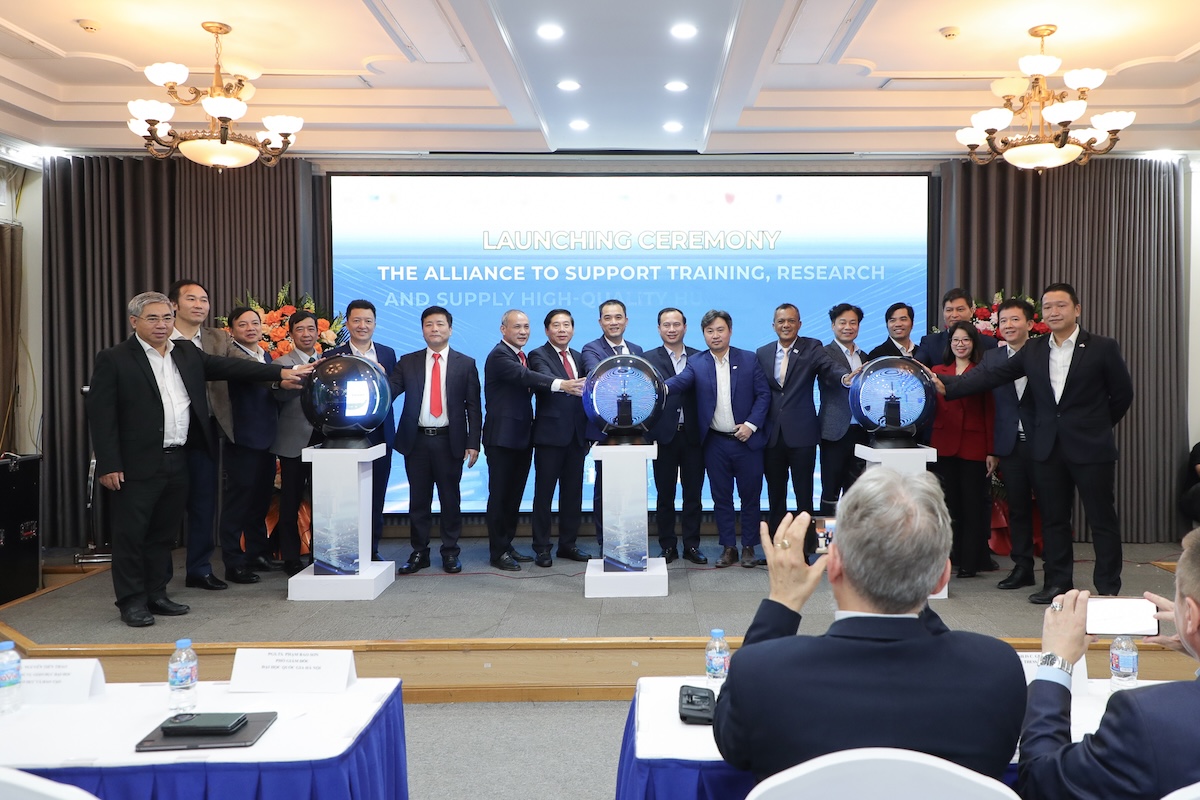
The launch of the alliance supporting training, research, and high-quality talent development for the semiconductor industry
Under the cooperation framework, participating members will connect a network of universities, research institutes, and enterprises domestically and internationally; share laboratories and facilities; support the training of core lecturers; promote technology transfer and the commercialization of research outcomes; and jointly contribute policy recommendations to the Government for developing Vietnam’s semiconductor ecosystem.
Speaking at the event, Nguyen Vinh Quang, Director of FPT Semiconductor, stated that Vietnam’s semiconductor industry currently faces two major gaps slowing its development. The first is fragmented collaboration between universities and enterprises. The second is limited linkage among domestic enterprises themselves, each following “its own path” without forming a collaborative ecosystem like those in leading semiconductor nations. He stressed that the creation of the Semiconductor Alliance is the essential condition to establish meaningful connections and enable all parties to seize upcoming opportunities.
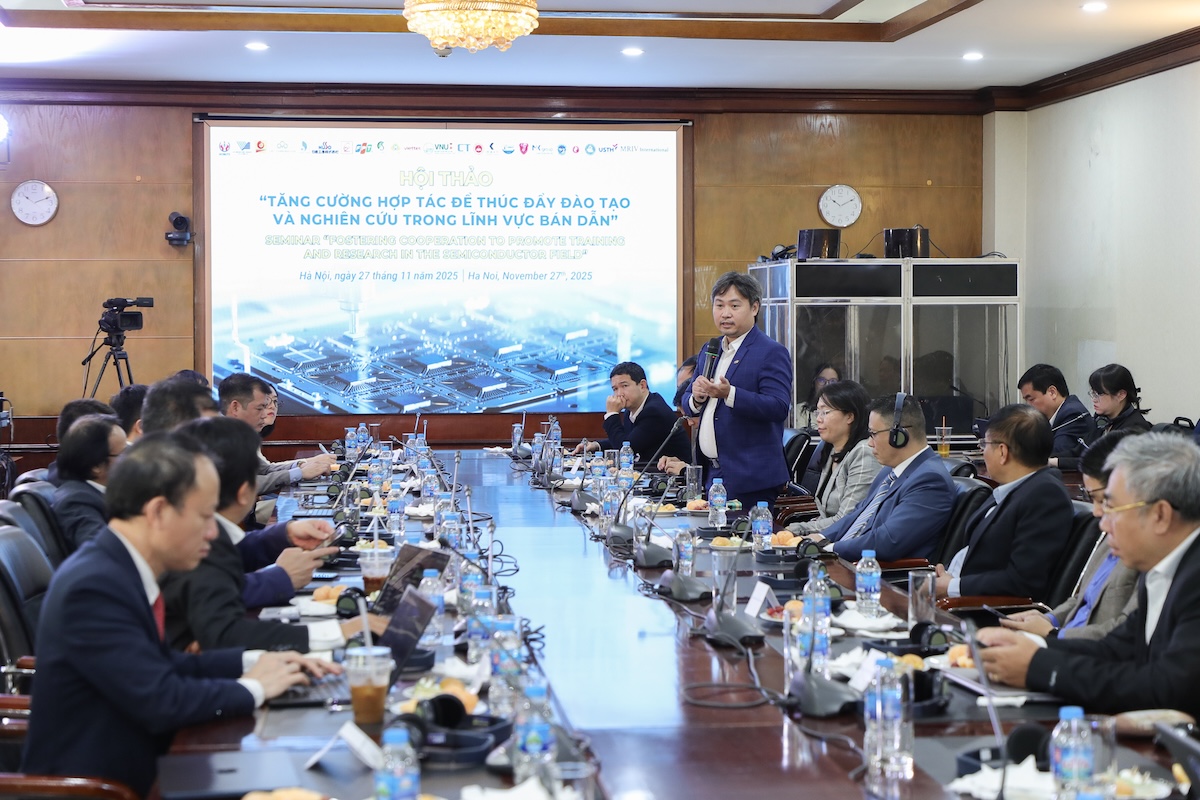
Mr. Nguyen Vinh Quang, Director of FPT Semiconductor under FPT Corporation, shares at the event
Mr Quang expressed confidence that with government support and strengthened collaboration among enterprises and academic institutions through the alliance, Vietnam is well-positioned to gradually master critical stages of the semiconductor value chain and become a strategic destination for the global semiconductor industry in the near future.
FPT reaffirmed its long-term commitment to partnering with universities and research institutes in semiconductor education and technology development. FPT, the Institute for Advanced Materials and Semiconductor Nanotechnology (VNU), and the E3 Lab of the University of Engineering and Technology (VNU) are advancing plans to establish an Innovation Center to develop training programs and provide students and young engineers with hands-on industry exposure. FPT has also launched the Vietnam Semiconductor Incubation and Development Center (V.S.I.C.) in collaboration with the National Innovation Center and partners, creating an environment for high-quality workforce development and semiconductor entrepreneurship.
The company is building a comprehensive training ecosystem, from the bachelor’s program in IC design at FPT University, to the specialized college-level program at FPT Polytechnic, and international programs at BTEC. FPT is also expanding partnerships with top Asian engineering universities, such as Asia University (Taiwan) and Gachon University (Korea)—the first Korean university specializing in semiconductor training—offering “2+2” programs where students study two years in Vietnam and two years abroad, obtaining globally recognized semiconductor engineering degrees. These efforts support FPT’s goal of training 10,000 semiconductor engineers by 2030, contributing to Vietnam’s national target of 50,000.
To participate in the semiconductor race, FPT has nurtured its “Vietnam chip dream” for more than a decade. A major milestone came in 2022, when the company officially established FPT Semiconductor. Within three years, FPT Semiconductor successfully developed PMIC and Power IC product lines fully designed by Vietnamese engineers, with exports to demanding markets such as Japan and Korea.
In the next phase, FPT aims to develop MCU chips, AI-on-Edge SoCs, IoT chips, and automotive chips, gradually building a “Make in Vietnam” semiconductor product ecosystem. In parallel with IC design, FPT is deepening its participation in high-value segments of the semiconductor supply chain, including chip packaging and testing.