FPT accompanies the Ministry of Ethnic Affairs and Religion in piloting the religious database information system for state management
Within the framework of implementing the task of building a database for the Ministry of Ethnic Affairs and Religion (MEAR) for the 2025–2026 period, the Ministry officially announced the pilot deployment of the Religious Database Information System at the Government Committee for Religious Affairs, with the accompaniment of FPT Corporation. This milestone marks an important step in the roadmap to modernize state management of religious affairs, while laying the foundation for the formation of a centralized and unified sectoral data system to effectively support leadership, administration, and policy formulation in the new phase.

The Ministry of Ethnic Affairs and Religion announces the pilot deployment of the Religious Database Information System with the accompaniment of FPT.
Recognizing data as a core foundation playing a decisive role in renewing methods of leadership, administration, and management, and closely following major orientations of the Central Party and the Government—particularly Resolution No. 57-NQ/TW, Plan No. 02-KH/BCĐTW, and Government Resolution No. 71/NQ-CP—together with current legal regulations such as the Law on Belief and Religion and its guiding documents, the Ministry of Ethnic Affairs and Religion, the Government Committee for Religious Affairs, and accompanying enterprises, including FPT Corporation, have actively and urgently developed an implementation plan for the task of building the religious database. The database is required to meet nationwide criteria of being “accurate, complete, clean, live, unified, and shared.”
In practice, prior to the development of this system, the sectoral database on religion had not been established in a centralized and synchronized manner. Data remained scattered across multiple units; information technology infrastructure did not meet requirements; information security systems were only assessed at Level 2; and human resources for information technology were limited. These shortcomings posed significant difficulties in aggregating and analyzing information to support leadership, administration, and policy formulation.

The Religious Database Information System aims to digitize and centrally manage religious data nationwide
The Religious Database Information System has been developed to fundamentally address the above limitations, with the goal of centrally managing data on a nationwide scale. The system contributes to the establishment of a centralized data platform managed and operated by the Government Committee for Religious Affairs, ensuring consistency, accuracy, safety, and security. It enables the digitization, standardization, and integration of information groups serving state management of religion, while supporting data aggregation, statistics, and visualization for centralized and interconnected management nationwide. At the same time, the system is oriented toward development under an open architecture, capable of connecting and sharing data with other information systems of the Ministry and with the National Population Database under the Government’s Project 06. This connectivity helps ensure data consistency, supports data cleansing, and enhances the efficiency of administrative procedure processing in the field of religion. In addition, the system aims to enhance transparency by providing official data on religious organizations, places of worship, and religious activities in accordance with the law, thereby improving the effectiveness of advisory work for specialized units and the leadership of the Ministry and the Government Committee for Religious Affairs, as well as strengthening information dissemination and external relations.

Mr. Nguyen Tien Trong – Deputy Head of the Government Committee for Religious Affairs noted that building a large-scale database within a short timeframe poses significant challenges for both the Committee and FPT.
Mr. Nguyen Tien Trong, Deputy Head of the Government Committee for Religious Affairs, stated: “Building the Religious Database is a difficult task, with a large workload and extremely challenging timelines. However, with the accompaniment of FPT Corporation and the close coordination of specialized units under the Ministry of Ethnic Affairs and Religion, the system has been deployed on schedule in accordance with the Central authorities’ requirements, while ensuring quality. The official pilot deployment of the Religious Database Information System carries both professional significance and important political meaning, laying the foundation for the Government Committee for Religious Affairs and the Ministry to gradually build a fully unified religious database nationwide in the coming period.”
Previously, on December 9, 2025, the Government Committee for Religious Affairs issued a notice inviting organizations and individuals with sufficient capacity and experience to participate in researching, proposing solutions, and piloting the task of “Building a religious database.” Based on the proposals received, FPT Corporation was approved as the pilot implementation unit. Following approval, the Government Committee for Religious Affairs coordinated with FPT Corporation to rapidly develop solutions and demonstrate pilot versions of the Religious Database Information System within an accelerated timeframe. Through the working process, the leadership of the Government Committee for Religious Affairs assessed that the system was developed in a methodical manner, meeting management requirements, featuring an intuitive interface and scientific layout, and proposed the addition of certain statistical contents and map-based displays.
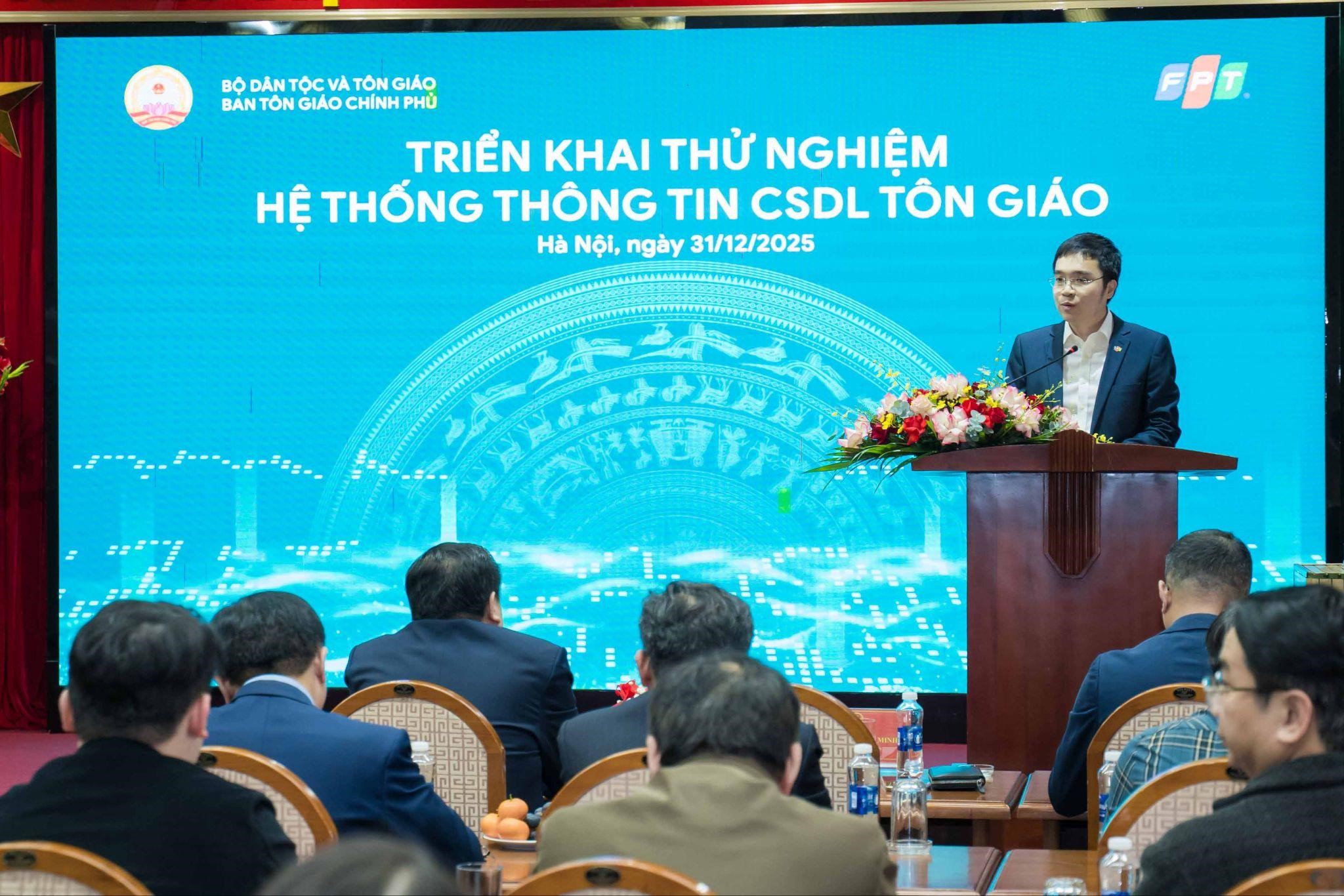
Mr. Nguyen Hoang Minh, FPT, committed to continued close coordination with the Ministry and the Government Committee for Religious Affairs to further the Religious Database Information System and other digital transformation activities.
Representing FPT, Mr. Nguyen Hoang Minh, Chief Executive Officer of FPT IS, FPT Corporation, shared: “With experience in consulting and implementing digital transformation strategies and data strategies for many ministries and sectors, FPT is honored to accompany the Ministry of Ethnic Affairs and Religion throughout the entire process—from comprehensively surveying the current situation to building and refining the Ministry’s digital transformation strategy and database development strategy. The pilot deployment of the Religious Database Information System is a concrete and pioneering outcome that materializes the strategic orientations approved and promulgated by the Ministry. In the coming period, FPT commits to continuing close coordination with the Ministry and the Government Committee for Religious Affairs to further improve and complete the Religious Database Information System in particular, as well as digital transformation initiatives more broadly.”
The announcement of the pilot deployment of the Religious Database Information System demonstrates the strong determination of the Ministry of Ethnic Affairs and Religion to accelerate digital transformation, taking data as the foundation for modern, effective, and transparent governance. This is not only a concrete step in the Ministry’s roadmap toward building a digital government, but also an important premise for enhancing the quality of state management of religious affairs, meeting the requirements of sustainable national development in the new era, and further ensuring the people’s freedom of religion.