FPT supports businesses in accelerating preparations for the electronic labor contract implementation roadmap from July 1, 2026
With only days remaining before the provisions of Decree No. 337/2025/ND-CP and Circular No. 08/2026/TT-BNV are officially implemented nationwide from July 1, 2026, many businesses are urgently reviewing their processes, technology infrastructure, and implementation plans to meet the new requirements for electronic labor contracts. The strong interest from the business community was reflected in the webinar “Electronic Labor Contracts in Compliance with Decree No. 337/2025/ND-CP: From Legal Compliance to Smart HR Operations,” hosted by FPT, which attracted nearly 700 business representatives nationwide and hundreds of questions concerning legal, technical, and practical operational issues.
FPT supports businesses in accelerating preparations for the electronic labor contract implementation roadmap from July 1, 2026
Decree No. 337/2025/ND-CP and Circular No. 08/2026/TT-BNV Establish New Standards for Electronic Labor Contracts
In recent years, alongside the digital transformation of human resource management, electronic labor contracts have attracted growing interest from businesses thanks to their ability to streamline contract signing processes, centralize document management, and improve operational efficiency. However, practical implementation has continued to raise questions regarding legal validity, technical requirements, authentication procedures, and the ability to connect with state management authorities.
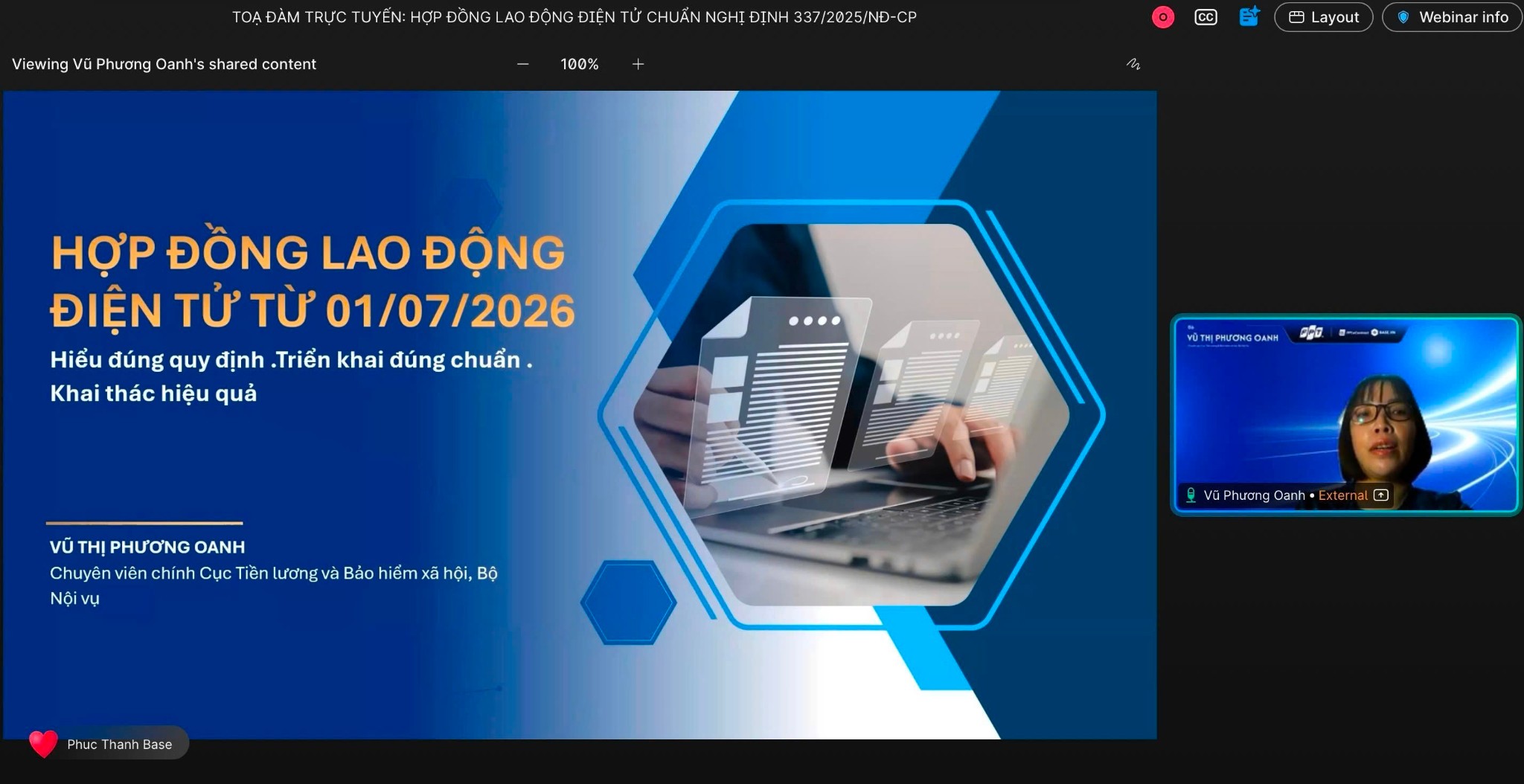
Ms. Vu Thi Phuong Oanh, Labor, Wage and Social Insurance Expert, provides an update on regulations for implementing electronic labor contracts.
At the program, Ms. Vu Thi Phuong Oanh, Labor, Wage and Social Insurance Expert, said that Decree No. 337/2025/ND-CP and Circular No. 08/2026/TT-BNV have helped establish a more complete legal framework for electronic labor contracts, providing clearer regulations on the processes for entering into, managing, and utilizing data in the digital environment.
Accordingly, from July 1, 2026, regulations concerning connection, issuance of identification codes (IDs), and the management and use of the National Electronic Labor Contract Platform will officially take effect. A valid electronic labor contract must meet requirements for identification and authentication of the parties, digital signatures, timestamps, data message certification, and the issuance of a unique ID by the National Electronic Labor Contract Platform. The ID serves as the contract’s “identification number,” supporting regulatory authorities in searching, connecting, and managing data, while not altering the content or legal validity of the signed document.
Ms. Oanh noted that July 1, 2026 marks the nationwide implementation of the new regulations on electronic labor contracts, while businesses can proactively choose an adoption roadmap suited to their scale, operational characteristics, and level of readiness. Early implementation not only enables businesses to proactively adapt to the new requirements but also brings practical benefits to HR management. Once contract data is digitized and centrally managed, businesses can streamline HR processes, reduce manual workloads, lower operating costs, and improve the employee experience through faster and more convenient digital signing processes.
From Business Concerns to a Practical Implementation Roadmap
During the program, many businesses expressed interest in changes to signing procedures after July 1, 2026, requirements for connecting with the National Electronic Labor Contract Platform, the ability to integrate with existing management systems, and the impact on HR operations when transitioning from paper-based contracts to digital processes.
Addressing these concerns, Mr. Nguyen Ta Anh, Deputy Director of the Enterprise Digital Solutions Center, FPT IS, FPT Corporation, said that Decree No. 337/2025/ND-CP has established a unified legal framework, giving businesses a clearer basis for implementing electronic labor contracts. According to him, businesses should not view this simply as replacing one signing method with another, but rather as an opportunity to standardize data and modernize HR management.
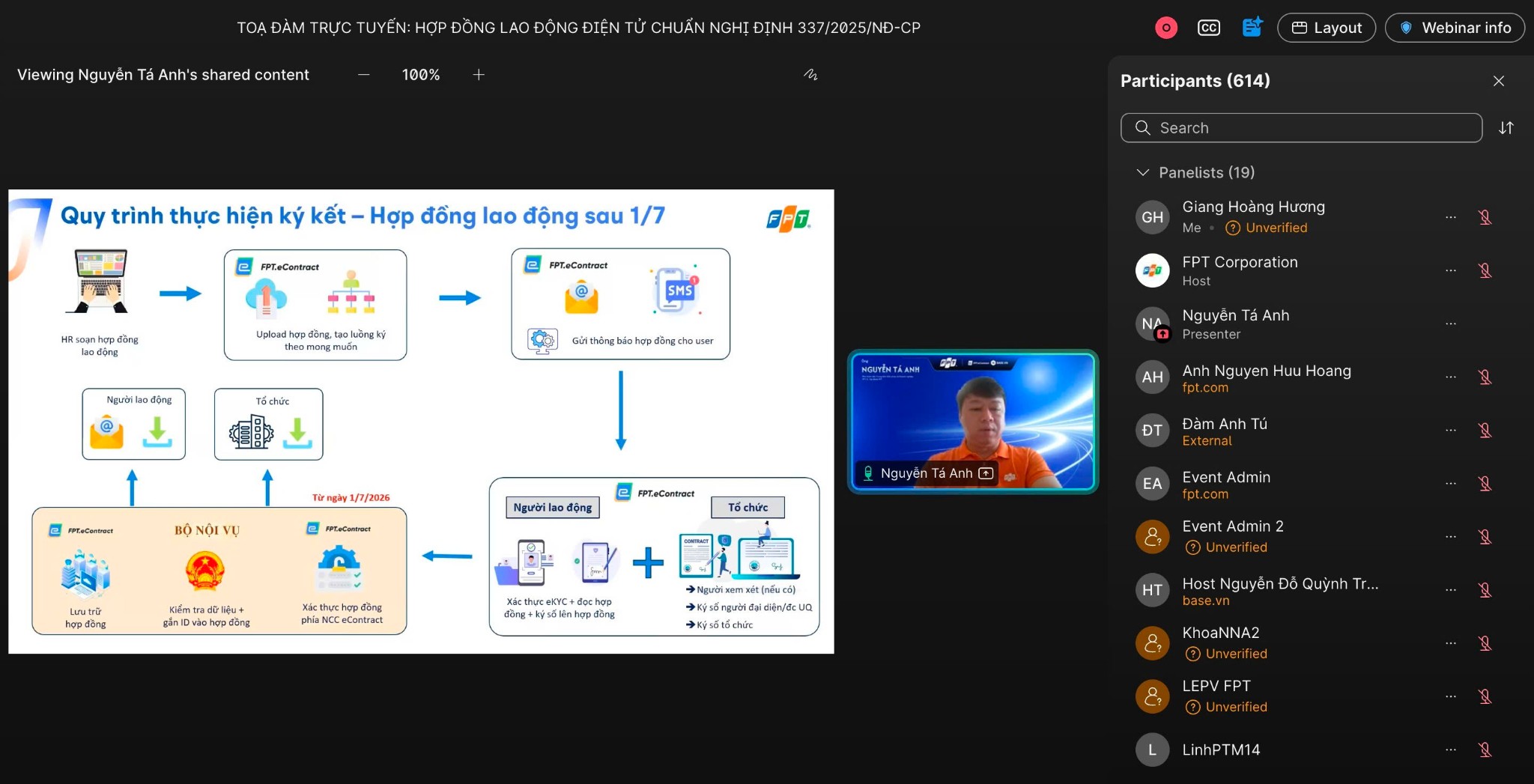
Mr. Nguyen Ta Anh, FPT Corporation, shares key benefits for businesses adopting electronic contracts.
Based on its practical implementation experience, FPT recommends that businesses begin by reviewing their existing processes, assessing data readiness, and developing a transformation roadmap suited to their scale and operational characteristics. With solutions such as FPT.eContract, businesses can configure signing workflows according to their needs, send contracts through multiple channels, conduct digital signing between parties, centrally store contracts, and be ready to connect with the National Electronic Labor Contract Platform in accordance with the new regulations.
Mr. Ta Anh said that implementing electronic labor contracts typically takes between one and 12 weeks, depending on the scale and readiness of each business. In addition to technology, training and user support play an important role during the initial stage of the transition. For businesses with large workforces or employees distributed across multiple locations, systems need to provide sufficient flexibility to enable employees to conveniently access and complete the signing process through multiple channels.
According to implementation data, adopting electronic contracts can help businesses reduce signing time by up to 95% and save approximately 80% in costs compared with traditional paper-based processes. In addition to reducing printing, storage, and delivery costs, electronic contracts allow parties to sign anytime and anywhere, helping improve operational efficiency and employee experience. FPT has worked alongside numerous organizations, including businesses with employees across diverse levels of digital literacy, with solutions designed to provide a convenient signing experience for users.
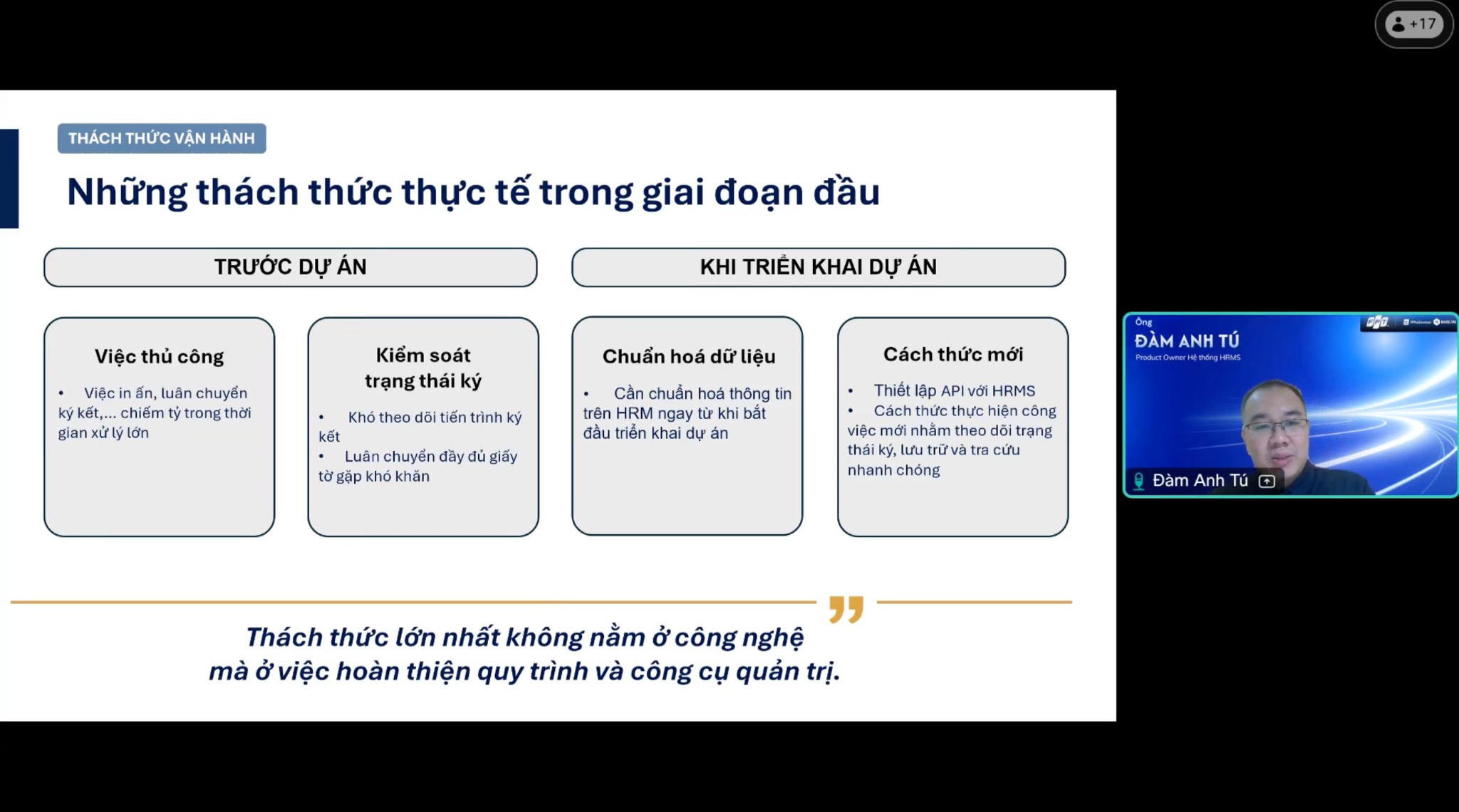
Mr. Dam Anh Tu, Product Owner of the HRMS system, discusses practical barriers businesses face when implementing the new signing method.
From an operational perspective, Mr. Dam Anh Tu, Product Owner of the HRMS system, said the biggest challenge in the transition lies not in technology itself but in completing processes and management tools. Before implementation, many businesses still rely on manual processes such as printing, circulating paper documents, or tracking signing status and storing contracts. When moving to a digital environment, businesses not only need to deploy a new tool but also standardize HR data, adjust operational processes, and strengthen connectivity between the electronic contract system and the HRMS platform, where applicable. According to Mr. Tu, these preparations will enable businesses to make more effective use of HR data while ensuring a smooth and sustainable transition.
Security and compliance are also among businesses’ top concerns. According to FPT, compliant electronic contract solutions such as FPT.eContract need to meet requirements for identity authentication, digital signatures, timestamps, data message certification, information security, electronic record storage and management under Decree No. 337/2025/ND-CP. They should also be ready to connect with the National Electronic Labor Contract Platform and businesses’ existing management systems.
“Decree No. 337/2025/ND-CP is not a barrier, but an opportunity for businesses to standardize HR data and establish a solid foundation for comprehensive digital transformation,” Mr. Ta Anh said.
Toward End-to-End HR Management on a Single Platform
From a management perspective, experts believe that electronic labor contracts should not be viewed as standalone documents but should instead be integrated throughout the entire employee lifecycle.
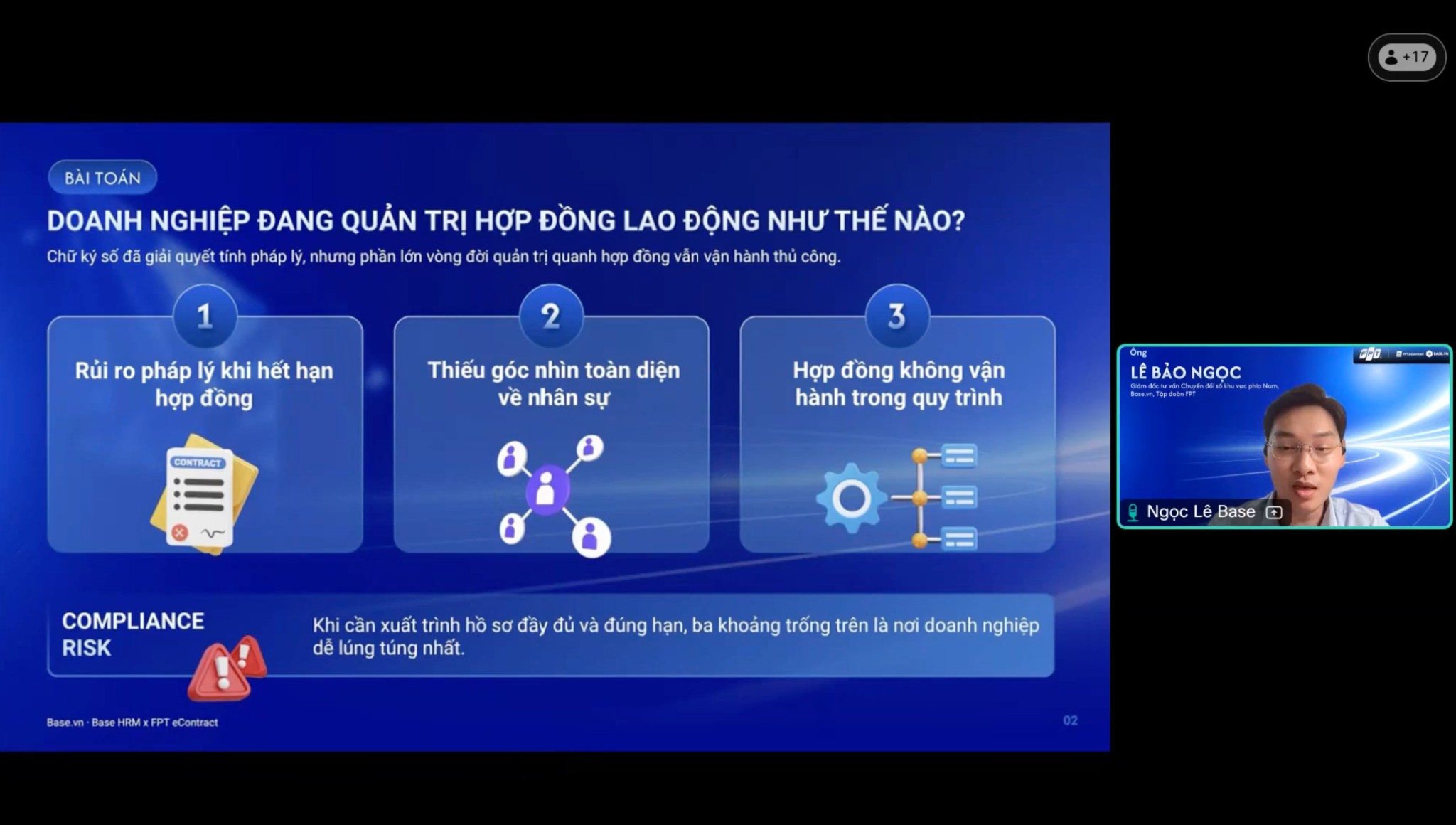
Mr. Le Bao Ngoc, FPT Corporation, discusses direct integration between HR management platforms and digital signing systems.
Mr. Le Bao Ngoc, Director of Digital Transformation Consulting at Base.vn, FPT Corporation, said that synchronizing contracts with employee records can significantly reduce manual tasks and minimize errors in management processes.
By connecting recruitment, probation, official employment, contract renewal, and contract termination data on a single system, businesses can automate multiple operational processes and proactively manage the entire employee lifecycle. In particular, contract expiry alerts enable HR teams to proactively handle renewal procedures and reduce potential risks arising from employment relationships.
Mr. Ngoc also highlighted the ability to directly integrate HR management platforms with digital signing systems. Businesses can configure approval workflows, conduct bulk signing, and manage the entire signing process on a single platform. Employees can also receive notifications and digitally sign contracts through flexible channels such as email, SMS, or Zalo, helping improve the user experience and accelerate digital transformation within businesses.
During the discussion session, hundreds of questions were submitted to the experts, focusing on practical issues such as choosing digital signatures, identity authentication, timestamps, data message certification, and the ability to connect with the National Electronic Labor Contract Platform and existing HRM systems. This demonstrates that businesses are moving beyond simply understanding the policy and are increasingly focusing on specific implementation roadmaps and approaches.
The program’s survey results also showed that more than 91% of businesses wanted to learn more about technology solutions supporting digital transformation. Among these, electronic labor contracts were the most highly sought-after solution, accounting for 59.1% of responses. According to the experts, early implementation not only helps businesses proactively meet the new requirements but also contributes to standardizing HR data, optimizing operational processes, reducing costs, and improving the employee experience. In particular, for businesses already using HR management platforms or digital enterprise management systems, electronic labor contracts can become an important link in building a more seamless and modern management ecosystem.