The final machine is the mind: as software gets cheaper, responsibility gets pricey
A person who can’t code sits with AI for an afternoon and builds a working app. Today, that no longer shocks us like it did a year ago. But if you pause for a moment, it’s still deeply strange.
For two centuries, nearly every major technological leap replaced humans in their limbs. This time, machines are starting to intrude into the realm of thought. Not the entire mind—but enough to shake an old assumption: that cognitive labor is humanity’s final refuge. And when even that last layer is touched, the rules change—for both engineers and the people who pay them.

The 200-year ladder
Looking back at history reveals a rather consistent pattern: every technological revolution tells the same story—machines replace humans in one type of work, differing only in which part they replace.
The steam engine replaced muscle; one worker with a power loom produced as much as many workers before. Electricity and assembly lines replaced repetitive labor at scale—Henry Ford didn’t invent the car; he changed how it was built. Computers replaced rule-based office work: calculation, storage, ledger reconciliation. Look far enough, and the shift becomes clear: machines always move from the rough to the refined aspects of labor. Human strength first, then repetitive operations, then processes describable by rules.
Each time a layer gets automated, humans move up to a higher layer—one requiring more judgment, more understanding, more responsibility. In 1800, most American workers were in agriculture; by the late 20th century, that figure was just a few percent. Farming didn’t disappear, but direct labor demand plummeted, and people shifted to factories, offices, research, and services. For 200 years, that was almost always the escape route: machines get better at the lower layers, humans climb higher.
The problem is, the ladder has a top. And the layer machines are touching now is one we previously assumed only knowledge workers could handle. Not all thinking, but enough to force us to rethink how we create value.
When machines start drafting thoughts
AI doesn’t carry loads, turn wheels, or stand on assembly lines. It reads, writes, reasons, synthesizes, generates code, proposes solutions—and in many cases, drafts the very first version of a decision.
Steve Jobs once called the computer “a bicycle for the mind”: it helps humans go farther and faster, but the person still pedals. AI is different—it’s not just a bicycle; it starts suggesting the route itself. That’s what makes many people uncomfortable. When muscle gets replaced, humans retreat to the mind. So when part of the mind gets replaced, where do we retreat to?
Software isn’t dying—The way we create it is
That’s why I wrote a few months ago that “Software Development is dead.” Many read that as a prediction about the software industry. In reality, it’s just one manifestation of a much larger movement.
Software isn’t the only field affected. It’s simply where we see most clearly what’s happening: the cost of turning ideas into intellectual products is dropping at unprecedented speed.
That question leads straight to the real meaning behind what sounds like a sensational claim. Software isn’t becoming unimportant—on the contrary, it’s more critical than ever. What’s changing is the cost of creating it.
The part that once made an engineer’s value scarce—the ability to translate requirements into code—is plunging in price rapidly. In a controlled Microsoft Research experiment, teams using GitHub Copilot completed a specific programming task (building an HTTP server in JavaScript) 55.8% faster than teams without it.
That number doesn’t prove AI can replace engineers; it shows the “code generation” layer is being accelerated dramatically.
This commoditization isn’t happening uniformly. Software with repetitive structures and clear requirements gets hit first. Systems requiring extreme reliability, complex business constraints, or intricate operations change more slowly. But even there, the cost of producing lines of code is falling.
Just as when the power loom appeared, fabric didn’t lose value—the skill of hand weaving did.
Translate this into financial language for business leaders: what you once paid a premium to own is becoming a commodity. And whatever becomes common sooner or later ceases to be a competitive advantage. Advantage shifts elsewhere.
The 1-Man Module: one person owning a slice of value
Previously, a sufficiently large scope usually required many people: requirements analyst, designer, backend developer, frontend developer, tester, reviewer, operator. AI isn’t making those roles disappear, but it collapses many of the operations within them into the hands of one sufficiently skilled person.
One person, if they understand the problem correctly and know how to use AI, can quickly build a prototype, write most of the code, generate test cases, read logs, find bugs, write documentation, even create a demo for stakeholders. Tasks that once required a small team now orbit around one person.
But here’s where misunderstanding easily happens. A 1-Man Module doesn’t mean one person doing everything haphazardly. It means one person fully owning a slice of value—from understanding the problem, creating the solution, validating it, to operating it.
AI helps that person move faster. But what keeps that speed from becoming chaos is the harness.
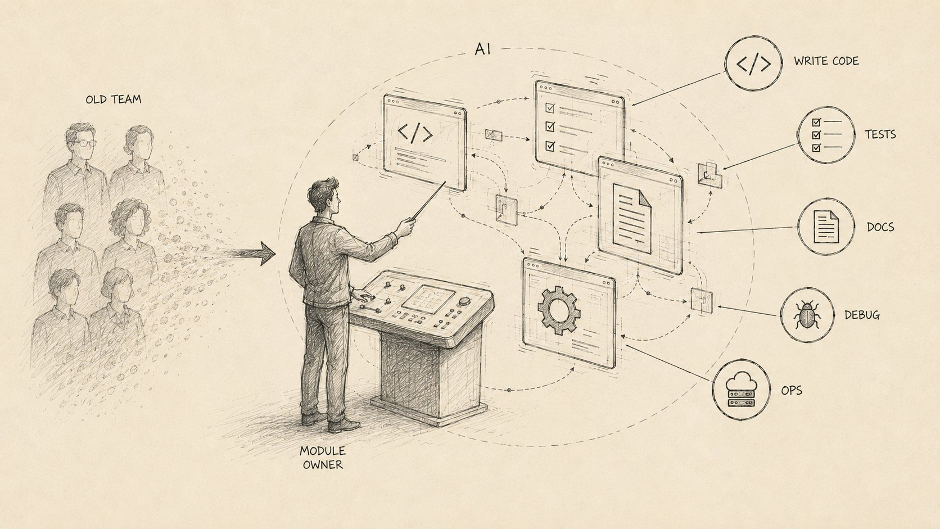
The old team dissolves into one person. That person doesn’t do less—they decide more.
Harness: Turning Speed into Reliability
I’ll temporarily call that part the harness—the entire mechanism that turns AI’s speed into reliable outcomes.
Imagine a car for clarity. The engine is the most powerful part, but placing an bare engine block on a road gets you nowhere. You need a steering wheel to drive, brakes to stop, seatbelts to protect, a chassis to bear load—only then does the engine’s power become a car that drives on real roads.
AI is the engine. The harness is everything else in the car. Specifically, it’s the control framework around AI and around the module: testing, guardrails, code conventions, review rules, deployment pipelines, monitoring, rollback mechanisms when failures occur, security checks, acceptance criteria.
Without a harness, AI just increases the speed of generating garbage. With a harness, AI becomes an amplifier.
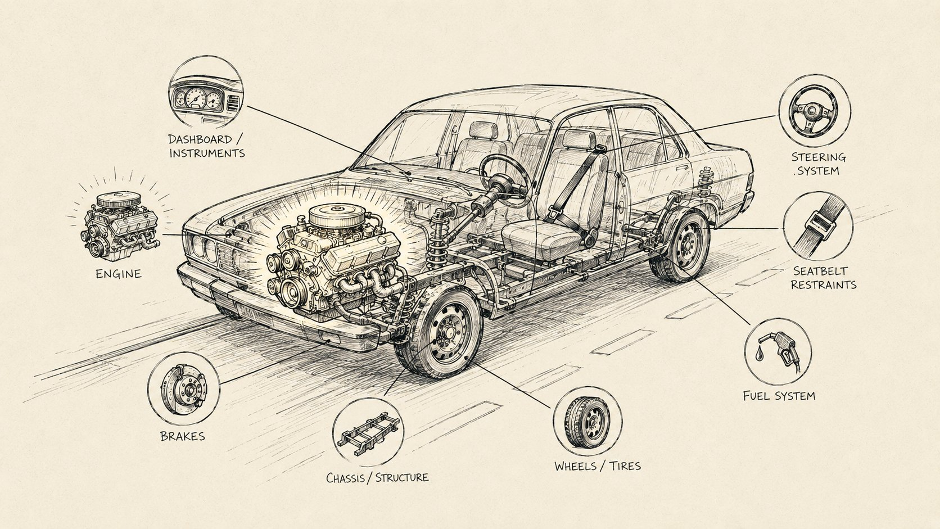
Everyone can buy the same engine. The difference lies in the rest of the car.
This is also why the debate over “which model is stronger” often misses the point. With the same AI and the same problem: someone without a harness produces an interface, an API, a few green tests—looks like it works. Someone with a harness limits scope, separates guesswork from what must be absolutely accurate, plugs in clean data, verifies, then deploys via a traceable process. Two products look identical in a demo, but only one survives the first month of operation.
AI is getting better at producing solutions. But it still depends on the quality of context provided. In many organizations, the bottleneck is no longer whether a solution can be written, but whether the problem to solve is understood correctly, operational constraints are understood correctly, and the consequences of each choice are understood correctly.
That’s why domain expertise, system intuition, and real-world operational experience remain irreplaceable assets.
In other words, the engineer’s future isn’t sitting and writing lines of code faster than AI. It’s designing systems so AI creates software within a safe boundary, with validation, with accountability. AI generates the draft; the harness turns the draft into something trustworthy; humans take responsibility for the entire loop.
There’s a curious linguistic detail that fits this story oddly well. Many people think the word engineer comes from engine—the machine. But both trace back to a deeper Latin root: ingenium, meaning intelligence, cleverness, creative capacity. The engineering profession at its root has never been just about writing code or operating machines; it’s about using intelligence to solve problems. AI is taking away part of the “machine,” and pushing humans back to exactly the “mind” part.
Humans plus machines, not humans versus machines
Chess is the clearest example. When Deep Blue defeated Garry Kasparov in 1997, many believed human chess was over. It didn’t happen. Kasparov reached a different conclusion: the strongest future isn’t humans versus machines, but humans plus machines—he essentially said machines don’t make humans obsolete; human complacency does.
That’s not comfort; it’s a warning. Clinging tightly to old skills means losing; knowing how to use machines to elevate judgment means still having a chance.
But to know where to add machines, you must avoid the two extremes everyone easily falls into: one side thinks AI replaces everything immediately, the other thinks it’s just hype that will pass. Both can be wrong.
Roy Amara has a memorable quote: we tend to overestimate technology’s impact in the short term and underestimate it in the long term.
In the short term, many demos create illusions—look intelligent but break when facing real data, real users, real constraints. Long term, when AI embeds into processes, tools, hiring practices, productivity measurement, and decision-making, its impact is far deeper than a few demonstrations.
So the right question isn’t “Will AI replace engineers?” but rather: which parts of an engineer’s work will get commoditized first, and which will become scarcer?
The answer is becoming clear. Writing code gets cheaper; understanding the problem correctly gets more expensive. Generating solutions gets cheaper; choosing the right solution gets more expensive. Building demos gets cheaper; real operations get more expensive. Knowing how to use AI will be a baseline skill everyone has; knowing how to take responsibility for AI’s output is the differentiating capability.
The Compressed Shift
History shows professions rarely disappear completely, but there are always generations stuck between two eras—people holding skills that just lost value before they’ve built new ones. AI’s biggest difference isn’t in nature but in speed. The steam engine took decades to spread widely; electricity took multiple decades to restructure production; the internet needed nearly twenty years. AI reached massive user scale in a very short time, then continued improving on cycles measured in months.
McKinsey Global Institute estimates that by 2030, approximately 30% of current work hours could be automated—a trend significantly accelerated by GenAI. Notably, this figure remains quite consistent across the organization’s 2023 and 2024 reports, even as the analysis scope expanded from the US to Europe and many other major economies.
But the more thought-worthy point isn’t the automation rate. McKinsey also estimates the number of people needing occupational transitions by 2030 could be about 25% higher than forecasts made before GenAI emerged. That doesn’t necessarily mean jobs disappearing. It means the speed of skill shifts is accelerating.
This is no longer a story for the next generation. It’s the story of this cycle.
Organizations must redesign around responsibility
Individuals can teach themselves new skills. Organizations must redesign how they create value. A few things worth starting immediately:
Change how you measure value. Stop measuring engineers by lines of code, stop rewarding activity, start measuring by outcomes: does the feature create business impact, is the system more stable, are risks controlled well? When code-writing costs plummet, counting lines becomes a dangerous metric—it makes organizations think they’re creating value when they’re actually just creating more maintenance surface area.
Invest in AI operational capability, not just buying AI. Good models will quickly become commodities anyone can buy. What’s hard to copy is how an organization controls and leverages them: verification processes, risk governance, access control, monitoring, resilience when AI returns wrong results. Two companies using the same model can produce vastly different outcomes—the difference lies in the operating system around the model, not the model itself. That’s the real competitive moat.
Organize around outcome ownership. When one person can do work that once required an entire team, the need for intermediate coordination drops. Organizations will become flatter, with fewer transitional layers, more people taking direct responsibility.
That doesn’t mean the middle management layer disappears. It means the value of management changes. When AI reduces the cost of information synthesis, reporting, and coordination, a manager’s value no longer lies in transmitting information but in making decisions under uncertainty.
A strong manager isn’t someone who controls more activities, but someone who helps the organization make better decisions with less friction.
Don’t abandon the middle generation. This group is the riskiest, but also the most valuable. They have operational intuition, domain knowledge, troubleshooting experience, and organizational knowledge that AI doesn’t yet possess. Abandoned, they become obstacles; properly retrained, they become the most effective AI amplifiers. Organizations that only hire new people who know AI while forgetting to upgrade existing staff are erasing their own operational memory.
Race against the clock. AI doesn’t wait for anyone to finish adapting before moving forward. Organizations treating this as a future issue will learn from a position of disadvantage. Advantage belongs to those who start changing while there’s still time to try, fail, and fix.
Conclusion
Every time technology steps to a new rung, it takes away part of the value that once belonged to humans, then forces us to redefine ourselves by what remains. Muscle was lost long ago. Now it’s a part of the mind. But the ability to determine what’s worth doing, make judgments in uncertain contexts, and take responsibility for final outcomes—those still can’t be automated.
Two hundred years ago, machines took away the advantage of muscle. Today, AI is starting to take away the advantage of part of the thinking process. Each time this happens, value shifts to a higher layer.
If AI is the most powerful engine ever to appear for cognitive labor, then the remaining question isn’t how powerful the engine is, but who’s holding the steering wheel.
| Exclusive article by FPT expert
Vo Ta Nhat Anh Solution Architect, Delivery Division, FPT IS, FPT Corporation. |