FPT partners with Quang Ninh General Hospital to develop electronic treatment protocols and an intelligent clinical drug alert system
Upon entering Quang Ninh Provincial General Hospital, visitors immediately sense not only the smooth, well-coordinated operations, but also the reassurance experienced by every patient. Behind this seamless environment lies the hospital’s persistent digital transformation efforts, driven by a medical team that has pioneered and successfully deployed Electronic Treatment Protocols and a Clinical Decision Support System for Drug Safety (CDSS). With FPT as its technology partner, the hospital is shaping a more modern, safer, and more consistent healthcare environment—where every clinical decision is supported by data and every patient receives increasingly high-quality care.
Addressing long-standing challenges through meaningful digital transformation
In medical practice, diagnosis is the critical step that determines the entire course of treatment. Every clinical order, prescription, and decision must be based on accurate, consistent data aligned with current professional guidelines. Since 2020, Quang Ninh Provincial General Hospital, in partnership with FPT Corporation, has built a comprehensive IT infrastructure, deploying systems such as HIS, LIS, PACS, and EMR to display patient information including medical history, test results, prescriptions, and alerts for potentially dangerous drug interactions.
However, beyond checking interactions between medications, reviewing drug interactions with specific disease conditions—an essential professional activity—has largely relied on textbooks, paper-based protocols, or guidance from highly experienced physicians. Differences in clinical experience have sometimes led to inconsistent approaches among doctors, increasing the risk of misunderstandings in diagnostic testing or medication use. This challenge is compounded by increasingly complex disease patterns, as patients often present with multiple comorbidities, requiring physicians to make fast, accurate, and highly personalized decisions regarding tests and treatment plans.
It was from these practical concerns that Quang Ninh Provincial General Hospital decisively launched the Electronic Treatment Protocols and CDSS initiative. This is not merely a digitalization tool, but a fundamental shift in clinical practice—data-driven, standardized, and designed to support physicians in making faster, more accurate, and safer decisions. Through this system, the hospital aims to establish a consistent, transparent, and efficient treatment environment, demonstrating a strong commitment to substantive digital transformation in healthcare.
To date, nearly 2,800 treatment protocols have been developed, serving 50,000 patients, with 148,000 medical visits applying electronic treatment protocols.

Doctors use the Electronic Treatment Protocols and Clinical Drug Alert System in daily practice
International-standard technology platform powered by Big Data
The entire electronic protocol and CDSS system operates on a Big Data platform and is tightly integrated with FPT.eHospital Electronic Medical Records, forming a unified, intelligent, and secure digital infrastructure. All traditional paper-based protocols have been fully digitized into a standardized treatment protocol repository compliant with Ministry of Health regulations and the ICD-10 international disease classification system. The hospital has successfully developed and deployed seven Level-2 CDSS modules for drug safety alerts, along with a Level-3 CDSS module that supports adherence to treatment protocols across the entire hospital.
These seven advanced alert modules—including drug–drug interactions, drug–age interactions, drug–comorbidity interactions, drug–renal function alerts, and alerts on timing and methods of medication use—operate in real time at the point of prescribing. This enables physicians to prescribe safely and effectively while avoiding adverse drug reactions.
Dr. Nguyen Van Han, Specialist Level I in Internal Medicine, shared: “When a doctor prescribes medications that may interact with each other, the system immediately issues a warning—for example, alerting that combining certain drugs may increase the risk of muscle injury or interact adversely with the patient’s underlying conditions. The system clearly advises against combining such drugs, which I find extremely valuable.”
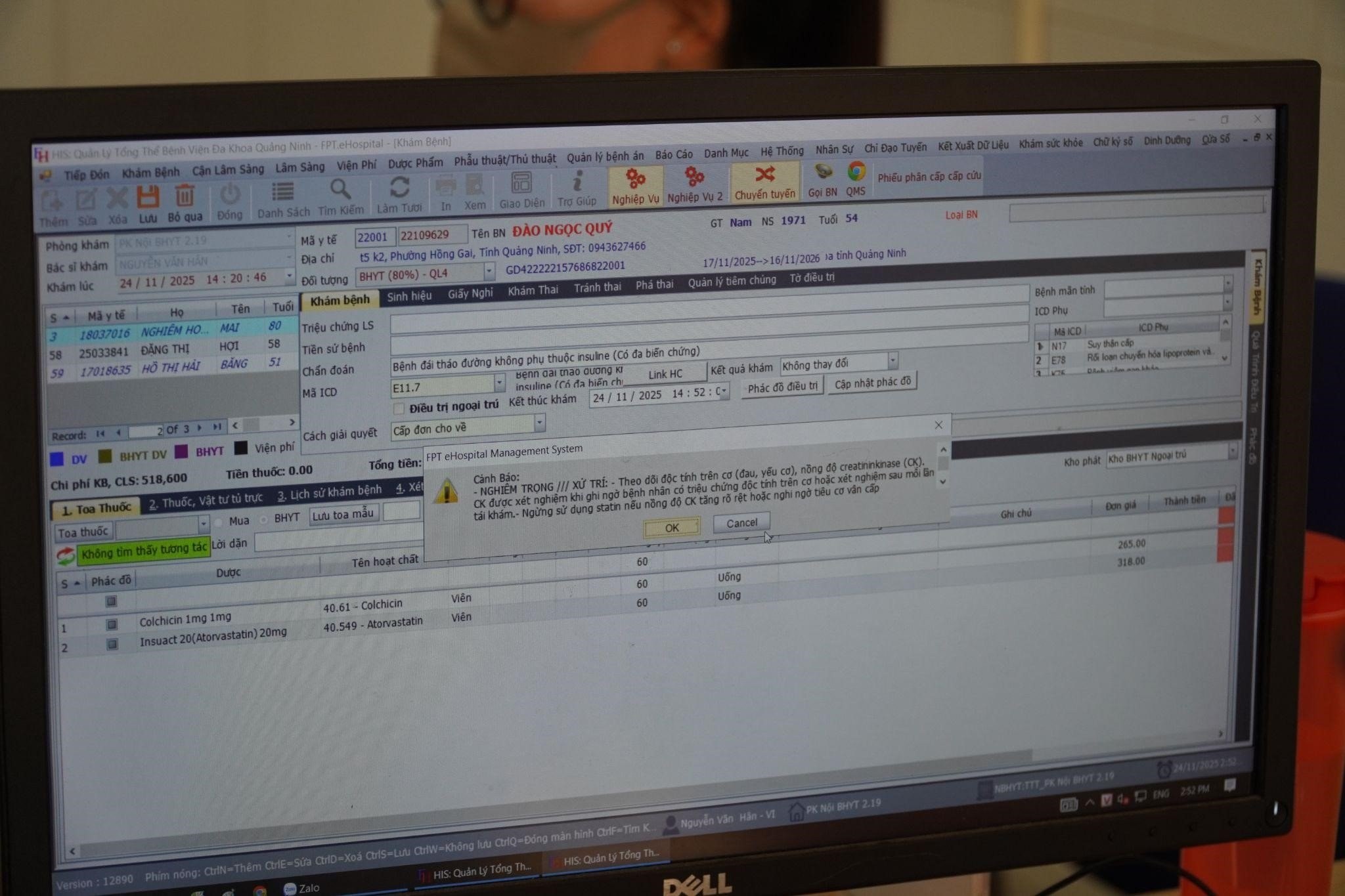
The system displays real-time alerts when potential drug interactions are detected
The Level-3 CDSS functions as a virtual assistant for physicians. From the moment a preliminary diagnosis is made, the system suggests appropriate tests and medications based on standardized protocols—significantly reducing the time required for clinical orders and prescriptions, minimizing waste, and preventing health insurance claim rejections.
At the same time, audit trails and monitoring features enable hospital leadership to track protocol compliance in real time, improving governance efficiency and reducing clinical risks. With this advanced level of digitalization, the hospital is steadily approaching Level 7 of Vietnam’s Hospital Information System Maturity Model under Circular 54/2017/TT-BYT—the highest level for electronic medical records nationwide.
Implementation journey: From leadership commitment to technological excellence
The smooth operation of the Electronic Treatment Protocols and Drug Alert System at Quang Ninh Provincial General Hospital is the result of a determined implementation process involving hospital leadership, physicians, leading medical experts, and FPT’s technology specialists. This was not simply a technology transfer, but a comprehensive transformation of clinical thinking and standardized professional workflows across the hospital.
From the outset, hospital leaders provided close direction, establishing specialized working groups and clinical councils to standardize treatment protocols and review clinical processes. Clear incentive and accountability mechanisms encouraged medical staff to actively contribute data, provide feedback, and continuously refine protocol content. This collective commitment was the key factor in ensuring the project met both timeline and quality expectations.
The implementation also benefited from expert guidance, including Associate Professor Dr. Nguyen Thanh Hai, Head of the Digital Clinical Pharmacy Research and Application Unit at Hanoi University of Pharmacy, who served as a key advisor. His scientific insights and practical experience formed the foundation for ensuring high protocol accuracy, alignment with updated clinical guidelines, and improved treatment effectiveness.
With extensive experience deploying Hospital Information Systems at hundreds of medical facilities nationwide, FPT brings deep knowledge of healthcare standards and strong capabilities in developing complex systems such as CDSS. This partnership ensures stable system operation, deep integration with existing data infrastructure, and opens the door to advanced feature expansion in the future.
Delivering tangible benefits at every level
The implementation of the treatment protocol recommendation system has generated clear benefits for physicians, patients, and hospital management, creating far-reaching impact on daily clinical operations.
For physicians, the system significantly improves productivity and medical record quality. The average time required to complete a full patient record—including tests and medications tailored to both primary and comorbid conditions—has been reduced by 80%. Automated alerts have reduced prescription revisions by 85%, particularly in complex cases involving multiple medications. Rapid access to medication histories and test results provides physicians with a more comprehensive view of patient conditions, while an optimized user interface shortens discharge documentation time by 75%.
The system also helps narrow the experience gap between junior and senior physicians through a standardized protocol library and intelligent treatment suggestions. Dr. Nguyen Thi Nha Trang noted that the system synchronizes drug interaction assessments that previously depended heavily on individual experience, effectively “shortening the experience gap among physicians” by delivering data-driven alerts, including cross-specialty interactions that individual doctors may not fully recognize.
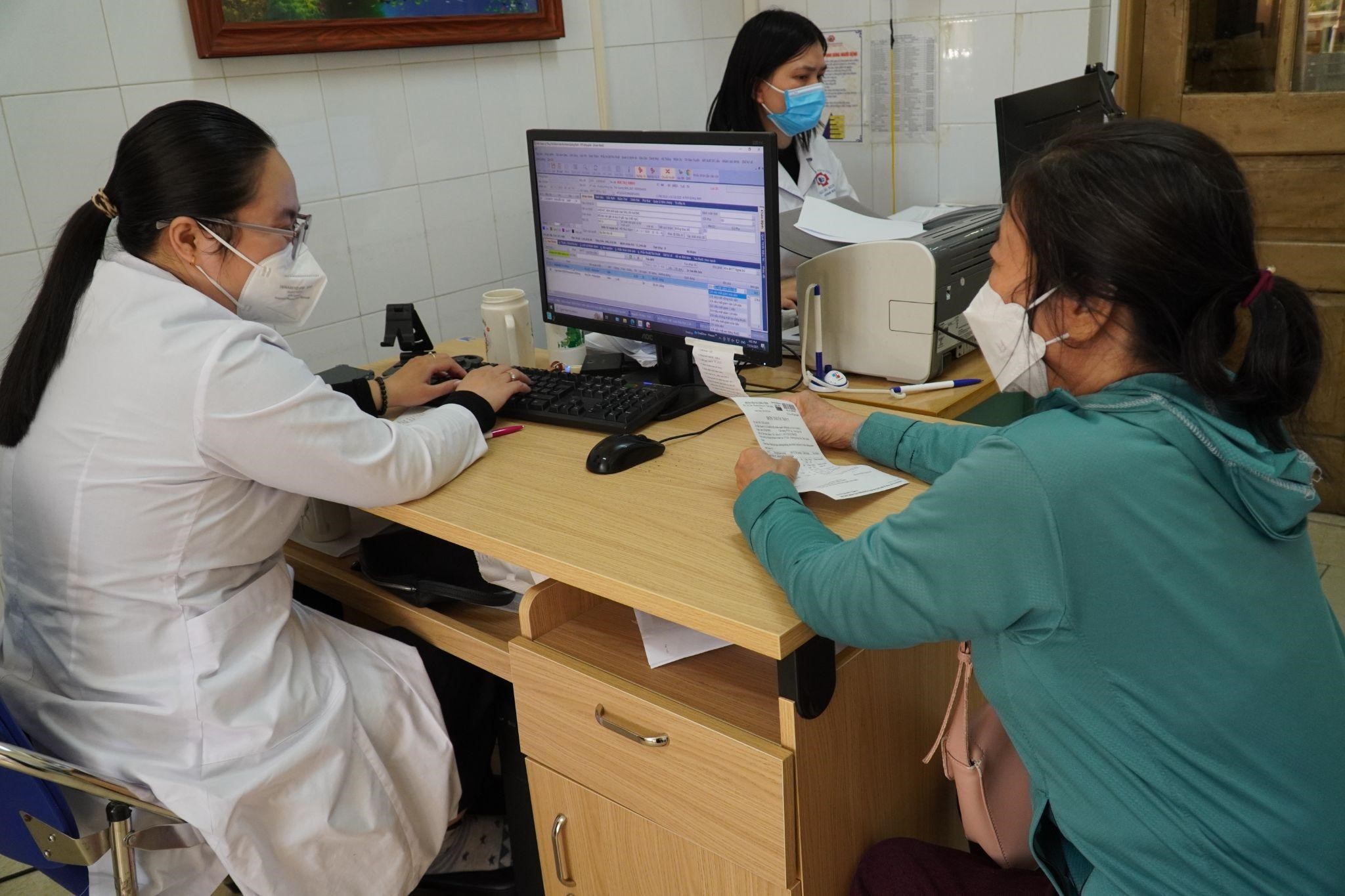
Doctors use Electronic Treatment Protocols while examining patients
For patients, improvements in workflow and treatment quality are clearly evident. The time required for examinations, admissions, and administrative procedures has been reduced by two to three times thanks to integrated data and automated processing. More accurate, data-supported clinical decisions improve treatment outcomes, while physicians have more time to counsel patients on medications and care plans. Patients can also access their complete medical and test histories online, enabling more proactive, transparent, and convenient health management.
From a management perspective, the system enhances transparency in health insurance claims, minimizing risks of reimbursement rejection due to documentation errors or inappropriate prescriptions. The entire clinical workflow has been upgraded through digitalization, moving the hospital toward the highest level of modernization. Real-time audit trails allow leadership to monitor prescription risks and protocol compliance by department, strengthening hospital-wide governance. Most importantly, these achievements have positioned the hospital as a pioneer in healthcare digital transformation and a model institution within the locality.
Affirming Quang Ninh’s leading role in healthcare digital transformation
Beyond internal benefits, the Electronic Treatment Protocol initiative has demonstrated strong external impact, winning First Prize at the 10th Quang Ninh Provincial Technical Innovation Contest and currently being prepared for national-level competition. This recognition underscores the system’s practicality, scalability, and positive impact on the healthcare sector. As one physician stated: “Very few hospitals have successfully implemented this system as effectively as we have. In Quang Ninh, our hospital is currently the only one operating it this smoothly.”
The success of the Electronic Treatment Protocols and Clinical Drug Alert System not only reflects Quang Ninh Provincial General Hospital’s commitment to healthcare innovation, but also serves as a compelling example of technology-driven transformation in clinical practice. This success has already been demonstrated through the initial transfer of the solution to five hospitals and one medical center, including facilities outside the province.
Through its partnership with FPT – Vietnam’s leading digital transformation enterprise – the hospital has established a standardized, scalable model that can be replicated across healthcare facilities nationwide.
This project affirms that digital transformation does not merely change how hospitals operate – it fundamentally enhances patient safety and quality of life.