FPT leader calls for stronger business alliances to advance Vietnam’s semiconductor ecosystem
At the first 2026 meeting on semiconductor industry development chaired by Deputy Prime Minister Nguyen Chi Dung, head of the National Steering Committee for Semiconductor Industry Development, Tran Dang Hoa, Chairman of FPT IS, FPT Corporation, proposed several recommendations aimed at strengthening collaboration between the government and businesses to accelerate the development of Vietnam’s semiconductor ecosystem and help the country move deeper into the global value chain in line with Resolution 57-NQ/TW.
The meeting was attended by leaders from ministries and government agencies including Science and Technology, Finance, Education and Training, Industry and Trade, Construction, Justice, Agriculture and Environment, and the Government Office. Representatives from local authorities such as Hanoi, Ho Chi Minh City, Da Nang and Bac Ninh also participated, along with universities and research institutions including Vietnam National University in Ho Chi Minh City, Vietnam National University in Hanoi and Hanoi University of Science and Technology, as well as technology enterprises such as FPT, Phenikaa and VSAP Lab.

Deputy Prime Minister Nguyen Chi Dung chairs the first 2026 meeting of the National Steering Committee for Semiconductor Industry Development. Photo: VGP/Thu Sa.
In his opening remarks, Deputy Prime Minister Nguyen Chi Dung noted that the global semiconductor industry continues to experience strong growth and significant restructuring in both technology and supply chains. The rapid development of artificial intelligence and emerging digital technologies further reinforces the foundational role of semiconductors in the global digital economy, particularly in areas such as AI, cloud computing, the Internet of Things and big data.
Many countries and major economies are therefore accelerating efforts to diversify supply chains and strengthen strategic autonomy in the semiconductor sector.
In recent years, ministries and government agencies have actively implemented tasks and solutions under the national semiconductor industry development strategy and the program for developing semiconductor human resources. Vietnamese enterprises have also gradually participated in global value chains, enhancing capabilities in chip design, manufacturing and semiconductor services.
However, the Deputy Prime Minister noted that despite these achievements, the development of the semiconductor industry still faces significant challenges, particularly in high-quality human resources, research and development capacity, technical infrastructure, policy frameworks and the level of participation by domestic enterprises in global value chains.
At the meeting, the Steering Committee reviewed progress in implementing key initiatives and discussed solutions to further accelerate the development of Vietnam’s semiconductor ecosystem in a faster and more effective manner, while also providing input for the committee’s 2026 action plan. Representatives from local governments, universities and technology companies also contributed proposals aligned with the committee’s development objectives.

Tran Dang Hoa, Chairman of FPT IS, FPT Corporation, highlighted the importance of alliances among enterprises to develop Vietnam’s national semiconductor ecosystem.
From the perspective of FPT, Tran Dang Hoa emphasized that the world is currently undergoing profound geopolitical and economic shifts, with strategic competition among nations increasingly centered on high-tech supply chains.
“From artificial intelligence and cloud computing to 5G/6G, electric vehicles and defense systems, all rely on a fundamental foundation: semiconductor chips,” he said.
According to the FPT representative, Vietnam has introduced a number of incentive policies to encourage enterprises to participate in the semiconductor sector. However, to ensure these policies are effectively implemented in practice, further detailed guidelines and mechanisms are needed.
For example, clearer implementation mechanisms are required for corporate income tax incentives and preferential policies. In addition, businesses have proposed the introduction of a “green lane” mechanism for semiconductor equipment imports, as many machines—although previously used—still meet technological requirements but may face lengthy import procedures.
Regarding certificates of origin (C/O), the semiconductor industry involves highly complex supply chains with components sourced from multiple countries. As a result, determining the proportion of domestic value added to qualify for “Made in Vietnam” certification under current regulations remains challenging and lacks clear precedent for semiconductor products. Businesses therefore hope for more detailed guidance to facilitate policy implementation.
On human resource development, FPT also proposed a three-tier workforce strategy that includes rapid upskilling programs for engineers from related fields, policies to attract international experts and overseas Vietnamese professionals, and expanded practical training programs closely linked with industry.
In addition, FPT recommended the development of a national Chip Lab based on a shared-resources model—a research infrastructure center operated similarly to an enterprise and jointly managed by an alliance of major technology corporations in cooperation with government agencies to support the broader semiconductor ecosystem.
“With strong policy direction from the government, enterprises such as FPT are ready and committed to working together to promote alliances within Vietnam’s semiconductor ecosystem, strengthen semiconductor research and development as a strategic national technology, and help Vietnam move deeper into the global value chain,” Hoa said.
FPT began investing in the semiconductor sector more than 11 years ago and has gradually built a relatively comprehensive ecosystem covering chip design, packaging, testing and human resource training. In chip design, the company is currently focusing on power management chips, including Power IC and PMIC products, which are critical components in many electronic devices and technology systems.

FPT exported its first batch of “Make in Vietnam” power chips to Japan in December 2025.
At the end of 2025, FPT successfully exported its first commercial batch of power chips to Japan. Entering a market known for its stringent technical standards and strict supply chain requirements demonstrates the design capabilities of Vietnamese technology companies.
According to Hoa, in 2026 FPT will continue accelerating the commercialization of its “Make in Vietnam, Made by FPT” chip lines in markets such as Japan, Korea, Taiwan and China. The company has also begun receiving turnkey chip design orders, providing end-to-end services including design, foundry manufacturing coordination, assembly, testing, packaging and final delivery.
Building on its expertise in power chip design, FPT is also developing core design capabilities to expand into system-on-chip (SoC) solutions integrated with AI at the edge. These chips are optimized for specific applications such as smart agriculture, smart healthcare, unmanned systems, UAVs and drones. They will also serve as the foundation for FPT’s “Bonsai AI” ecosystem—specialized AI solutions tailored to specific industries and use cases.
In January 2026, FPT announced the establishment of the FPT Advanced Semiconductor Testing and Packaging Factory. The facility is the first semiconductor testing and packaging plant in Vietnam owned and operated by a Vietnamese company, contributing to the development of a more complete semiconductor ecosystem covering research, design, workforce training, production and commercialization.

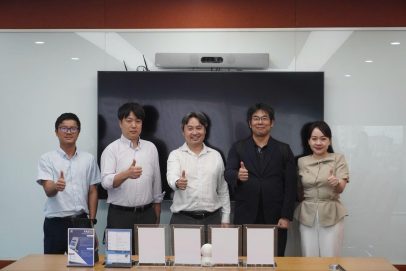
FPT and Viettel sign a comprehensive cooperation agreement to strengthen Vietnam’s semiconductor technology capabilities.
To address one of the semiconductor industry’s biggest challenges—high-quality human resources—FPT has set a target of training 10,000 semiconductor engineers by 2030 through a multi-tier education and training system.
The company has developed programs ranging from short-term courses to long-term academic pathways, including university programs specializing in integrated circuit design, international semiconductor technology programs in partnership with BTEC, and globally recognized certification programs in chip design.
FPT has also implemented international “2+2” training models, in which students study for two years in Vietnam and complete the final two years of specialized training in Taiwan or South Korea before undertaking internships with leading semiconductor companies.