FPT and Gachon University Launch Semiconductor Bachelor’s Program and Sign Cooperation to Develop High-Quality Talent
Recently, at the “Semiconductor Future Summit,” FPT and Gachon University officially launched a joint bachelor’s program in Semiconductor Technology under a 2+2 model. At the same time, FPT signed a cooperation agreement with the FPT–Gachon Collaboration Center to promote training, research, and the development of high-quality human resources for the semiconductor industry.
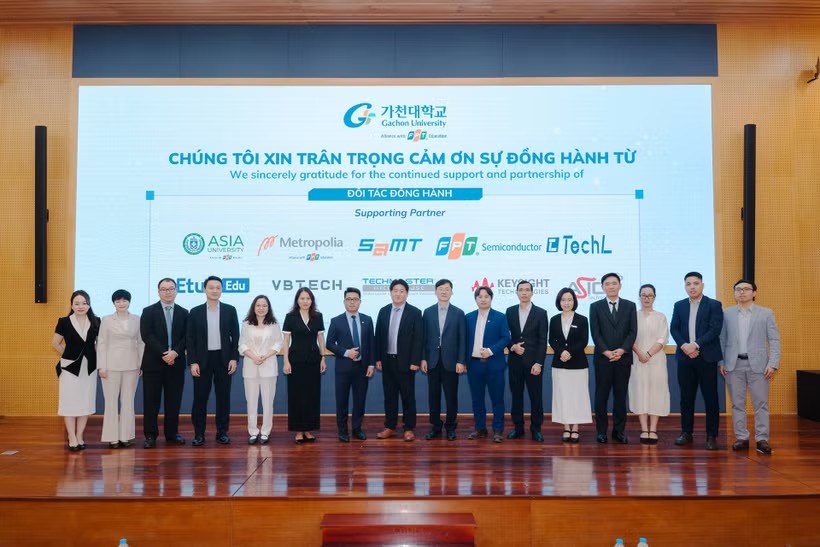
FPT partners with Gachon University to train high-quality semiconductor engineers for Vietnam
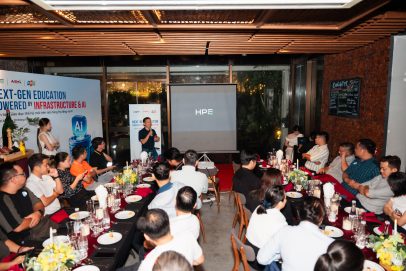
The event, organized by FPT International University in Hanoi, focused on addressing the shortage of semiconductor talent amid rapidly increasing global demand for chips driven by the growth of artificial intelligence (AI).
According to the Semiconductor Industry Association (SIA), the global semiconductor industry is projected to reach a market size of USD 1 trillion by 2030, creating significant demand for technical talent. In Vietnam, estimates from the National Innovation Center (NIC) indicate a need for approximately 50,000 semiconductor engineers by 2030, while current training capacity meets only a small portion of this demand.
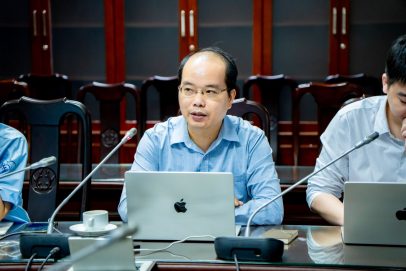
Speaking at the summit, Dr. Vo Xuan Hoai, Deputy Director of NIC, noted that Vietnam’s “bottleneck” lies not only in quantity but also in the quality of its workforce. Many engineers do not yet meet the requirements of international working environments due to limitations in foreign language proficiency, hands-on skills, and project experience. This calls for a shift in training models—from “learning to know” to “learning to do.”
In response to this urgent need, within the framework of the summit, FPT University and Gachon University officially launched the joint bachelor’s program in Semiconductor Technology, realizing the Memorandum of Understanding signed in July 2025 under the witness of leaders from both countries. Previously, Gachon University—the world’s first university specializing in semiconductors—had initiated a strategic partnership with FPT, aiming to train the next generation of semiconductor talent in Vietnam, aligned with the national goal of developing 10,000 semiconductor engineers by 2040.
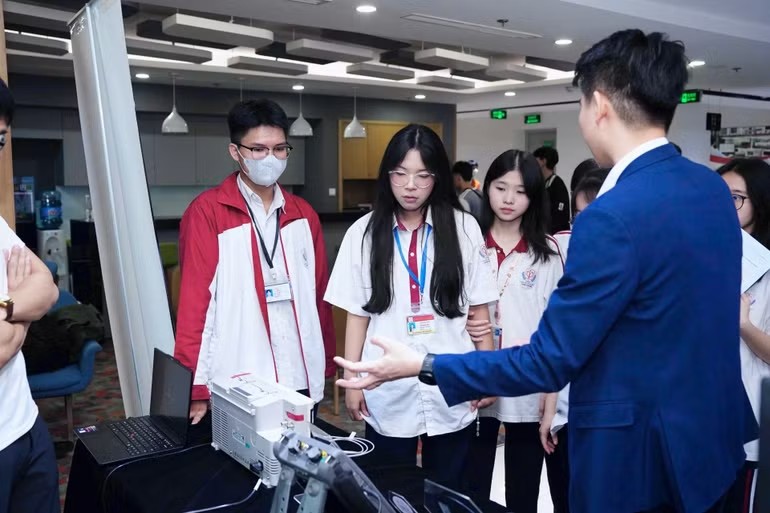
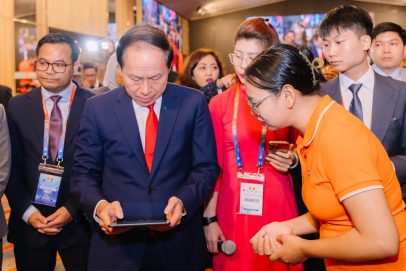
Students participate in hands-on experiences to explore semiconductor technology at the event
The joint bachelor’s program is designed as a market-driven training model. Instead of focusing primarily on theory, the program features a clear two-phase pathway: students are equipped with foundational knowledge, language skills, and global mindset in Vietnam before transferring to South Korea for specialized training in a leading semiconductor education environment. There, students not only study but also participate directly in chip design projects, access advanced laboratory systems, and connect with the technology ecosystem in Techno Pangyo—often referred to as the “Silicon Valley of South Korea.”
The core objective of this model is to produce job-ready engineers upon graduation, minimizing the need for retraining by employers. Students will have opportunities to participate in enterprise training programs and gain practical experience at major technology corporations such as Samsung, SK Hynix, and other companies within the semiconductor ecosystem. This approach aims to shorten the training cycle and directly meet labor market demands.
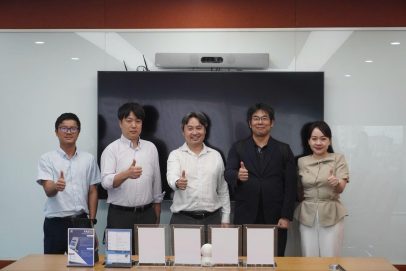
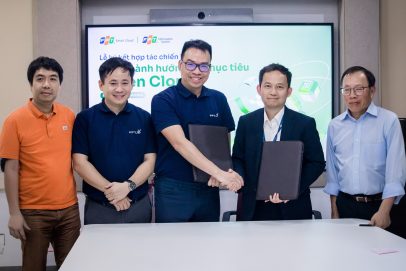
Within the event, a Memorandum of Understanding (MoU) signing ceremony also took place between Gachon Vietnam and seven enterprises, including FPT’s semiconductor business unit. This agreement seeks to expand collaboration in training, research, and human resource development for the semiconductor industry in Vietnam.
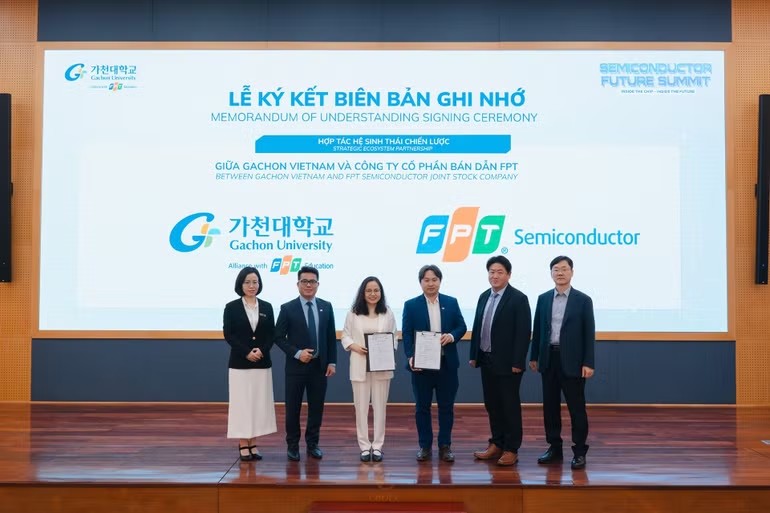
Signing ceremony between Gachon Vietnam and FPT on developing semiconductor human resources
Under the MoU, the two parties will focus on three key pillars:
First, in education, both sides will co-develop industry-aligned training programs, assign experts to participate in teaching and mentoring, and collaborate in curriculum design to enhance the quality of semiconductor human resources.
Second, in research and development (R&D), the two parties will jointly implement applied research activities, leverage expert resources and infrastructure to carry out semiconductor projects, and promote laboratory development as well as hands-on research activities.
Third, in human resource development, FPT will receive students for internships and on-the-job training programs, providing opportunities to participate in real-world projects. The company will also coordinate with the university on recruitment activities, career seminars, and job placement connections, contributing to the development of engineers who are ready to meet job requirements immediately after graduation.
In addition to training and collaboration initiatives, FPT also announced plans to implement support programs, including scholarships for outstanding students of Gachon Vietnam, to encourage and nurture high-quality talent for the semiconductor industry.
Mr. Nguyen Vinh Quang, CEO of FPT Semiconductor, FPT Corporation, shared: “Close collaboration between academia and industry, and enabling students to engage in practical training during their studies, is the decisive factor in narrowing the gap between education and real-world demand—a long-standing weakness of Vietnam’s tech workforce. With a strategic focus on key technologies such as semiconductors, FPT is proactively building a comprehensive ecosystem from training and research to deployment, thereby contributing to the development of a workforce capable of working immediately and meeting the needs of businesses and the global marke”.