Experts from FPT and IBM share strategies for intelligent operations driven by data and AI
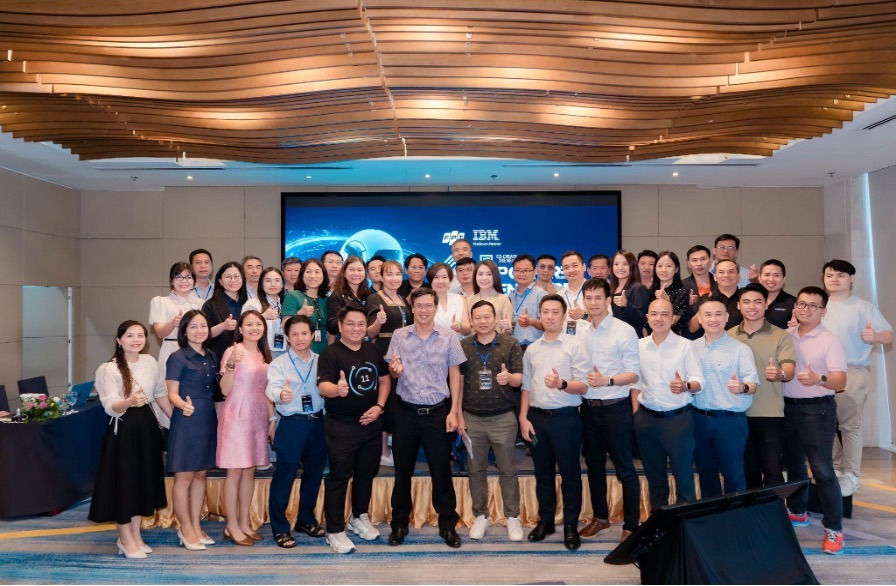
On March 24, FPT Corporation, in collaboration with IBM Vietnam, hosted the seminar “AI-Powered Enterprise: From Data to Intelligent Operations”, attracting more than 30 enterprises. The event offered a comprehensive overview of the role of data in effectively deploying artificial intelligence (AI) applications, as AI increasingly becomes a long-term strategic pillar in business operations.
In the opening remarks, Ms. Dang Vu Viet Anh, director of Enterprise Business at FPT IS, FPT Corporation, emphasized that AI is no longer a question of whether to adopt, but rather a practical trend already being implemented across enterprises.
Citing data from McKinsey & Company, she noted that 78% of organizations worldwide now regularly use AI in at least one business function. In Vietnam, this momentum is evident, with nearly 170,000 enterprises adopting AI, marking a 39% increase, according to Amazon Web Services.
“In this context, the challenge is no longer about adopting AI, but about how to apply it effectively in alignment with each enterprise’s realities”, Ms. Viet Anh stated.
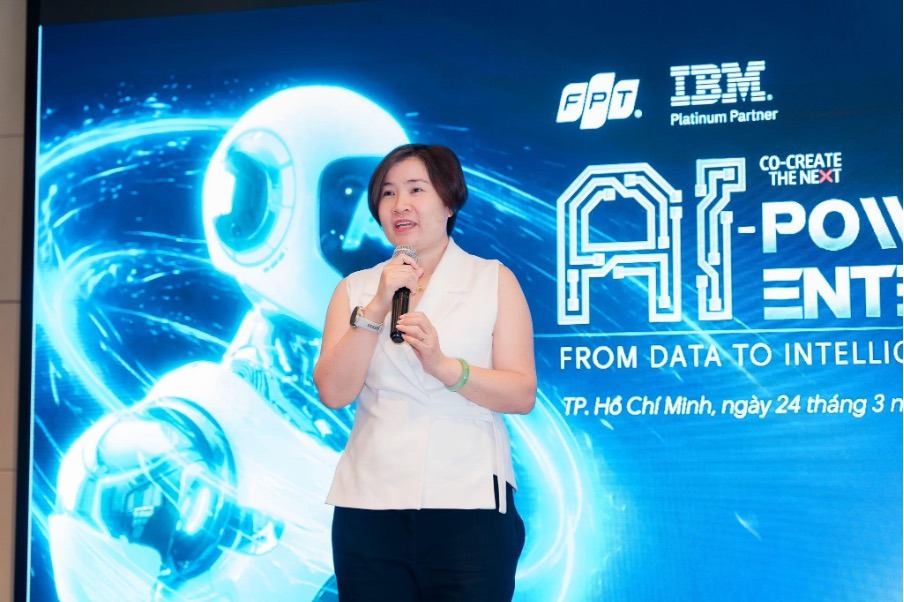
Ms. Dang Vu Viet Anh shared the practical implementation trend of AI in enterprises.
Sharing a similar perspective, Mr. Bui Tien Bao, representative of IBM Vietnam, deemed AI as a new growth driver for businesses rather than a separate trend. However, he pointed out that a major challenge lies in data utilization, since most available data remains underexploited.
According to a global IBM survey of more than 1,000 CEOs, around 60% of enterprises have integrated AI into daily operations, with 65% making deployment decisions based on return on investment (ROI). However, only 16% have implemented AI at scale, highlighting a significant gap between experimentation and expansion. Mr. Bui Tien Bao also stressed that data governance and the ability to generate practical operational value remain central issues.
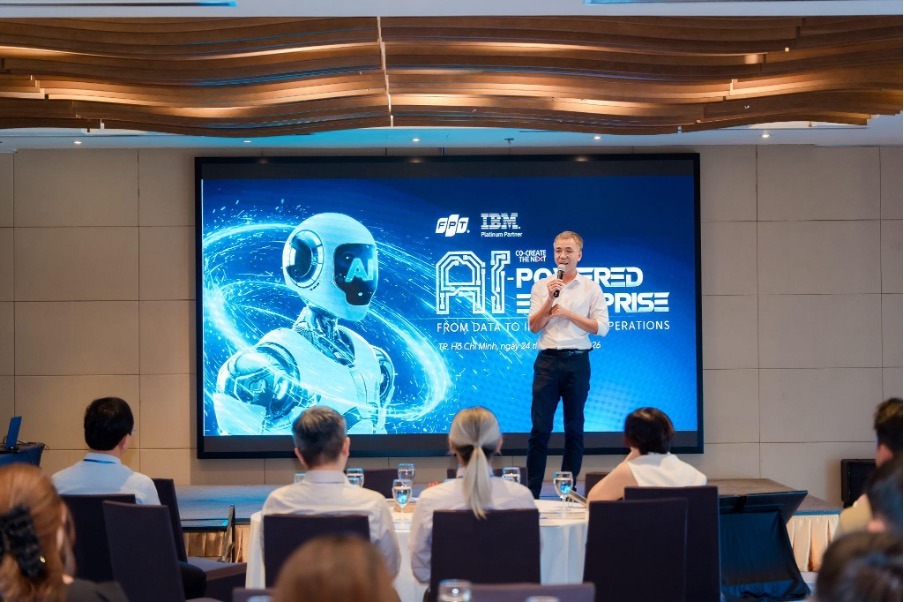
Echoing FPT’s perspective, Mr. Bui Tien Bao noted that AI is becoming a new growth driver for enterprises.
Explaining why many AI projects have yet to reach their full potential, Mr. Vo Hoang Linh, Data & AI Solutions Consultant at IBM Vietnam, noted that while enterprises are currently accelerating AI adoption, particularly AI Agents, the outcomes have not always been outstanding.
“The main reason is that data remains fragmented, lacking connectivity and context, making it difficult for AI systems to analyze and deliver accurate decisions,” he said.
To address this issue, he recommended that businesses build a “data intelligence” strategy to ensure consistent data governance, high-quality data, and contextual completeness. At the seminar, he demonstrated solutions such as IBM watsonx.data, a platform designed to support comprehensive data exploitation, governance, and complete protection. This solution is considered as a critical foundation for enterprises to deploy controlled AI and ensure long-term expanding ability.
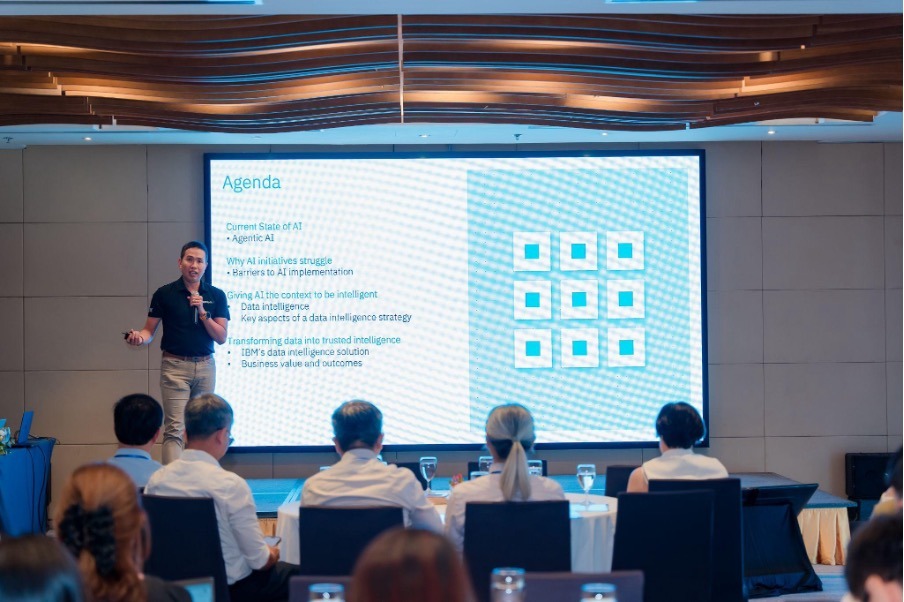
Mr. Vo Hoang Linh provided a broader perspective on how enterprises can exploit, govern, and protect data in the AI era.
Alongside data challenges, the demand for high-performance storage and data protection against risks is becoming increasingly urgent. Mr. Nguyen Van Hai, Storage Solutions Consultant at IBM Vietnam, commented: “As data volumes continue to grow, traditional storage systems, while meeting basic operational needs, still require significant manual intervention for management and optimization. In response, IBM has developed a new generation of storage solutions that allow administrators to interact directly with systems through AI. Instead of performing complex configuration steps, users can issue requests in natural language, and the system will automatically process them.”
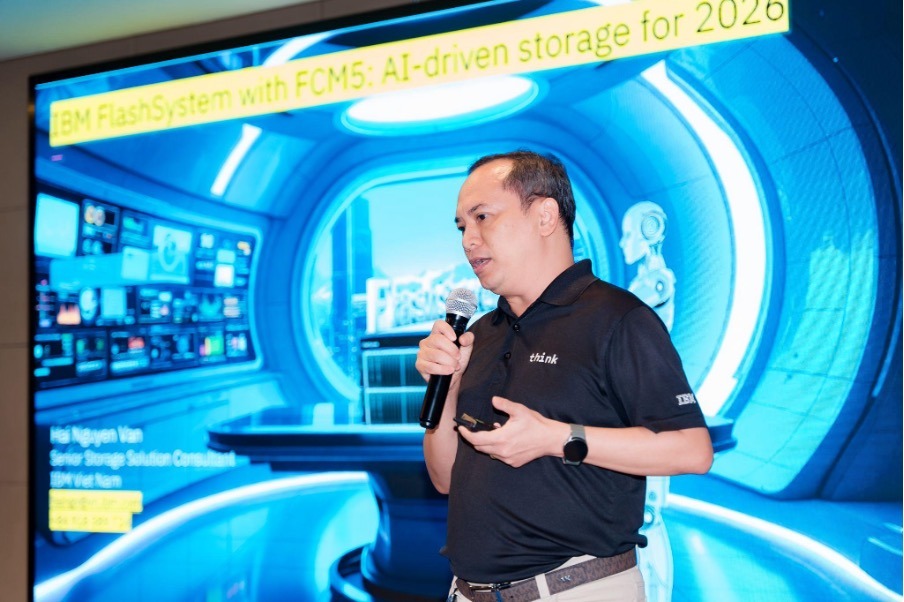
Mr. Nguyen Van Hai discussed the challenges of high-performance storage and data protection against risks.
Specifically, with the new generation of IBM FlashSystem, repetitive operational tasks such as resource provisioning, system configuration, and failover scenario setup can be executed quickly through simple commands. As a result, processes that previously consumed significant time and resources are substantially shortened, while operational errors are minimized. In addition to automation capabilities, the system is integrated with AI to monitor and detect cybersecurity threats such as ransomware in real time. This enables enterprises to proactively protect data, reduce the risk of disruptions, and ensure business continuity.
Digital transformation is progressing at an unprecedented pace. Mr. An Minh Khoi Nguyen, Automation Solutions Consultant at IBM Vietnam, noted that a process that once took decades is now being compressed into approximately one year, pushing IT systems to unprecedented levels of complexity, with terabytes of data generated daily, including millions of metrics and thousands of alerts.
To address this, he introduced the AIOps model (AI-driven IT operations), which combines system observability, automation, and AI-powered analytics. This approach helps reduce incident detection time from days to minutes, reduce up to 70% of service requests, and optimize approximately 30% of operational costs.
“In increasingly complex systems, the application of AI and automation in operations is no longer optional but a prerequisite for enterprises to maintain competitiveness and achieve sustainable growth,” Mr. Nguyen emphasized.
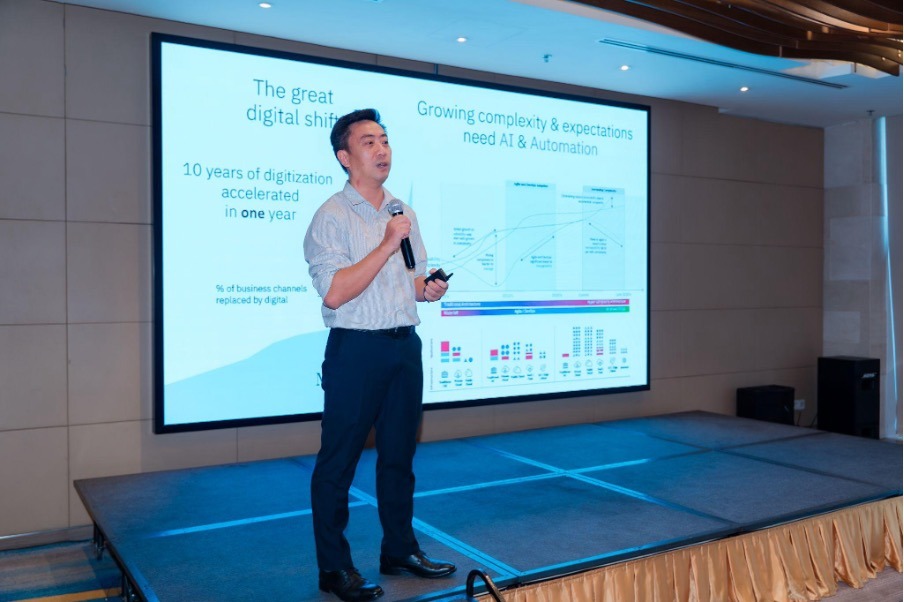
Mr. An Minh Khoi Nguyen stressed that IT systems are no longer merely supportive but are becoming direct drivers of business performance.
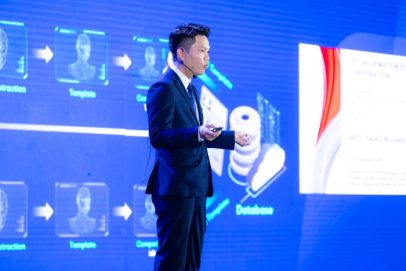
Following discussions on strategy and technology, Mr. Nguyen Huu Thinh, Solutions Consultant at FPT IS, FPT Corporation, shared a real implementation case. The client’s core ERP system had to simultaneously support production operations and more than 50 business applications, leading to system overload, data conflicts, and unstable performance, particularly in reporting and analytics tasks.
To address this issue, FPT implemented a system offloading solution by synchronizing near real-time data from the core system to a separate data platform for analytics. This approach separates operational and analytical systems, ensuring production performance while providing timely data for reporting needs. As a result, enterprises can significantly improve system efficiency, minimize bottlenecks and disruptions, reduce the risk of data conflicts, and be well-prepared for future expansion in analytics and AI applications.

Mr. Nguyen Huu Thinh shared a practical enterprise implementation case.
Representatives of participating enterprises expressed strong interest in the topics presented. The seminar concluded with a consistent message from all speakers: data is the fundamental foundation for all AI initiatives. For AI to truly deliver value, enterprises must simultaneously ensure data governance capabilities, system integration, and operational readiness, three key factors shaping the journey toward intelligent operations in the future.